 The Pacific War Online Encyclopedia
|
| Previous: Sloops | Table of Contents | Next: Small Arms |
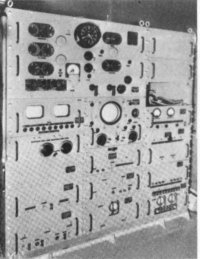
U.S. Navy. Via ibiblio.org
| Wavelength | 10 cm |
| Pulse Width | 1 microsecond |
| Pulse Repetition Frequency | 775-825 Hz |
| Power | 600-700 kW |
| Range | 50 nautical miles (90 km) (bomber) 25 nautical miles (50 km) (battleship) |
| Scan rate | 2-6 rotations per minute in search mode 7.5 scans per second over a 60 degree sector in track mode |
| Scope |
PPI with 10, 50, and 80 nautical mile (19, 90, and 150 km) distance scales |
| Accuracy | 200 yards/0.5 degree/500 feet 180 meters/0.5 degrees/150 meters |
| Resolution | 200 yards/3 degrees 180 meters/3 degrees |
| Production | First prototype installed on Lexington 3/43. First two production models on Bunker Hill 9/43 and Enterprise 10/43. A total of 23 were deployed through 1944-10. |
| Variants | The SM-1 was a lighter version. All 26 were given to the Royal Navy as Lend-Lease. |
The SM was a fighter direction
radar developed from the SCR-584.
It was rather heavy at 9 tons and so was only installed on carriers.
It could
track in three dimensions with high
accuracy and at close range, and it included a BM antenna for
Identification Friend or Foe (IFF). However, its distinctive
beam, which was narrow both horizontally and vertically, made it
unsuitable for air search.
References
Friedman
(1981)
Guerlac (1987)
The Pacific War Online Encyclopedia © 2007-2009, 2011 by Kent G. Budge. Index