 The Pacific War Online Encyclopedia
|
| Previous: Antioch | Table of Contents | Next: Antung |
Antitank guns are one of the oldest defenses against tanks and remained important in the Second World War, though their role was gradually diminished by friendly armor and light antitank weapons. The ideal antitank gun was easy to manhandle into position near the front line; had a low enough profile to be easily concealed; had a high rate of fire; and fired a heavy projectile at very high velocity and with great accuracy. No antitank gun was perfect, but the best combined most of these features.
At the start of the war, most antitank guns fired a solid hardened steel shot that did its damage through pure kinetic energy, punching through the target's armor to spray metal fragments into the interior of the tank. This basic armor-piercing (AP) round could be given a soft cap (APC) or a soft cap under a ballistic nose (APCBC) to slightly improve its performance. The kinetic energy of the projectile is given by E=1/2 MV2 where M is the mass of the projectile and V is its velocity. This formula suggests firing a less massive projectile at higher velocity. However, at high velocity, hardened steel projectiles hitting armor plate tended to shatter. The British introduced the armor-piercing composite rigid (APCR) round, which contained a very hard tungsten core in a light metal jacket. The light jacket allowed this relatively light round to be fired from a larger caliber gun, increasing its velocity considerably, and the tungsten core was less prone than steel to shatter on impact. However, the APCR round was not very successful, as its large cross section relative to its weight meant that it tended to lose energy very rapidly from drag, so that it was effective only at close range.
The APCR was replaced with the armor-piercing discarding sabot
(APDS) round. This resembled the APCR round in having a hard tungsten
core and light metal jacket. However, the jacket was designed to
separate cleanly from the core when the projectile left the muzzle of
the gun. This reduced drag and allowed the tungsten projectile to
retain its kinetic energy at much greater ranges. The APDS round was the ancestor of modern antitank APFSDS rounds.
In addition to kinetic kill rounds, a few antitank guns employed high explosive antitank (HEAT) rounds, which were shaped charge rounds. These proved only moderately effective, because the spin imparted to the round by conventional rifled barrels tended to weaken the penetrating jet. However, the round was equally lethal at any range, since it did not depend on its own kinetic energy to penetrate the target.
Towed antitank guns proved increasingly ineffective in the European
theater as the armor protection on tanks improved. Antitank guns large
enough to penetrate the frontal armor of the newest tank designs were
too large to be manhandled or easily dug in, and they began to be
replaced by light shaped charge weapons and by tank destroyers, which essentially combined antitank gun, prime mover, and protection into a single weapons system. However, Japanese
tank designs lagged behind those of the European powers, and antitank
guns remained effective weapons (if more often employed as infantry
guns) until the very end of the war.
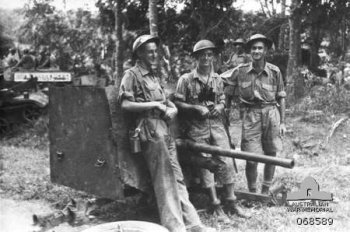
Australian War Memorial #068589
The main British antitank gun in late 1941 was the 2-pounder. This fired a 40mm caliber shot weighting slightly over 2 pounds (0.9 kg) at a velocity of 2600 feet per second (792 meters per second), giving a nominal kinetic energy of 282 kilojoules. It could penetrate 37mm of armor at 500 yards when striking at a 30-degree angle. The gun had an unusual carriage that allowed for rapid traverse through a full 360 degrees. Its chief drawback was that no high explosive round for the gun ever went into production, giving it little capability against unarmored targets.
The 2-pounder was adequate against the relatively lightly armored
Japanese tanks, and so the British Army in the Far East retained these
weapons longer than British forces in the Mediterranean and
Europe.There is little indication that units in the Far East were ever
equipped with
the Littlejohn squeeze bore adapter and APCNR round, which increased
the muzzle velocity to 3750 feet per second (1143 meters per second)
and armor penetration to better than 88mm.
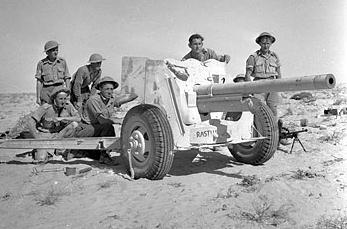
Imperial War
Museum. Via Wikipedia
Commons
By mid-1942 the 2-pounder began to be replaced in Europe and the Mediterranean with the 6-pounder Mark 2. This fired a 2.244" (57mm) caliber shot weighing 6.25 pounds (2.83 kilograms) at a velocity of 2675 feet per second (815 meters per second), giving a nominal kinetic energy of 940 kilojoules. It could penetrate 74mm of armor at 1000 yards when striking at a 30-degree angle. An APCR round saw very brief service before the APDS round was introduced in early 1944. This round doubled the original penetration.
The 6-pounder became the mainstay of antitank artillery units, but a small number were issued to infantry units. The gun was small and fairly mobile (weighing 2521 pounds or 1143 kilograms) and was popular with its users. Its penetration with the original AP round was sufficient for it to be effective against German tanks up to the PzKpfW IV or against any Japanese tank that saw service during the war. The APDS round was capable of taking out any Axis tank except the Tiger II.
The more powerful 17-pounder never entirely replaced the more mobile
6-pounder and likely never saw service in the Far East. On the
contrary, the Japanese tank threat in Burma was so reduced by April
1945 that most antitank units were reequipped with 3" and 4.2" mortars.
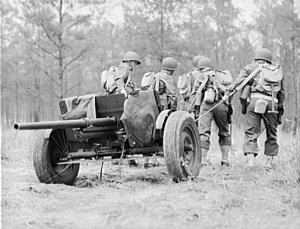
Library of
Congress. Via Wikipedia
Commons
The U.S. Army began the
war with the 37mm M3A1 antitank gun, which fired an APC round weighing
1.92 pounds (0.87 kilograms) at 2900 feet per second (884 meters per
second) for a nominal kinetic energy of 680 kilojoules. This gave a
penetration of 2" (51mm) at 1000 yards on normal impact. This was
adequate against all but the most advanced Japanese tanks. The gun
was also capable of firing a high explosive shell or a case shot shell.
The latter was essentially a large shotgun shell that was lethal to
infantry. It was discovered that this shell was also effective at
stripping away jungle vegetation to
expose enemy bunkers,
clear fields of fire, or flush snipers.
The gun was very small and light (950 lbs or 430 kg), making it ideal for use in rough
terrain. One weakness was that it used a hand-operated breech that
reduced the rate of fire. Another was the use of firing segments to
absorb recoil that
were fine in theory but rarely used in practice and merely increased
the weight and complexity. The gun was widely used by infantry units in
the Pacific, and about 1,669 of the 37mm guns were sent to China as Lend-Lease.
The Americans experimented with an ultralight 37mm antitank gun that could be dismantled to be ported by infantrymen. However, interest in this weapon waned before its bugs could be worked out.
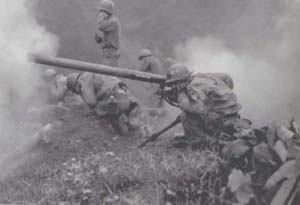
U.S. Army. Via Wikipedia
Commons
Later in the war, the Americans deployed recoilless rifles to some infantry units. These guns used perforated cartridges to produce a backblast to counter the recoil from the projectile. High velocities were not easy to achieve with these weapons, so the antitank round was a HEAT round. Conventional explosive rounds were also provided. The 57mm M18 recoilless rifle could penetrate 3" (75mm) of armor, while the 75mm M20 recoilless rifle could penetrate perhaps 4" (100mm) of armor. The M18 was largely experimental, but the M20 became standard infantry equipment in June 1945 and was being shipped to units in the Pacific when the war ended. It would likely have seen extensive use in any invasion of the Japanese home islands.
The Americans also produced their own version of the British
6-pounder, which they designated the 57mm M1 antitank gun, but this was
primarily deployed to Europe. It was originally intended as Lend-Lease
for the British, but only about a third of those manufactured actually
ended up in British hands. Marine divisions in the Pacific retained the
37mm gun to the end of the war, though some Army divisions had
reequipped with the 57mm M1 by the time of the Japanese capitulation.
The mediocre M5 75mm antitank gun saw no service in the Pacific, and
the 76mm gun projected to replace it was not put into production before
the war ended.
The Japanese began the war with the 37mm Type 94 Rapid Fire Gun, which fired a projectile weighing 1.42 pounds (0.64 kilograms) at 2300 feet per second (700 meters per second) for a nominal kinetic energy of 160 kilojoules, considerably less than its American counterpart. Penetration was just 32mm at 500 meters and a 30 degree angle of impact. This was inadequate to threaten anything but the Stuart light tank, and then only at close range. The Model 94 also fired a high explosive shell. The Japanese also purchased and used a small number of the German PAK 36 antitank gun, which resembled the Model 94 but had marginally greater penetrating power.

A better antitank weapon was the 47mm Type 1 antitank gun, which inflicted serious tank casualties at Okinawa. It fired a 3.1 pound (1.41 kilogram) projectile at 2700 feet per second (823 meters per second) for a nominal kinetic energy of 480 kilojoules. Penetration was 70mm at 500 meters at normal impact. This was sufficient to allow the Type 1 to penetrate the side armor of the Sherman medium tank, or even the front armor at close range.
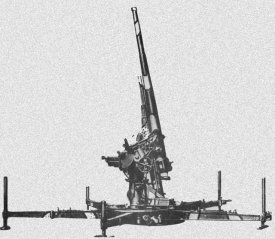
The Japanese also employed the 75mm Type 88 Antiaircraft
Gun in an antitank
role, much as their German allies employed their 88mm antiaircraft gun.
The weapon had a muzzle velocity of 2360 feet per second (720 meters
per second) and, assuming a 12.5 lb (5.7 kg) shell, a nominal kinetic
energy of about 1470 kilojoules. Comparison with similar American
weapons suggests an armor penetration of at least 100mm at 500 yards,
sufficient to penetrate the armor of any tank it was likely to employed
against except the Russian JS-2 and possibly the American M26 Pershing.
The Type 88 was probably the most potent long-range tank killer in the
Japanese arsenal, and it is likely many of the American tank losses
attributed to the 47mm Type 1 at Okinawa were actually inflicted by the Type 88.
The Japanese also made some use a HEAT shell for conventional artillery, which they called the "anti-tank perforating shell" (Tai-sensha-senkō-dan or Ta-dan).
References
"Handbook on Japanese Military Forces" (1944-9-15; accessed 2013-5-4)
The Pacific War Online Encyclopedia © 2007-2009, 2011-2013 by Kent G. Budge. Index


