The Pacific War Online Encyclopedia
|
| Previous: Amoy | Table of Contents | Next: Amphibious Command Ships (AGC) |

National
Archives
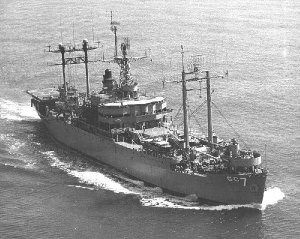
#80-G-415308
Amphibious assault is the military operation of landing troops on
a shore under fire. It is rightly regarded as one of the most
difficult of military operations. Defending positions usually have
good cover and excellent
fields of fire against boats approaching the shore and troops on
the beach. On the other hand, the assaulting troops lack cover and
are unable to move quickly while coming ashore. Logistics is a major
difficulty for the attacker, since the usual port facilities for unloading ships are absent.
Until the beachhead is secured, there is no rear area in which to
deploy artillery and other
supporting arms.
During the First World War, the Allies suffered a costly defeat
in their amphibious assault on Gallipoli, a strategy for which Churchill took much
of the blame. Most military strategists in the interwar years
assumed that a successful amphibious assault against determined
opposition was impossible. A prominent exception was the U.S. Marine Corps, which was
looking for a new mission and found it in the Navy's contingency
plan for war with Japan, Plan Orange. This plan
called for an advance across the central Pacific to the Philippines, which
would require the capture by amphibious assault of defended
islands in the Mandates. As
a result, while Japan, Britain,
and the Unites States all studied amphibious operations between
the wars, only the United States identified a need to the
capability to conduct opposed landings. Murray and Millett (1996)
assess the American understanding of amphibious operations when
war broke out as unequaled by either Britain or Japan, though
actual capability lagged.
The amphibious doctrine of
1919 was primitive. The Navy envisioned loading 50-foot motor
launches with as many Marines as they could carry, then towing
them toward shore while the warships fired a few shells at enemy
positions. The Navy did not consider an effective bombardment to
be a realistic hope because of the belief that "a ship's a fool to
fight a fort", meaning that warships should not operate in range
of fortified coastal artillery, and also because the ships
would have to carry both armor-piercing shells for use against
enemy warships and high explosive
shells for use in the bombardment. There was also the problem of
finding suitable landing sites, since motor launches had a very
wide turning radius.
However, in 1931 three Marine majors, Charles Barrett, Pedro Del Valle, and Lyle Miller, began work on the Tentative Manual for Landing Operations. Their effort was informed by the landing exercises in Hawaii in 1932, the first joint landing exercises since 1927. On 14 November 1933, all classes at Quantico were suspended and all students and instructors were put to work refining the manual. The Marines closely studied the Gallipoli campaign and concluded that it could have succeeded with the right landing doctrine. The Tentative Manual for Landing Operations, which has been characterized as "as much a catalogue of problems that would have to be solved in an amphibious assault as a guide to its execution" (Spector 1985). However, in many respects it proved remarkably prescient in its assessment of the requirements for a successful amphibious assault. Some of the problems it identified were that naval artillery fired on too flat a trajectory for land targets and had only limited reserves of ammunition; the proper use of air support was unknown; and ordinary ship's boats were completely inadequate to transport attacking troops from ship to shore. The last problem was in many respects the key to the situation.
In 1935, the first Fleet Landing Exercise (FLEX-1), involving all
three services (Army, Navy, and Marines) was held off
southern California. Four more joint FLEX were held through
1938, while FLEX-5 (1939) and FLEX-6 (1940) were strictly
Navy-Marine exercises.The lessons learned contributed both to the
1938 Landing Operations Doctrine, USN (FTP-167), the
successor to Tentative Manual for Landing Operations, and
to the the revisions of Plan Orange.
Control of the Sea and Air. Before an amphibious operation could be seriously considered, there had to be a reasonable expectation that the invading force could secure and maintain control of the sea and air in the operational area. Amphibious forces were highly vulnerable, since they were usually loaded in ships build according to civilian designs with limited speed and little capacity for self-defense. Besides providing an adequate escort for the invasion convoy, the invasion commander generally needed to provide a covering force that could strike at any enemy force that materialized to pose a threat to the invasion.
Where the invasion took place out of range of friendly land-based
fighter aircraft, as most of
the Allied invasions in the Central
Pacific did, the invasion force had to bring along its own
air cover in the form of aircraft carriers.
During the Centrifugal
Offensive, the Japanese avoided making landings out of range
of land-based fighter cover, which was aided by the long range of
the Zero fighter. This
proved particularly important in the Philippines, where the
availability of the Zero meant that only the landings at Legaspi and Davao required carrier cover.
This in turn meant that the six first-line carriers of 1 Air
Fleet were available for the strike against Pearl Harbor. The Allied
invasions in the Central Pacific were far outside fighter range,
and air cover was provided primarily by escort carriers, since
the fleet carriers
were allocated to the covering force and did not linger in the
immediate invasion area.
The Allied toehold on Guadalcanal remained precarious for many months precisely because the Americans did not have control of the sea and air around the island. The numerous air and naval engagements in the Solomons after the Guadalcanal campaign followed a similar pattern, but on a lesser scale. Other landings that provoked a major Japanese attempt to wrest control of the sea and air away from the Allies were the Biak invasion (Operation KON), the Marianas invasion (Operation A-Go) and the Leyte invasion (Operation Sho-Go). None of these attempts were successful, though KON came very close.
Only 14% of modern amphibious operations have succeeded where local air superiority was not achieved (Speller and Tuck 2001).
Another vital aspect of sea control, prominent in official
histories of the Pacific War but not often mentioned in popular
works, was sweeping for
enemy mines. An invasion force
must come as close to the beach as possible to land its force,
rendering it vulnerable to mines, which are shallow-water weapons.
However, the Japanese were weak in the area of mine warfare
(consistent with the overall Japanese doctrinal emphasis on
offense and neglect of defense) and they did not accomplish nearly
as much with mines as they might have. Nevertheless, the Iwo Jima invasion (where the
ocean bottom dropped off extremely rapidly away from shore) was
the only Allied invasion of the Central Pacific campaign that was
not preceded by a lengthy mine sweeping operation, and the
invasion of Corregidor was
marred by losses of destroyers
at Mariveles that hit
unswept mines. The latter may be an indication that Japanese mine
warfare did show some improvement over the course of the war.
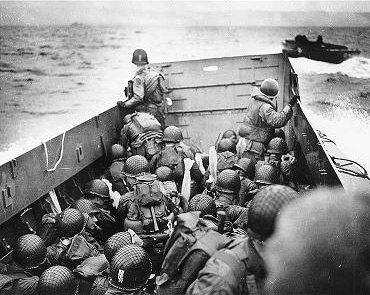
Landing Craft. Craft for transporting troops to shore must be sufficiently shallow in draft to be able to beach high up on the shore; they must enable the troops to disembark very quickly; and they must be able to easily back off the beach to retrieve subsequent waves. There needed to be enough freeboard to prevent the craft being swamped in heavy seas without making the craft inviting targets for shore guns. Ordinary ship's boats do not meet these requirements. The United States found a solution in the LCVP or Higgins boat, based on marsh boats developed by Andrew Higgins of Louisiana. These boxy, flat-bottomed craft were driven by a recessed drive shaft and propeller that was protected from grounding damage and had a bow ramp that could be dropped in very shallow water to allow troops to disembark rapidly. They thus met all the requirements previously outlined for a landing craft.
Experience in early operations made it clear that larger landing
craft would be required, capable of carrying vehicles, including tanks to support the landing.
This led to the development of the LST,
an oceangoing ship with bow doors that could land surprisingly
high up on a beach and disembark vehicles.
Another development was the LVT or amtrack, an amphibious tracked vehicle that could swim to shore and crawl out of the water and on inland. This was the one purely American innovation in landing craft, other designs having British or Japanese roots. These were lightly armed and armored and proved to be the key to successful amphibious assaults in the central Pacific. At Tarawa, where conventional landing craft were hung up on the reef and their passengers slaughtered, the amtracks were able to crawl across the reef and turn the tide of the battle. It was unfortunate that only a relatively small number of these craft were available. Later assaults were much more lavishly equipped with LVTs, but these relatively expensive craft were never able to completely displace simpler types of landing craft.
U.S. Marine
Corps. Via ibiblio.org
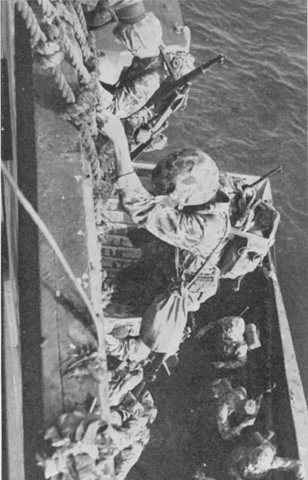
Another important development was the LSD, an oceangoing vessel with a large dock in the stern that could be flooded by ballasting down the vessel. This dock could hold a number of smaller landing craft and launch them much more easily than a conventional transport, which had to lower its landing craft from davits and load the men from cargo nets. By the end of the war, it was becoming clear that the ideal amphibious fleet was spearheaded by LSDs carrying amtracks and supported by LSTs or other ships capable of landing tanks and vehicles.
During the invasion of Guadalcanal,
insufficient manpower was assigned to unloading supplies and
moving them inland, and as many as a hundred boats were beached
for unloading at one point while another fifty waited offshore.
Based on this experience, the Marines added a pioneer battalion to each of their divisions whose job was to
unload the supplies. Unsurprisingly, the pioneer battalion was
often used as replacements for the rifle companies of the division once
the bulk of the supplies were ashore, and since the pioneers were
often black Marines
rejected for service elsewhere, this provided the opening wedge
for introducing black Marines to combat. By the time of the New Georgia campaign, the
Allies reckoned that manpower requirements for unloading supplies
were 150 men for each cargo
ship and transport, 150 men per LST, 50 men per LCT, and 25 men per LCI.
Naval Historical Center #NH 98709
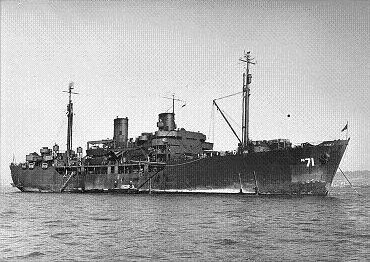
Sea Lift. In late 1943, the sea lift requirements for a reinforced division of about 20,000 men (three regimental combat teams, their ammunition, 1500 vehicles, and supplies) was reckoned at 12 attack transports, three attack cargo ships, and one LSD. Each regimental combat team was carried by a transport division consisting of 4 attack transports and an attack cargo ship. A corps headquarters and supporting units required four attack transports and four attack cargo ships, in addition to those required for its divisions. For the landings on Tarawa, the immediate logistical allotment was 1322 pounds of supply per man, not including fuel and heavy weapons and ordinance. Each attack transport carried about 1100 men into combat.
If the distance was short then some of the sea lift could take the form of short-range beaching vessels such as LSTs and LCIs.
By early 1945 the U.S. Navy had organized transport squadrons
composed of 15 attack transports, six attack cargo ships, 25 LSTs,
10 LSMs and one LSD. Each
could land a fully equipped division on a hostile shore. Eight
such squadrons were organized in time for the Okinawa landings.
The U.S. Army made some important contributions to amphibious doctrine in the area of logistics, at which it excelled. During the invasion of Attu, 7 Division pioneered the use of palletized supplies. The use of pallets caused friction between Holland Smith and Ralph Smith in the rehearsal for Makin, since the Marine commander wanted a full rehearsal and the Army commander feared this would require extensive reloading of the pallets. Eventually a compromise was worked out, but this likely contributed to later tension between the commanders leading to the "War of the Smiths."
Availability of shipping was the chief limiting factor on what
the Allies could undertake throughout the war. The U.S. Navy
had emphasized warships to the almost complete exclusion of
auxiliaries in its prewar expansion plans, and had just 38
transports and 38 cargo ships at the end of 1941. None of these
was a specialized amphibious vessel. The shortage of amphibious
assault shipping was a particularly strong constraint in the
Pacific. By June 1944 the allocation in the Pacific was as
follows:
| Location |
APA |
AKA |
APD |
XAP |
AGC |
LSD |
LSI |
LCI |
LST |
LCT |
LCM |
LCVP |
LCA |
|---|---|---|---|---|---|---|---|---|---|---|---|---|---|
| U.S. West Coast |
3 |
1 |
0 |
0 |
0 |
0 |
0 |
41 |
0 |
1 |
60 |
181 |
0 |
| Central Pacific |
25 |
8 |
13 |
0 |
1 |
5 |
0 |
72 |
72 |
70 |
281 |
1105 |
0 |
| South Pacific |
16 |
5 |
2 |
0 |
1 |
3 |
0 |
13 |
33 |
60 |
215 |
751 |
0 |
| Southwest Pacific |
4 |
1 |
5 |
0 |
1 |
1 |
0 |
56 |
30 |
70 |
702 |
442 |
0 |
| British Far East |
0 |
0 |
0 |
0 |
0 |
0 |
1 |
4 |
0 |
2 |
67 |
0 |
46 |
Thus, at the time of the Marianas campaign, there was sufficient
assault shipping in the Central Pacific for about two divisions,
and the combined shipping resources in the South Pacific and
Southwest Pacific were sufficient for less than two divisions. The
invasion of the Marianas required the loan of many of the attack
transports in the South Pacific, plus the use of a significant
number of ordinary (non-APA) transports pressed into the role of
assault shipping.

U.S. Army. Via
ibiblio.org
Fire Support. Until a beachhead could be secured in which artillery could be deployed, the troops ashore had to be supported by naval firepower. This proved problematic. Warships carry a limited number of shells and fire them on much shallower trajectories than is usually the case with land artillery. It was found at Tarawa that naval bombardment was not nearly as effective as had been hoped. Experiments at Kahoolawe in Hawaii showed that naval bombardment had to be highly accurate plunging fire to have much effect on Japanese fortifications. The Navy's older battleships, including survivors of the attack on Pearl Harbor, became the heart of the amphibious bombardment force, freeing the more modern battleships to escort carrier task forces.
Naval fire support was carefully coordinated during the Allied
counteroffensive across the Pacific. Each battalion had a naval
shore fire control party, controlled by the regimental naval
gunfire liaison team. Each Marine division had a naval gunfire
officer (normally a major) and there were special staff at corps level and above.
Another source of fire support was the landing craft themselves, which were fitted with increasingly heavy armament. In addition, a number of amtracks were fitted with tank turrets ("amtanks") to provide direct fire support, while other landing craft were fitted with large batteries of rockets that could deliver a devastating barrage.
Air support was an important component of fire support from the
very start. However, it took some time to learn how to make air
support effective. Fighter-bombers like the Corsair were fitted with
rockets and bombs, including napalm bombs, as the war
progressed. Air support typically was flown from task units of escort carriers,
leaving the fleet carriers
free to provide distant cover or carry out supporting raids deep
into Japanese territory.
Towards the end of the war, fire support become so effective that the Japanese largely abandoned efforts to hold at the water's edge, and turned to defense in depth, out of range of direct naval gunfire. This pattern was first seen at Peleliu. The Japanese plan in the event of an invasion of the Japanese home islands called for the defenders to stay well back from the beaches until the Allies were ashore, then engage them as closely as possible to nullify the Allied long-range firepower.
U.S. Marine Corps. Via ibiblio.org
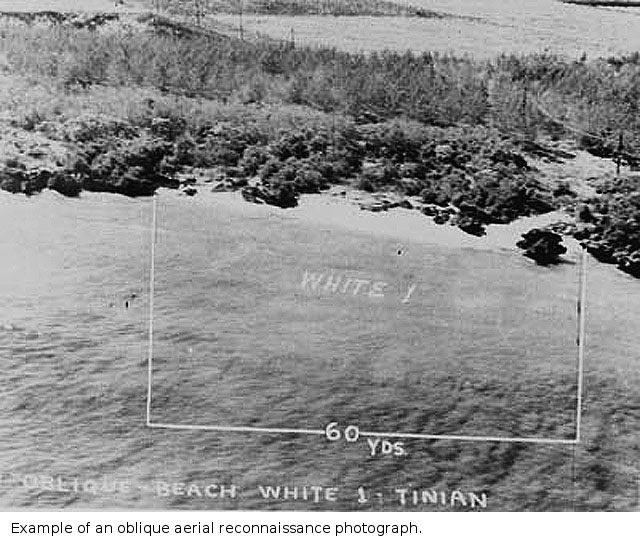
Intelligence. A successful opposed landing must have adequate intelligence about the target. The attacker must know where his landing craft can cross any reef and successfully beach themselves, and the locations of enemy fortifications must be pinpointed for the preliminary bombardment. Intelligence was obtained by photoreconnaissance aircraft, by submarines taking photographs through their periscopes (though these were of limited value), and by underwater demolition teams scouting the reef and beach while demolishing natural and man-made obstacles with explosives. Photoreconnaissance aircraft took both high-altitude stereoscopic pairs of photographs for mapping purposes and oblique photographs from very low altitude that gave a ship's-eye view of the target.
Nautilus spent
18 days taking 2000 photographs of Tarawa
prior to the invasion. However, she could not obtain information
on the reef inside the atoll, nor could she identify many of the
gun positions for destruction by the preliminary bombardment.
The presence of submarines, reconnaissance aircraft, and
frogmen was an obvious sign that a coast was about to be invaded,
so intelligence gathering was a trade off for security. Krueger has been
criticized by historians such as Taaffe (1998) for his reluctance
to risk giving away surprise by more fully employing his Alamo Scouts, particularly
at Biak, where lack of reliable
intelligence seriously handicapped the Allied invasion. Security
could be enhanced by sending reconnaissance missions against
several plausible targets, so that the enemy was left guessing
which was the actual target. Where the strategic situation was
such that the next target was obvious, there was little to lose by
mounting a thorough reconnaissance, as was done at Okinawa and Iwo Jima.
U.S. Navy. Via
ibiblio.org
Command and Control. An amphibious assault was an
exceedingly complicated operation, requiring that large numbers of
small craft arrive at the right points at the right time and in
coordination with their fire support. This required superb command
and control. The solution, as with so many other problems in
amphibious operations, was specialized ships and small craft.
At the top was an amphibious
command ship, usually a specially modified transport, that
carried the assault force commander and his staff and was equipped
with extensive communications facilities. These replaced the battleship or other large
warship favored as flagships by some early assault force
commanders, which proved unsuitable because their firepower could
not be spared from the preliminary bombardment. The blast of their
guns often knocked out their own communications.
In addition to the amphibious command ship, an LCC was eventually assigned to each transport division to control the landing craft. These were supplemented by submarine chasers and surplus LCVPs acting as wave guides (typically four to eight for each wave). Most of the landings were made in broad daylight, and the control craft typically employed brightly colored flags to identify themselves and the landing beach to which they were assigned.
The Marines themselves carried the TBX, a portable radio designed
by General Electric. This was fully waterproof and sturdy enough
to take considerable abuse.
It is perhaps unsurprising that there was considerable contention
early in the war over who should command the amphibious command
force. The sensible compromise that was eventually reached by the
Americans was that the senior Navy officer commanded the force so
long as it was at sea and during the initial assault, while the
senior Army or Marine commander took command once he was able to
establish his headquarters ashore.
The British prepared a manual on amphibious operations (which they usually referred to as combined operations) in 1922, with revisions in 1925, 1934, 1936, and 1938. There were also small-scale exercises (involving single battalions) in 1924 and 1928, taken on the initiative of local commanders, and a brigade-sized exercise 1934 that involved 41 warships. However, these efforts presupposed an unopposed landing, and there was a serious lack of organizational commitment or institutional memory. The Royal Marines shrank to just 9000 men, and their leaders never seized upon amphibious assault as a distinctive mission, emphasizing base defense (in the form of the Mobile Naval Base Defense Organization) instead.
The 1936 revision to The Manual of Combined Operations
finally sparked serious interest in amphibious assault, and the
Inter-Services Training and Development Centre opened in July
1938. Its director, Captain L.E.H. Maund , who had observed the
Japanese operations in 1937, won the support of Majkor General
Hastings Ismay, who noted that (as quoted in Murray and Millett
1996):
... as our strong suit was command of the sea, we should be making poor use of our hand if we relegated combined operations to the background of our war plans. Indeed it seemed that we should be laying ourselves open to justifiable criticism if we made no effort in time of peace to train on modern lines for a possible combined operation in time of war.
However, the British had completed just eight experimental Motor
Landing Craft (MLC) by 1939, when it was estimated that several
hundred were required to land a division, and the prototypes were
too heavy to be handled by ordinary passenger liner davits. After
war broke out, work accelerated on the LCA and LCM, while Churchill, as First
Lord of the Admiralty, inaugurated a crash program to develop the
LST.
U.S. Marine Corps. Via ibiblio.org
The Japanese began World War II with near parity in
amphibious capability and doctrine with the United States. The
Japanese Navy and Army were unusually cooperative in the
development of amphibious doctrine, in spite of maintaining
separate amphibious forces (of which the Army's was the larger),
holding joint exercises in 1922, 1925, 1926, and 1929. These were
large exercises, with three divisions involved in the 1922
exercise. The lessons learned from these exercises were distilled
into the "Outline of Amphibious Operations" (Joriku sakusen
kōyō) of 1932, which predated the Tentative Manual for Landing Operations and
became the Japanese bible of amphibious warfare. The Army
Transportation Service organized shipping engineer regiments of 1200
officers and men to operate landing craft, debarkation units to to
load or unload transports either through ports or over a landing
beach, and managed its own port facilities and Army shipping
through shipping transport commands.
Following the Shanghai
Incident of February 1932, in which the Japanese rikusentai
at Shanghai clashed with Kuomintang
troops and took heavy casualties,
the Navy organized the Special Naval
Landing Forces. These were activated at the four major naval
bases (Sasebo, Kure, Yokosuka, and Maizuru) and numbered in order
of activation. By 1941, they closely resembled Army battalions in
organization,
equipment, and tactics.
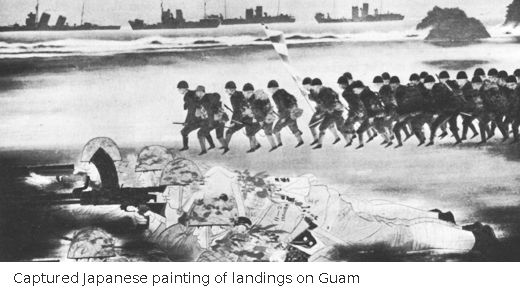
The Japanese avoided opposed landings whenever possible. During
the Centrifugal
Offensive this was almost always possible, because the
Japanese had command of the sea and Allied forces were stretched
very thin. Japanese amphibious forces tended to land in columns
rather than waves, in order to concentrate at the point of attack.
The only two attempts by the Japanese to land under heavy fire
both took place at Wake; the
first attempt failed before the assault troops had even gotten
into their boats, and the second succeeded only with heavy casualties in spite of
overwhelming numbers and massive air and naval support.
In spite of a doctrine of avoiding opposed landings, the Japanese made some important innovations in amphibious craft that often closely paralleled those of the Allies. Indeed, many respects, the Japanese were well ahead of the Allies when war broke out. For example, the Japanese had already developed landing craft, such as the Daihatsu, that strongly resembled the LCVP in form and function. The Japanese Army experimented with amphibious tanks as early as the 1926 exercises. The Japanese Army and Navy also cooperated in the construction of Shinshu Maru, the first ship laid down specifically for landing operations. Japanese innovation reached its peak with the Akitsu Maru, which could carry and launch both landing craft and aircraft. This prefigured some of the features of postwar amphibious assault ships.
U.S. Army. Via ibiblio.org
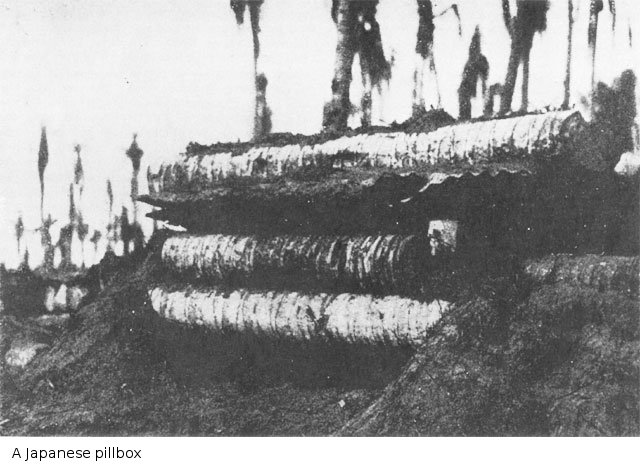
The Japanese Army remained preoccupied with the Soviet threat until September 1943, when the Army schools finally switched their emphasis to countering American tactics. Prior to that time it was assumed that the Navy would take responsibility for fighting the Americans. Emphasis was originally put on counterattacks against the beachhead, but when this doctrine proved unsuccessful (particularly at Peleliu, where a Japanese tank-infantry counterattack was cut to ribbons while a defense in depth in the high terrain held up the Americans for a month) the Army was force to change tactics. The Army issued its Essentials of Island Defenses in August 1944, which called for a mobile defense anchored to strong points from which local counterattacks could be launched. Fortifications, dispersal, concealment, and fighting spirit were emphasized. In October a new draft was released that abandoned defense at the water's edge and called for defense in depth. However, it proved difficult to overcome a generation of training that emphasized cold steel and offensive spirit, and the Emperor himself questioned why the commander at Okinawa abandoned the airfields to the Americans rather than defend the beaches.
References
The Pacific War Online Encyclopedia © 2006-2011, 2013, 2016 by Kent G. Budge. Index