 The Pacific War Online Encyclopedia
|
| Previous: KRS Class, Japanese Submarines | Table of Contents | Next: KS Class, Japanese Submarines |
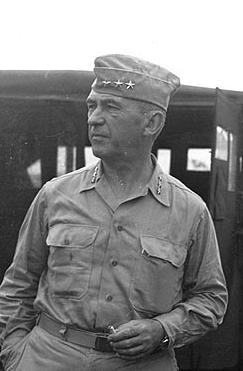
Cropped by
author.
Walter Krueger was born in East Prussia to a former German Army captain who died when the youngster was four years old. His family emigrated to the United States four years later, and Krueger's mother remarried a strict Lutheran minister who drilled him in mathematics, languages, and classics at home while he simultaneously attended the local public school. He abandoned his plans to enter a college engineering program and instead enlisted in the Army in April 1898. He fought in the Spanish-American war, rising to the rank of sergeant, and was commissioned in 1901 for his part in taking the barrio of San Juan de Guimba. He graduated from the Infantry and Cavalry School in 1906 and the Command and General Staff School in 1907. He participated in Pershing’s expedition in Mexico. In 1916 he briefly served as lieutenant colonel with the National Guard on the Mexican border before returning to the Regular Army as a captain. During World War I he held staff assignments in France. Between the wars, he continued to receive important assignments, and graduated from the Army and Navy War Colleges.
The outbreak of the war found Krueger in command of 3 Army as an acting lieutenant general, where he had achieved a notable "victory" in the Louisiana Maneuvers. On 18 February 1943 he assumed command of 6 Army in Australia. As such he should have been under the command of Thomas Blamey, who was the nominal Allied land forces commander in the theater. However, MacArthur, who seems to have despised all things Australian, including Blamey, got around this by designating 6 Army as Task Force Alamo, thus putting Krueger under his direct command. Task Force Alamo fought all the way from New Britain to the Philippines.
Krueger was an able linguist and
military historian as well
as an excellent planner and trainer
of troops. None of his colleagues doubted his intelligence and
capacity
for hard work, though one observed that "he didn't have much of a
personality" (Frank 1999). However, he
was not an
outstanding field commander, in spite of having commanded almost
every
echelon from squad to field army.
Krueger himself had "about concluded that being practically
sixty-two I
would be thought too old for active overseas service" (Zedric
1995).
The conduct of his campaigns
suggests that
he was too often out of touch with the real situation in the
field,
particularly at Biak,
where his orders made no
sense given the tactical
realities. After one operation he received to
a report of high officer casualties
with approval, believing this was proof the junior officers were
leading as they should. This likely reflected Krueger's tendency
to identify more with the enlisted men than with his fellow
officers. Paradoxically, his fellow officers considered
him excessively slow and cautious. However, MacArthur
rewarded loyalty
with loyalty, and Krueger was loyal to MacArthur, showing no
interest
in
publicity for himself. It was not until the Leyte campaign that Krueger
directly
commanded his army in combat,
and MacArthur was so dissatisfied with
his performance that he considered relieving him. It was probably
Marshall's patronage
that
saved Krueger's career.
Krueger directed the occupation of Honshu by 6 Army following the surrender,
but retired immediately
thereafter, in January 1946. His postwar life was unhappy: His son
was
dismissed from the Army for conduct unbecoming an officer in 1947,
and
his daughter was convicted of stabbing her husband in his sleep in
1952. (She was released three years later when the Supreme Court
ruled
that civilians could not be tried by court-martial in peacetime.)
| 1881-1-26
|
Born at Flatow, West Prussia |
|
| 1898 |
Sergeant
major |
Enlists and fights in
Spanish-American War (2 Volunteer Infantry) |
| 1899-6 |
Reenlists as a private in the
Regular Army |
|
| 1901-1-31 |
Second
lieutenant |
30 Regiment |
| 1905 |
Infantry
and Cavalry School |
|
| 1906 |
Command and General Staff
School |
|
| 1918 |
Captain |
G3, 26 Division, France |
| 1918 |
84 Division, France |
|
| 1918-10 |
Colonel
(temporary) |
Chief, Tank Corps |
| 1919-6 |
Lieutenant colonel |
Army War College |
| 1924 |
War Department |
|
| 1927 |
Washes out of flight school |
|
| 1928 |
Instructor, Navy War College |
|
| 1932 |
Colonel |
Commander, 6 Regiment |
| 1934 |
War Plans Division |
|
| 1936-10 |
Brigadier general | |
| 1938-5-29 |
Chief, War Plans Division |
|
| 1938 |
Commander, 16 Brigade |
|
| 1939-2-1 |
Major general |
Commander, 2 Division |
| 1940-10 |
Commander, VIII Corps |
|
| 1941-5-16 |
Lieutenant general |
Commander, 3 Army |
| 1943-1-25
|
Commander, 6 Army |
|
| 1945-3-5 |
General |
|
| 1946-1 |
Retires |
|
| 1967 |
Dies |
References
Dupuy
et al. (1992)
Frank (1999)
Generals.dk (accessed 2008-2-18)
The Pacific War Online Encyclopedia © 2007-2010, 2012, 2016 by Kent G. Budge. Index