 The Pacific War Online Encyclopedia
|
| Previous: Lead | Table of Contents | Next: Leander Class, British Light Cruisers |
National Archives. Via ibiblio.org
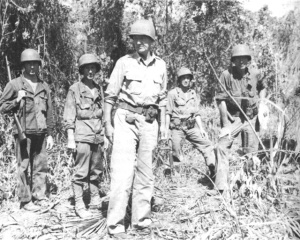
The difference between an armed mob and an army is its leadership. An army is led by men who have authority to command their subordinates and who thus can be held responsible for their actions. Because there is a limit to the number of subordinates that even the best leader can direct in battle, there is a hierarchy of leadership, with each rank in the hierarchy commanding those in the lower ranks and answering to those at higher ranks. It was unusual for a leader to directly command more than three or four subordinates, except possibly at the lowest levels.
The rank structure differed slightly between armies.
The discussion which follows is based on the rank structure and
organization of the U.S.
Army.
Non-commissioned
Officers (NCOs). At the lowest level of the Army,
ordinary enlisted soldiers (holding the rank of private or private
first class) were directed by non-commissioned officers. The
latter were enlisted soldiers selected for their perceived
leadership qualities. Soldiers were organized into squads or sections of eight to
twelve soldiers led by a corporal or sergeant, who was typically
assisted by the senior private first class or by a corporal. Every
army had several sergeant ranks, with the higher ranks often
serving as assistants to officers rather than as squad leaders.
In the U.S. and British armies, the selection and training of NCOs was the responsibility of the commissioned officers in each unit. There were no uniform standards, although on-the-job training was the accepted approach. Bergerud (1996) interviewed Bill Crooks, an Australian platoon sergeant, who said:
The section leaders were special men with special attributes. Yet outside some technical literature there was only one military textbook dealing with leading a section. Just think of it. Only one book about a man holding that position. G-d, to become a section leader for a Digger was the next best thing to becoming prime minister or a fighter pilot or a university professor.
By contrast, the Japanese
Army instituted the NCO Preparatory School in 1927. This accepted
volunteers, who were typically second or third sons of poor rural
farmers. The prospective NCOs were permitted to volunteer after
three months in the Army, but were required to continue training
alongside private soldiers of their parent units for the remainder
of their first year of service before being admitted to the
school. If they successfully graduated from the one-year course,
they then assumed NCO duties. While this likely improved the
professionalism of Japanese NCOs, it is also likely that it
created a yawning social gulf between NCOs and ordinary private
soldiers. As the war situation deteriorated, the length of the
course was reduced.
A squad leader had to have courage, but in jungle fighting it was at least as important that he have excellent situational awareness. His squad was likely to be spread out in dense cover, and he could easily lose track of his men when a fire fight broke out. If that happened, his shining example and all his shouted words of encouragement were likely to be useless.
Warrant Officers. Warrant officers were
specialists who were superior in rank to all enlisted men and
inferior in rank to all commissioned officers. Their specialized
duties did not generally place the in the chain of command.
Company Officers.
The next rung in the leadership ladder was the platoon leader, who was a
commissioned officer holding the rank of first or second
lieutenant. While it was not unknown for outstanding
non-commissioned officers to receive a battlefield commission,
most platoon leaders were recent graduates of a military academy,
a reserve officer program at
a civilian university, or an officer candidate school.
A platoon typically consisted of three or four squads, supplemented by specialist elements such as a medium machine gun crew or a mortar or bazooka team. The platoon leader was assisted by a sergeant first class. In Western armies, the platoon sergeant often had considerably more combat experience than the platoon leader and was expected to be a steadying influence. In the Japanese Army, the social gulf between commissioned officers and NCOs meant that such an influence was inconceivable.
Three or four platoons were organized into a company led by a captain. Ideally, the captain was significantly more experienced than his platoon leaders and was expected to be their mentor in the profession of combat leadership. He usually had a first lieutenant as executive officer and was assisted by a first sergeant.
Field Officers. Three or four companies were organized into a battalion led by a lieutenant colonel. In addition to its rifle companies, a battalion also typically had a heavy weapons company equipped with heavy machine guns, heavy mortars, or a section of infantry or antitank guns. In addition to a major as executive officer, a battalion was large enough to have a small staff.
Three or four battalions were organized into a regiment led by a colonel. A regiment often had an artillery battery or tank battalion attached for specific operations. Regiments were large enough formations to have a unique identifying number.
General Officers.
Three or four regiments were organized into a division, which was led by a
major general with the assistance of a brigadier general. In
addition to its infantry
regiments, the division typically had an artillery regiment or brigade, a battalion of engineers, a reconnaissance company,
and other supporting elements. The division was usually the
largest permanent formation in an army.
Higher echelons were organized as needed for various operations and usually did not have a fixed structure. Two to four divisions were organized into a corps, which was usually led by a major general or lieutenant general. Two to four corps were organized into an army led by a lieutenant general, and two to four armies were organized into an army group led by a lieutenant general or general. The commander of an entire theater, if he was an Army officer, was a general or general of the Army. Only four American officers were appointed as generals of the Army during the war: Marshall, the Army Chief of Staff; MacArthur, who commanded the Southwest Pacific Area; Arnold, commander of the Army Air Forces; and Eisenhower, commander of the European Theater.
The U.S. ranks of fleet admiral and general of the
Army were established, largely at the instigation of Ernest J. King, to ensure
parity of the top American commanders with their Allied
counterparts. It took some time to get consensus on the titles of
these ranks. King's original suggestions of Arch Admiral and Arch
General proved as unpopular as Roosevelt's suggestions of Chief
Admiral and Chief General. King disliked the traditional British
title of Admiral of the Fleet, while the traditional rank of Field
Marshal was obviously going to be awkward if applied to Field
Marshal Marshall.
Other Armies and
Services. The U.S. Marines
had essentially the same organization and rank structure as the
Army (differing only in the names of some of the enlisted ranks.)
The British Army had brigades in place of regiments. These were
commanded by brigadiers, who were not considered general officers.
There was no equivalent of a corps in the Japanese
Army, where two to four divisions were organized into an army led
by a lieutenant general and two to four armies were organized into
an area army led by a general or field marshal. Divisions in
the Japanese Army were commanded by a lieutenant general assisted
by a major general. This major general also commanded the infantry
group of the division, which consisted of its infantry regiments.
There was no rank of brigadier general in the Japanese Army.
The Chinese Army
organized two to four divisions into units whose Chinese name has
been variously translated as corps or army (the latter probably
being the better translation) and two to four armies were
organized into an army group. Army groups were organized into war
areas. The Chinese title equivalent to field marshal or general of
the army was generalissimo, held only by Chiang Kai-shek. This
was as much a political as a military title.
Naval noncommissioned officers were known as petty officers. Like their Army counterparts, they were selected from the enlisted sailors, but they were also typically required to complete a prescribed course of shipboard training and pass an examination to qualify for their new rank. This reflected the specialized technical knowledge required to operate modern warships.
Because ships' complements vary greatly in size, the
duties of naval officers are much less fixed than those of army
officers. At the time of the Second World War, the most junior
officers were ensigns who, like Army second lieutenants, were
often fresh out of school and green as grass (especially in a beam
sea.) On larger warships, these inexperienced officers were
assigned as assistant division commanders, a Navy division being a
group of ten to thirty sailors. The naval equivalent of a first
lieutenant was a lieutenant junior grade, while the naval
equivalent of an army captain was a lieutenant. A lieutenant might
command a division on a larger warship, or he might command a
small craft, such as a PT boat.
The naval equivalent of a major was a lieutenant commander, who might command a small destroyer or submarine or serve as a department head on a large warship (cruiser, battleship, or carrier.) A commander, the naval equivalent of a lieutenant colonel, might command a large destroyer or submarine or serve as executive officer on a large warship, while a naval captain, equivalent to an army colonel, typically commanded a division of small warships or a single large warship.
The naval equivalent of generals were admirals. Since there were only three traditional grades of admiral in the U.S. Navy, versus four grades of general in the U.S. Army, those rear admirals who were in the lower half of seniority were considered equivalent to brigadier generals. They typically commanded a squadron of many small warships or a division of two to four large warships. Those rear admirals in the upper half of seniority were considered equivalent to a major general, and might command a task group of several large warships with their escorts. A vice admiral was equivalent to a lieutenant general and typically commanded a task force. A vice admiral might also command a naval district in home waters. Admirals were equivalent to generals and typically commanded a fleet, while the naval equivalent of the nontraditional rank of general of the army was a fleet admiral. Only four American officers were appointed as fleet admirals during the war: Leahy, President Roosevelt's personal military advisor and chairman of the Joint Chiefs of Staff; King, the top Navy commander; Nimitz, the Pacific Ocean Areas commander; and Halsey, the popular commander of Third Fleet. Spruance, Halsey's counterpart commanding Fifth Fleet, was denied his fifth star but was granted special status by Congress, including the right to continue drawing his full pay as an admiral after retirement.
Navies included officers within their ranks who were
trained for special duties, and in many cases, such officers were
ineligible for line command. In the U.S. Navy, these included
naval constructors, medical
officers, and construction
engineering officers. Other specialists who were eligible for line
command included aviators
and ordnance
officers. The latter, who generally held postgraduate degrees in
ordnance or related fields, made up the "Gun Club, a term used
both with respect and as a pejorative, depending on context.
A recurring problem for both sides during the war was command of combined forces. Interservice rivalry was a serious problem for the Allies, but paled in comparison with the interservice rivalry between the Japanese Army and Japanese Navy, which went clear back to the clan rivalries preceding the emergence of Japan as a modern state.
The American Army and Navy were entirely separate services when
war broke out in the Pacific, with no common command below the
level of the President himself. The service chiefs saw the need
for the services to work closely together, but this remained
informal until war broke out, and the lack of interservice
cooperation in Hawaii was
cited as a cause of the disaster there. In fact, Kimmel and Short got along well
personally and met regularly to discuss common concerns, but the
machinery simply did not exist for effective cooperation. In April
1942 Marshall and King agreed that "when a state of fleet-opposed
invasion is declared, unity of command is vested in the Navy"
(quoted by Symonds 2011), but while this worked for Nimitz and the
Army commanders at Hawaii, it failed in Alaska, where Theobald was unable to
persuade Butler to
stage his bombers forward to provide air cover for Navy surface
forces and unwilling to test the limits of the joint command
arrangements.
With the establishment of theater commands with authority over
both Army and Navy units in theater, the problem eased somewhat.
Nimitz made interservice cooperation a near fetish in the Pacific
Ocean Areas, but MacArthur maintained a purely Army staff in
the Southwest Pacific, with the Navy represented only by technical
liaisons.
Japan never really resolved its problem with interservice rivalry. The Imperial General Headquarters remained divided into Army and Navy sections, and joint command was never a reality during the war. Both the Navy and the Army maintained their own theater headquarters throughout the war and competed for scarce shipping. Some aircraft factories even had separate floors for Army and Navy assembly lines, with a padlocked door between the two. It was as if the war was being fought by two distrustful allies rather than sister services of a single nation.
Command of allied forces was an even more severe challenge.
However, it was of limited importance for the Japanese, whose few
allies were either too
distant to matter much or were very minor partners who could be
bullied into compliance with Japanese plans. For the western Allies, it was a more
serious problem, and the first attempt at allied command (ABDA) was an abject failure. The
division of responsibility between the British in southeast Asia and
the Americans in the Pacific settled some of the questions, and
the Australians and
Americans in the southwest Pacific and the British and Americans
in southeast Asia learned to work reasonably well together.
However, cooperation with the Chinese remained difficult
throughout the war.
It is a curious fact that, with the exception of China and possibly Japan, the ultimate command of the armed forces of the Second World War rested with civilian leaders. While the king of Britain was theoretically the sovereign commander-in-chief of all Commonwealth armed forces, in practice he was a figurehead, and the ultimate command for each Commonwealth nation rested with a civilian cabinet led by a prime minister. Winston Churchill, the British prime minister during most of the war, had to lead by persuasion when he first was appointed to office, but as his prestige increased, his political power also increased. In the United States, the Constitution names the President as commander-in-chief of the armed forces. President Roosevelt exercised this command with the assistance of the Secretaries of War and the Navy and of the Joint Chiefs of Staff. Both Churchill and Roosevelt had to be sensitive to public opinion and to the prerogatives of the legislative branches of their governments. Churchill was answerable to Parliament, which could compel his resignation with a motion of no confidence, while the U.S. Congress was constitutionally required to reauthorize the Army's budget every two years and had the power to pass laws regulating the armed forces.
Japan was theoretically led by the Emperor, but his actual role remains cloudy to this day. It is clear that the Army and (to a lesser extent) the Navy had accumulated considerable power, enough to virtually ignore the civilian elements of the government, but it is less clear how much effective command the Emperor had over the armed services. Hirohito was regularly briefed on military operations, and while he exercised little formal control, there is some reason to believe his informal influence was greater than portrayed by historians writing in the immediate postwar era.
China was effectively a military dictatorship led by Generalissimo Chiang Kai-shek, but regional warlords still had considerable autonomy at the time war broke out in the Pacific, and Chiang constantly felt obligated to play various rivals off against each other. The most powerful warlords were given command of war areas and were largely responsible for raising their own troops, who owed their loyalty to the warlord rather than the central government.
Civilian institutions largely remained in place even during the
mobilization for war, but were harnessed to increase quantity and
quality of production of
war materiel. The United States was much more effective than the
Japanese at managerial organization, in part because of the much
greater divide between the Army, Navy, and civilian institutions
in Japan. For example, Vannevar Bush, president of the Carnegie
Institution, served successively as chair of the National Advisory
Committee for Aeronautics and the National Defense Research
Committee, which proved effective at coordinating U.S. scientific
research on advanced weapons, such as radar, rocketry, and the atomic bomb. By contrast,
the bureaucratic power struggle between Army, Navy, and Ministry
of Education meant that such coordinating bodies as the Cabinet
Planning Office, the Science Mobilization Association, and the
Asian Development Board were ineffective. On 17 April 1941, in
what became known as the Planning Agency Incident, several members
of the Planning Agency were arrested on charges of "Communist
activity". Following the debacle at Midway, the Japanese
Army and Navy agreed to form an Army-Navy Technology Committee to
coordinate research efforts. This was only marginally effective,
particularly since it left out the Ministry of Education and
therefore the universities. Research was further fragmented by the
practice of awarding research contracts to individual scientists
rather than universities, a tendency that was probably encouraged
by the scientists themselves. Military leaders distrusted
professors,whom they suspected of being contaminated by Western
ideas or or being under Communist influence.
Leaders at
all levels in the chain of command had to be able to persuade
their subordinates to carry out their orders. As a result, much of
the training and discipline of servicemen was directed at breaking
down any reluctance to obey lawful orders. However, even the
best-trained troops could become insubordinate if their leaders
lost their trust. Troops of almost all nationalities agreed that
the most important element of maintaining such trust was the
ability of their leaders to produce victories. Different services
had different attitudes on the nature and importance of the
charismatic bond between the troops and their leaders. The British
Army, for example, strongly discouraged fraternization between
officers and men, as did the U.S. Army, at least at the beginning
of the war. U.S. Marine officers seem to have been closer to their
men, perhaps because of the traditional deployment of Marines in
small detachments on warships.
British observers during the Russo-Japanese War
remarked on the way Japanese officers were instantly obeyed in
spite of maintaining a close social intimacy with their men.
However, by the 1930s the service academies were systematically
obliterating the social bond that had previously existed between
officers and enlisted men. Officers were expected to treat their
men with "calculated brutality" (Edgerton 1997), including
frequent beatings, so that the soldiers to fear and hate them. The
intent was to turn the men into vicious fighters who would vent
their pent-up rage against the enemy. "Having been subjected to
cruel and irrational punishments we were trained to act without
thinking in response to orders" (Edgerton 1997).
It has already been pointed out that effective company officers needed to combine courage with situational awareness, including the ability to correctly read the terrain. "A British Army training report noted that soldiers would forgive almost any fault in their officers except incompetent map reading, which at best wasted energy and at worst got them killed" (Hastings 2011). In addition, the most outstanding officers showed an ability to take the initiative. This was carefully cultivated in the German Army, but neglected in the Commonwealth and U.S. armies, and actively discouraged in the Japanese Army. During the battle of Hong Kong, a Japanese battalion commander who seized the crucial Shing Mun redoubt on his own initiative was furiously bawled out by his superior for acting without orders, and told to pull his men back! The order to withdraw was eventually canceled, but the incident illustrates a crucial weakness in the leadership of the Japanese Army, which put almost all its leadership training emphasis on raw physical courage and rigid obedience to orders.
As an officer advanced further up the rank ladder, the ability to master details and to plan effective operations became increasingly important. While a general officer who took time to visit the front line could sometimes boost morale, it was more important that he have whatever intangible quality it is that allows a leader to foresee the likely outcome of decisions and be willing to accept their consequences -- a quality sometimes described as moral courage, in contrast with the physical courage required of junior officers.
Naval officers at all levels needed the constellation of skills that made up excellent seamanship. Physical courage was required of naval officers even in peacetime, since sailing the oceans was an intrinsically hazardous calling. Ship's captains, of whatever formal rank, carried an immense responsibility both in wartime and peace, and it is remarkable that the various navies were able to find as many competent officers to command warships as they did.
An illustrative case history of the problems of leadership is that of Lieutenant Colonel William E. Maxwell, commander of 1 Battalion, 5 Marine Regiment on Guadalcanal. Large numbers of his company officers had been transferred out to provide cadre for 7 Marine Regiment and most of his men were recent enlistees. They had not had much opportunity to train together because of constant movement since deploying from the States. Maxwell concluded that he had no choice but to insist on rigid obedience to orders, which he enforced with stinging critiques for errors. In effect, he traded off initiative for discipline. Faced with a difficult tactical problem in the ridges west of Henderson Field, communications broke down, and the battalion became paralyzed. Maxwell was relieved of command by his regimental commander, a decision most of his fellow officers supported.
All the major powers had special training colleges to groom those officers who showed particular promise for high command. In the United States Army, the most prestigious of these was the Army War College in Pennsylvania, which prepared field officers for high command. The Command and General Staff School, at Fort Leavenworth, Kansas, trained younger officers for staff responsibilities and field command and was generally a prerequisite for the Army War College. However, both suffered from overemphasis on the "school solution" and actively discouraged original thought. The naval counterpart to the Army War College was the Naval War College at Newport, Rhode Island, and seems to have been significantly more innovative. The Japanese and British had similar institutions.
The Chinese Army Staff College was organized in 1938
under Chiang Pai-li (Jiang Baili), an academic military
theoretician who had once commanded the Paoting Military Commander
and who had been imprisoned for advising Chiang's rivals, then was
granted nominal rank of lieutenant general to command the Staff
College. Jiang was largely responsible for the Chinese strategy of fighting a war of
attrition.
The U.S. Naval War College was founded in 1884 by
the brilliant Rear Admiral Stephen B. Luce. It was not only a
training institution for the Navy's future flag officers, but it
also served as a planning agency for the Navy. Plan Orange was developed
here and updated regularly by successive classes of students. The
Naval War College also trained a number of Marine officers,
including Holland M.
Smith, and it providing training cadre for the large number
of reserve officers inducted in time of war. Its curriculum prior
to the Second World War was organized around Command, Strategy,
Tactics, and International
Law. The College also put a heavy emphasis on war games, for which it
developed elaborate rules.
The Japanese Naval Staff College was founded in 1888 but did not assume its later importance until 1896, when the Navy General Staff send Sakamoto Toshiatsu to France to study the French Naval War College. He then became senior instructor at the Japanese Naval Staff College, advancing to President of the College by 1902 and instituting sweeping reforms. Sea experience was dropped as a requirement even as other qualifications were tightened. Instruction was organized around a six-month "B" course for junior officers and a two-year "A" course for middle officers, though the College also offered an engineering course and tailored elective courses. The "B" course was relatively limited in scope, but the "A" course was open only to the most promising candidates for flag rank and became a major stepping stone to such rank. Central to the "A" course was applied tactics, taught largely by presenting students with problems and requiring them to write essays on their solution, a technique used in the United States as well. Like its American counterpart, the College became a center for development of naval tactics tested through war games. These were distributed to the fleet as successive editions of Kaisen yōmurei ("Battle Instructions"). Unlike the Japanese Army, the Navy put significant emphasis on semmu, logistics, though the Japanese term was even broader in meaning, covering all non-combat activities.
The Japanese also established a Total War Research
Institute in April 1941 as the counterpart of the British Imperial
Defense College. This was open to the most talented future leaders
in both the military and the civil service and offered an
intensive one-year course. However, although its first dean, Iimura Jo, was a charismatic
leader who attracted some talented instructors, the physical
surroundings (a shanty in the heart of Tokyo) were unimpressive
and the classes were often uninspired and poorly prepared. Its
students concluded in August 1941 that Japan could not win a war
with the United States, and that the Navy's warships were
vulnerable to air attack, both sound conclusions that were mostly
disregarded.
Leadership
selection and training. Armies are notoriously poor at
selecting effective leaders. In the years leading up to the Second
World War, only the German Army, which placed tremendous emphasis
on leadership selection and training, came anywhere close to
making this a science. The Japanese Army selected its officer
candidates at a very young age (15 or even younger) and subjected
them to a brutal regimen designed to produce extreme physical and
mental toughness. So physically demanding was the training course
that Japanese Army officers were significantly shorter in average
height than the average enlisted man. The Japanese Naval
Academy at Eta Jima also combined academic studies (math, science,
foreign language, and military science) with judo, kendo, and
sumo. Saturdays were spent at boat training or pole fighting. The
pole fighting was fought between teams and involved considerable
physical contact, including punching and kicking.
The U.S. service academies of the prewar years were steeped in tradition and notorious for a lack of academic rigor. Cadets and midshipmen were selected by Congressmen and Senators, with the obvious political biases, though almost all based their nominations at least in part on competitive examinations. "Hazing" of underclassmen by upperclassmen was tacitly encouraged and, at least at the Army Academy at West Point, sometimes approached the brutality of Japanese officer education. George C. Marshall, for example, was compelled by upperclassmen to squat over a bayonet blade; when he slipped out of exhaustion, he was wounded nearly severely enough to be forced out of West Point. Instructors were not selected for their teaching excellence, most instruction revolved around rote memorization, and mathematics and sciences were emphasized to the exclusion of almost all else. Incredibly, almost no military history, tactics, or strategy were taught to cadets, who received almost no instruction in the weapons used in modern warfare or in how to lead the men who would wield those weapons. Actual military training of newly commissioned second lieutenants was left almost entirely to the units they would be joining.
The exception to the rigidity of most U.S. officer
training was the Infantry School at Fort Benning, Georgia, during
the time when Marshall was its assistant commandant. Marshall had
understood the reasons for the excellence of the German officer
corps better than almost any other American officer, and he
actively encouraged exercise of initiative and creative solutions
to tactical problems. Knowing that chaos rules the battlefield, he
sometimes deliberately sowed confusion during exercises, as when
he equipped one unit with maps written in Greek. Graduates of the
Infantry School remembered it as a stimulating and valued
experience, in sharp contrast with the experience of most students
at West Point, the Command and General Staff School, and the Army
War College.
The tremendous expansion in the officer corps early in the war led both services to apply scientific methods to officer candidate selection. Aptitude tests and psychological profiling, the latter in its infancy, were applied, with mixed success. In the U.S. Army, reserve officers were typically either university students who joined the Reserve Officer Training Corps (ROTC) or graduates of an officer candidate school. The officer candidate course took just three months, and its products were known derisively as "ninety-day wonders." The Japanese did not establish reserve officer schools until 1944, but the five reserve officer schools managed to turn out 20,000 graduates before the war ended. The schools took selected high school graduates and trained them for a year before awarding them reserve commissions. Regular officers and veteran enlisted men referred to these reserve officers as "dummy rounds".
The difficulty of selecting good leaders is
illustrated by the experience of an unofficial "selection board"
organized by U.S. Navy Secretary Frank Knox in February 1942. Nine
senior naval officers, retired and active duty, were secretly
asked to name the forty most competent admirals in the Navy. Five
or more votes constituted "selection." Stark and King were part of the
panel and were considered automatically "selected." Halsey and Ghormley each
received eight votes; Roy Ingersoll (who never served in the
Pacific), Fletcher,
Fitch, Turner, and Mitscher each received
seven; Leary, McCain and "Poco" Smith received
six; and Draemel and Theobald received five.
Among the admirals receiving no votes were Pye, Brown, Noyes, Kinkaid, Spruance, and,
incredibly, Nimitz.
There is evidence Nimitz heard of the "selection board" through
informal channels, and he confided his fear that he would not last
long as Pacific Fleet commander in a 22 March letter to his wife.
Nimitz has since come to be regarded as possibly the greatest
admiral the U.S. Navy has ever produced.
The inability of most armed services to predict who would make a good leader left them with the problem of how to get rid of officers who fell short. A professional officer corps where careers were constantly hanging on the evaluations of superiors bred sycophants. Yet an army cannot afford incompetent leadership in combat. This dilemma will probably never be completely resolved, but military organizations found various creative solutions. One was to proliferate non-line officer positions. An officer who was unfit for combat leadership might prove perfectly adequate, even talented, in a support position, and these were also vital to military success. Another creative solution was to clean house when a call came for cadre. When Vandegrift was asked to transfer some of his senior officers back to the States to help create new Marine units, he took the opportunity to get rid of officers he felt had not measured up. One of these officers was eventually promoted to full general, suggesting that successful leadership is sometimes a matter of the right chemistry, and a change in environment can transform a dud into a dynamo.
Combat troops were sometimes less than impressed
with their leaders. This posed yet another dilemma. Those being
led were often in a good position to evaluate an officer's
leadership qualities, but giving any voice to subordinates was
considered an unacceptable breach of the chain of command.
However, commanders like William
Slim made it clear to their junior officers that they were
expected to take good care of their men, with the unspoken
implication that unhappiness in the ranks would reflect badly on
an officer. How such unhappiness would be communicated was left
unstated, since speaking to a senior officer without first
securing the permission of one's immediate superior was considered
insubordination. Senior officers who visited the ranks were
careful not to ask direct questions about how the men viewed their
officers, but they could ask oblique questions directed at
evaluating morale, state of training, or other factors reflecting
on the overall quality of leadership.
On rare occasions, troops took matters into their
own hands. I have not found a substantiated account of the actual
murder of a Western officer by his men during the Second World
War, but there are many rumors that it occasionally happened.
Bergerud (1996) quotes one veteran of 37 Division:
One captain on the front didn't like something I was doing and threatened to court-martial me. I told him if he brought up the subject again, I'd shoot him. He didn't bother me anymore. The front was no place for petty discipline. Some of the leaders didn't quite get the idea. A few were shot, no question. I saw it almost happen twice. It was nearly insane to come across hardened infantry and give them some petty harassing order. Good soldiers, the ones who made it through all the rotten things, were tough and used to killing. If a leader they didn't respect gave them a foolish order just to show them who was in charge, he was taking his life in his hands. Some people should not lead others in battle, it's that simple.
It seems likely that most instances of the murder of
leaders by their own men occurred in combat situations where the
death could plausibly be attributed to enemy fire or accidental friendly fire.
Ironically, the iron discipline of the Japanese Army may actually have led to more cases of murdered officers than in the Western armies. In one incident at Bandung, a private murdered his company commander, who earlier had refused to let the private board a lifeboat after their ship was sunk by Allied aircraft. The private was rescued by another lifeboat and thereafter bore a fatal grudge against the officer. Japanese prisoners of war claimed that "it was not uncommon for officers to be shot by their own men" (Straus 2003), but Japanese willing to surrender were far more likely to bear grudges against their officers than most Japanese.
The U.S. Department of Defense defines command and control as "The exercise of authority and direction by a properly designated commander over assigned and attached forces in the accomplishment of the mission" (DoD 2012). Before a commander can impose his will on the enemy, he must first impose his will on his own men. This requires that he issue orders that clearly communicate his intent through communications channels that are effective in delivering those orders to his subordinate commanders.
At the lowest level, command and control was exercised through
verbal commands or, in combat situations requiring silent
movement, through arm and hand signals. Command above the squad
level required runners or communications equipment, the latter
increasingly so the further up the chain of command. Telephone
lines were relatively reliable and secure but immobile. Radio
equipment promised much greater mobility but was more subject to
breakdown and could be easily intercepted by the enemy.
The principal obstacle to effective command and control is the
fog of war. This is partially mitigated through doctrine, which is a body of
guiding principles that subordinate commanders can be assumed to
understand. When doctrine is clearly articulated and understood, a
commander can give very brief orders that rest on shared doctrinal
assumptions. The Germans were
the acknowledged experts in doctrine during the Second World War.
German officers were expected to carry out missions prescribed by
doctrine, but to use their own initiative in determining how to
carry out the mission (Auftragstaktik).
German
doctrine was sufficiently uniform that the Germans could throw
together a Kampfgruppe from units that had never fought or
trained together before and
still be effective, whereas the British had no common doctrine
above the regimental level
and often had considerable difficulty coordinating operations
between units that had not spent considerable time together. The Japanese Army was so rigid in its
doctrine that it often displayed a dangerous inflexibility.
The American experience in the First World War was misleading. The Americans found themselves in the final stages of a static, semi-siege campaign, and only a few officers (of whom Marshall was one) recognized that future warfare was likely to be a war of movement in which confusion would reign. Marshall was especially scathing in his evaluation of the standard five-paragraph field order, which he considered "an absurd system" (Larrabee 1987). As commander of the Infantry School at Fort Benning, he strove for "a technique and methods so simple that the citizen officers of good common sense can readily grasp the idea" (Larrabee 1987). At this he was only partially successful, but given the challenge of rapidly expanding the tiny prewar professional officer corps into an officers corps for an army of millions, it was remarkable that he achieved as much success as he did.
Command and control at sea was almost as problematic as on land.
Commands within a ship were transmitted by speaking tube, by
sound-powered or dynamic telephone, or by runner. The speaking
tube was a simple pipe with cones at both ends that transmitted
sound relatively efficiently. It was mechanically simple and
required no external power but had limited ability to carry an
audible signal over long distances or in a noisy environment.
Telephones used sensitive microphones and speakers, which could
either operate passively from the energy of the sound alone (a
sound-powered telephone) or actively by electronically amplifying
the sound using an external source of power (a dynamic telephone).
Signals between ships had to be transmitted by signal flags or by
signal lamp, which were reasonably secure but had limited range
and were time-consuming, or by radio, which risked detection by
the enemy.
The Americans put considerable effort into developing a
short-range voice radio for tactical control during engagements.
The first successful model, which used very high frequency (VHF)
wavelengths that normally did not propagate beyond the horizon,
was designated TBS. According to Wolters (2013) the term Talk
Between Ships was invented to fit the designation, not the other
way around.
The admiral in command of a task force was expected to exercise central command based on reports from widely scattered ships assembled into a plot by his staff. This was subject to serious confusion that could easily lead to friendly fire incidents, especially during night combat. The U.S. Navy attempted control by exception, in which each ship captain acted according to doctrine and the battle plan until ordered otherwise, but this required each captain to know more about the tactical situation that was always possible. The contribution of radar with Plan Position Indicator (PPI) displays and Identification, Friend or Foe (IFF), combined with the plotting capability of a Combat Information Center (CIC), cannot be overstated.
An essential element of command and control is the chain of command. Commanders at each level are expected to communicate directly only with their immediate subordinates and their direct commander. This causes delays in propagating information up and down the hierarchy, but this is more than made up by the benefit of ensuring that each level is "in the loop" and its authority is not undercut. One of the most common complaints against Chiang Kai-shek by his senior generals was that he frequently ignored the chain of command to issue orders directly to lower commanders in the chain. This not only rendered the superior situational awareness of the senior commanders useless, but it caused the lower commanders to begin ignoring orders from their direct superiors in time-critical situations.
In Western armed forces, it was considered a punishable offense
for a serviceman to speak to an officer in his chain of command,
other than his direct superior, without permission, except in
purely social situations or other situations spelled out in
regulations. Likewise, senior officers visiting the front were
careful to treat the visit as a social occasion, not issuing
orders directly to the men (except in dire emergency) nor asking
direct questions about the men's immediate superiors. Senior
commanders concerned about the quality of leadership of their
junior officers were obligated to evaluate the situation through
discreet, indirect questions about general conditions in the unit.
These were superficially social chatter, but were actually pointed
at learning whether junior officers were properly training the men
and building their morale.
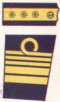
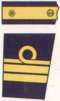
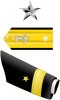
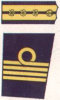
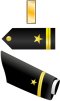
All armies used various uniform insignia to denote rank. In the Japanese Army, these were worn as patches on the uniform collar, or sometimes on the uniform lapels or over the breast pocket. Japanese naval officers in summer uniform wore their rank insignia as shoulder boards and sleeve braids, while the shoulder boards were replace with collar patchs in winter uniform.
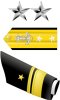
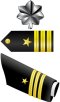
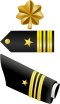
U.S. naval officers in dress or winter uniform wore their insignia as shoulder boards and sleeve braids. U.S. Army officers wore their rank insignia as metal badges pinned to their collars, as did U.S. Navy in summer uniform.
U.S. Army enlisted ranks were denoted by sleeve chevrons and arcs. Both U.S. and Japanese Navy enlisted ranks wore a sleeve insignia, while Japanese Army enlisted ranks wore patches resembling those of officers.
The correspondence of ranks in the following table is only
approximate:
| Japanese Army |
Japanese Navy |
U.S. Army |
U.S. Navy |
||||
| General |
 |
Admiral |
 |
General |
 |
Admiral |
 |
| Lieutenant general |
 |
Vice admiral |
 |
Lieutenant general |
 |
Vice admiral |
 |
| Major general |
 |
Rear admiral |
 |
Major general |
 |
Rear admiral |
 |
| Brigadier general |
 |
Rear admiral (lower half) |
 |
||||
| Colonel |
 |
Captain |
 |
Colonel |
 |
Captain |
 |
| Lieutenant colonel |
 |
Commander |
 |
Lieutenant colonel |
 |
Commander |
 |
| Major |
 |
Lieutenant commander |
 |
Major |
 |
Lieutenant commander |
 |
| Captain |
 |
Lieutenant |
 |
Captain |
 |
Lieutenant |
 |
| First lieutenant |
 |
Lieutenant junior grade |
 |
First lieutenant |
 |
Lieutenant junior grade |
 |
| Second lieutenant |
 |
Ensign |
 |
Second lieutenant |
 |
Ensign |
 |
| Warrant officer |
 |
Warrant officer |
 |
Warrant officer |
 |
Warrant officer |
(not available) |
| Sergeant major |
 |
Superior petty officer |
 |
Master sergeant |
 |
||
| First sergeant |
 |
Chief petty officer |
 |
||||
| Petty officer first class |
 |
Staff sergeant |
 |
Petty officer first class |
 |
||
| Sergeant |
 |
Petty officer second class |
 |
Sergeant |
 |
Petty officer second clas |
 |
| Corporal |
 |
Corporal |
 |
Petty officer third class |
 |
||
| Leading private |
 |
Leading seaman |
 |
||||
| Superior private |
 |
Superior seaman |
 |
||||
| Private first class |
 |
Seaman first class |
 |
Private first class |
 |
Seaman |
 |
| Private second class |
 |
Seaman second class |
 |
Private |
(none) |
Seaman apprentice |
 |
Insignia sources: ibiblio.org,
Wikimedia
Commons, usmilitaryabout.com
References
Army War College (accessed 2008-5-19)
Command and General Staff College (accessed 2008-5-19)
"Dictionary
of Military Terms" (accessed 2012-6-22)
Frank (1990; 2011, accessed 2012-6-16)
"Handbook on Japanese Military Forces" (1944-10-1)
Naval War College (accessed 2008-5-19)
The Pacific War Online Encyclopedia © 2008-2010, 2012-2016, 2019 by Kent G. Budge. Index
