 The Pacific War Online Encyclopedia
|
| Previous: Hirazukara Masakichi | Table of Contents | Next: Hirosaki |
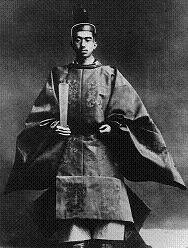
Hirohito was the grandson of the great Emperor Meiji, who helped push Japan into the modern world. Hirohito served as regent for his father, the Emperor Taisho, who was mentally unbalanced, and formally ascended the throne upon his father’s death in 1926. He had a keen interest in marine biology and even published a small number of scientific papers.
Hirohito visited Britain while still crown prince and seems to have been deeply and favorably impressed. It is widely thought that he desired to turn Japan into a constitutional monarchy like that of Britain. However, the mental instability of Emperor Taisho had already significantly weakened the power of the Emperor. Meiji had participated actively in the discussion at Imperial Conferences, but Taisho was neither interested nor able to do so. By the time Hirohito became regent, it had become court protocol for the Emperor to remain silent at Imperial Conferences, with the Lord Keeper of the Privy Seal (the Emperor's closest adviser) speaking for the Throne. This may have contributed to Hirohito's reluctance to intervene in politics, which kept him from confronting the Army when it began to establish a military dictatorship in Japan. He did not fully exercise his theoretical powers as Emperor until Japan lay ruined, and only then intervened to insist that the government accept the Potsdam Declaration which ended the war.
Hirohito did personally act to quash the mutiny of 26 February
1936,
when a number of radical junior officers
from 1 Division attempted to
overthrow the government in favor of direct rule by the Emperor,
which
would likely have been in name only. The radicals murdered a
number of
high officials, including the inspector-general of military
education
and the finance minister. The prime minister escaped only because
the
radicals misidentified his brother-in-law and killed him instead.
Hirohito demanded an immediate end to the coup and harsh
punishment of
the conspirators, and fifteen were executed by firing squad on 12
July
1936. Paradoxically, one consequence of the attempted coup was an
increased emphasis within the Army on Emperor worship.
A number of historians see Hirohito in a darker
light. These historians argue that Hirohito was the driving force
behind
Japanese
imperialism, that his interest in biology extended to biological
warfare, and
that the relatively benign postwar image of Hirohito was the
product of
masterful spin on the part of the Japanese and expediency on the
part
of MacArthur, the
Supreme Allied Commander and
virtual shogun (military dictator) of Japan after the war.
However, the notion that Hirohito was a figurehead controlled by
the
military could be found in American publications at least as far
back
as the time of Pearl Harbor,
and the more extreme versions of this revisionist view of Hirohito
have
largely been rejected by mainstream historians.
A somewhat different picture emerges from other recent histories, in which Hirohito appears as a weak and vacillating ruler who heaped praise on his Army and Navy when they were winning, and petulantly demanded greater efforts and sacrifices when they were losing. Prince Konoye, who preceded Tojo as prime minister, told an aide (Hastings 2007):
When I told the emperor that it would be a mistake to go to war, he would agree with me, but then he would listen to others and afterwards say that I shouldn't worry so much. He was slightly in favor of war and later on became more war-inclined ... As prime minister I had no authority over the army and could appeal [only] to the emperor. But the emperor became so much influenced by the military that I couldn't do anything about it.
The weight of evidence is that Hirohito was not the pacifist he was depicted to be by postwar apologists. His ambitions were aligned with those of the military, though he was himself cautious and frightened of the risks the military were taking. It is highly unlikely that he did not know of the biological warfare research being carried out in Manchuria, since two of his brothers were shown an Army film produced by Unit 731, yet he never spoke against the brutal policies of the Army before August 1945. His actions were those of a weak monarch whose chief concern was the preservation of the imperial house. Even the news that the Navy had initiated kamikaze tactics prompted only veiled criticism from the Emperor: "Was it necessary to go to this extreme? They certainly did a magnificent job" (Inoguchi et al. 1958)
Nonetheless, Hirohito's decision for peace took genuine courage
and
saved countless lives. U.S. ambassador
Joseph Grew had reported on 22 October 1940 that the Emperor had
been threatened assassination if he opposed the Army's policies.
The possibility that he might become the victim
of an Army coup was very real. This coup need not have taken the
form
of an assassination: The Army was constructing secret redoubts
northwest of Tokyo, in the
mountains
of Matsushiro, and the Emperor might have been forcibly moved here
for
his "protection." There was also talk of forcing the Emperor to
abdicate in favor of his young son, with the Emperor's more
bellicose
brother, Prince Takamatsu, serving as regent. Perhaps only Anami's twisted sense
of
honor stood between Hirohito and that fate in the interval between
the
Emperor's decision and its public announcement.
Hirohito was denied all but a few intimates by court tradition,
and
eschewed personal indulgences. His personal living quarters were
highly
Westernized, as was his family life, but he maintained the
traditional
social barriers towards all outside his immediate family. He
worked a
long daily schedule interrupted by simple meals, and neither
smoked nor
drank. He was physically somewhat frail and may have suffered from
a
mild congenital neurological condition, reflected in a somewhat
clumsy
gait that his court took pains to conceal. This may also account
for
reports that Hirohito came close to a nervous breakdown by the
summer
of 1943, which led him to spend much of his time away from Tokyo
at the
summer palace in Hayama.
Hirohito maintained the image of a benign figurehead from shortly after the surrender through the remainder of his life. Neither he nor any of his closest relatives were ever tried or even seriously interrogated about their roles in the war, a deliberate policy decision on the part of MacArthur. After his death in 1989, and in accordance with long Japanese tradition, Hirohito became known in Japan by his regnal name, Showa, which means “Enlightened Peace.” The irony did not pass unremarked by Japan’s neighbors in East Asia.
References
Inoguchi, Nakajima, and Pineau (1958)
The Pacific War Online
Encyclopedia © 2007-2010, 2012, 2016 by Kent G. Budge. Index
