 The Pacific War Online Encyclopedia
|
| Previous: Submarine Tenders (AS) | Table of Contents | Next: Suefuji Tomofumi |

The submarines of the Second World War
were among the most
sophisticated combat systems the world had yet seen. Designed
to keep men alive in
a hostile environment, filled with high-tech gadgets, and usually
manned by a
volunteer elite, they had an impact far beyond the investment made in
them.
Submariners strangled the economy
of Japan
and nearly strangled Britain.
Whereas the submarines of 1918 could dive to perhaps
250 feet and required half the crew to stand by the many valves, vents,
and rudders used to submerge or surface, the submarines of 1939 could
dive to better than 350 feet and had hydraulic controls that could be
operated by a single man in the central control room. Fire control had
also improved with the introduction of analog computers of various
degrees of sophistication. By the end of the war, the latest American submarines could dive
below 600 feet in an emergency.
Yet the submarines of this period were not true underwater craft. They were essentially surface torpedo boats with a limited capacity to operate underwater for purposes of stealth. In fact, a large percentage of kills were by submarines operating on the surface at night. This was particularly true of U-boats in the Atlantic, whose commander, Doenitz, trained his crews in surface torpedo boats until enough U-boats were constructed; but it was also true of American submarines in the Pacific.
The American submarine fleet was largely the product the decision by the Navy General Board in 1911 to consider the development of a "fleet submarine", capable of sustained 21 knot speed and good seakeeping so that it could operate with the battle fleet. Congress warmed to the idea of a weapon that might render expensive battleships obsolete, and on 30 June 1914 authorized construction of eight submarines, of which at least one was to be a fleet submarine. Funding for additional fleet submarines followed, but the American intervention in the First World War postponed most work on fleet submarines. Development resumed in March 1919 and culminated in the nine boats of the V program. These experiments in fleet submarine design were largely unsuccessful, but gave the Navy a great deal of experience examining submarine design tradeoffs. However, they were now fleet submarines in name only, so called because that is what the Congressional appropriations had called for. The boats were no longer expected to operate closely with the battle line, and thereafter "fleet submarine" became simply a term for a large submarine. The V program boats became the Barracuda, Argonaut, Narwhal, Dolphin, and Cachalot classes, most of which were still in commission and saw at least limited service during the Pacific War.
Meanwhile the main operational strength of the submarine force was the boats of the S-1 and S-42 classes, 800-ton designs that resembled the German U-boats of the First World War. They proved too large to be effective coastal defense submarines and too small to be effective fleet submarines, but they played a useful role early in the Pacific War.
With the completion of the V program in 1934, and with
the naval disarmament treaties expected to lapse, the U.S. Navy chose to
build up to the treaty limits with a smaller number of larger boats
suitable as prototypes for future mass production. Funding was generous
due to provisions in the National Industrial Recovery Act of 1933 for
spending on ships as a way to stimulate recovery from the Great Depression. The result was a series of designs over the next seven years (the Porpoise, Shark, Salmon, Sargo, and Tambor classes) that converged on the definitive fleet submarine class of the war, the Gato.
Prior to war, American submarine doctrine
was dictated by
international
prize rules that prohibited unrestricted submarine
warfare. Any
warship was fair game
for a surprise attack, but
merchantmen were
supposed to
be overhauled on the surface and their passengers and papers put
“in a place of
safety” before the ship could be sunk. Germany
ignored these
rules
in the Atlantic, and when Japan violated the Hague
Convention
by the surprise attack on Pearl
Harbor and the
subsequent unrestricted sinking of U.S.
merchantmen in Hawaiian
waters, the United States Navy decided to ignore the rules as
well.
However, the U.S. Navy was poorly prepared for a submarine war against commerce. Although a few officers had anticipated such a role, in spite of the the prize rules, the submarine service had not trained for it. U.S. submarines were plagued by defective torpedoes during the first two years of war, whose faults were due in part to the design emphasis on their use against heavily armored warships. However, once the faults were remedied, the submarines sank over half the ships of the Japanese merchant marine. Losses from other causes were sufficient to practically eliminate Japanese merchant shipping by the end of the war. American submarines also enjoyed significant successes against warships, accounting for six fleet carriers, three escort carriers, a battleship, twelve cruisers, over 40 destroyers, and numerous lesser warships and auxiliaries. An estimated 182,000 Japanese soldiers were lost at sea from sunken transports. This was accomplished at a relatively low cost. Of the naval powers that constructed significant submarine forces, the Americans suffered the lowest casualties in the Second World War: 52 American submarines were lost, versus 74 British submarines lost, 90 Italian submarines lost, 128 Japanese submarines lost, and nearly 800 German U-boats sunk. Nevertheless, submarine service was highly dangerous. The 374 officers and 3131 men killed in American submarine operations constituted 13% of the submarine sailor corps, or over 1 in 7.
In addition to the antishipping role, American submarines sometimes supported guerrilla operations, particularly in the Philippines, or transported small raiding forces, as at Makin. During the air strikes preceding the Gilberts invasions, the Pacific Fleet experimented with deploying submarines near target atolls to rescue downed aviators. This proved so successful (a number of aviators being rescued and the morale of the aviator corps being greatly boosted) that the deployment of lifeguard submarines became a standard feature of carrier strike planning for the remainder of the war.
American submarine technology steadily improved throughout the war, with increasingly sophisticated radar and sonar, more reliable machinery,
and equipment increasingly hardened against shock. Communications
equipment also improved, though ironically the Allied experience with HF/DF
in the Atlantic meant that American submarines in the Pacific would
continue limiting their communications, lest the tables be turned.
However, U.S. Navy engineers had noted as early as 1918 that very low
frequency radio waves could be detected at periscope depth with a
suitable antenna. No use was made of this until 1941, when the staff of the Pacific submarine force
began experimenting with underwater radio communications and suitable
antennas began to be installed on submarine periscope shears. This
permitted American submarines to receive instructions from ground
stations even while submerged.
Japanese antisubmarine defenses never approached the
sophistication of Allied
defenses in the Atlantic. The Japanese Navy did not even establish an
antisubmarine warfare school until March 1944. Convoying was adopted
rather late
in the war and too
few ships and planes
were assigned to escort duty. Small carriers that would have
been ideal for
escort were used as aircraft
ferries instead. Japanese depth
charges were too small and
were usually set
too shallow, at least until one of the stupidest men to ever darken the
doors
of Congress blurted out in a press conference why American submarines
were able
to evade counterattack. The Japanese did make effective use
of minefields and
developed a working airborne magnetic anomaly detector (Jikitanchiki),
but the former
were
partially negated by new Allied mine detecting sonar, and the latter
was
limited in detection range and never available in adequate numbers. The
Jikitanchiki
was not very sensitive, requiring the plane to fly no more than 40 feet
above
the surface.
Like their American counterparts, Japanese submariners were a volunteer elite who "had a special code of their own" (Yukata 1962). As with the Americans, Japanese submarine officers were almost all Naval Academy graduates, but in addition they were expected to serve at least two years in surface ships before being accepted to the submarine school at Otaka, near Kure. Several courses were taught, ranging from specialist courses for enlisted men to a course for prospective submarine commanders that ran for four months.On graduation, submariners were treated preferentially, including being given rations of 3300 calories per day, which was generous by Japanese wartime standards. Enlisted submariners enjoyed a familiarity with their officers that was unthinkable elsewhere in the Japanese Navy, where the social gulf between officers and enlisted men was very wide. While corporal punishment was common in other services, petty officers on submarines rarely struck an enlisted man.
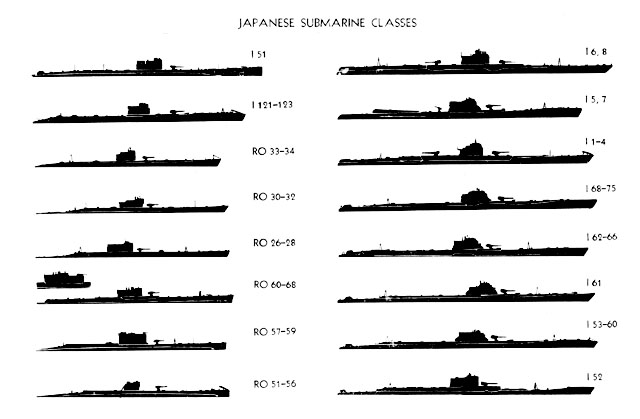
Most Japanese submarines fell into one of three families. The Junsen or cruiser submarines were developed for individual long-range patrol and reconnaissance, while the Kadai or fleet submarines were to operate in flotillas in conjunction with the surface fleet. The Ro were smaller coastal defense boats. Japanese submarines were generally somewhat larger than their Allied counterparts, but so much of their internal space was given over to equipment that their habitability was very poor, and Japanese submarine crews tired quickly on long patrols. Their large conning towers were excellent radar targets and their large size and lack of maneuverability reduced their ability to evade depth charge attack. Their crews had excellent night binoculars, giving them the same early advantage over the Allies in night actions as their surface forces, but this advantage eroded as the Japanese fell behind on radar development. Japanese submarines lacked radar until mid-1944, while even the American PT boats had small radar sets by the end of 1942. This caused great concern for the Japanese submarine commanders, who became increasingly fearful of being caught on the surface at night by light Allied forces.
A distinctive feature of the Japanese submarine fleet was the large numbers of submarines equipped to carry seaplanes or midget submarines.
The Japanese began experimenting with submarine seaplanes as early as
1923, and these experiments reached their culmination with the Third
Naval Replenishment Plan (1937). This called for the construction of
three classes of submarines by October 1941, to be formed into balanced long-range attack groups. The A1s were intended to direct scouting operations by B1 and C1
class submarines, the former specialized to locate targets and the
latter to carry out attacks. The A1s and B1s would carry seaplanes to assist in their command and reconnaissance roles, while the C1s carried midget submarines to join in their attacks. However, the only time the complete attack groups operated
in a manner that much resembled this prewar plan was in the attack on Pearl Harbor, although Kawano Chimaki led Submarine Squadron 3 in a short campaign against merchant shipping off southwest Australia from the A1 class submarine I-11 in July 1942.
The remainder of the Japanese submarine fleet was divided into coastal defense (Ro), cruiser (Junsen) and fleet (Kaidai) submarines of various classes. Cruiser submarines were designed to have great range and large torpedo loadouts. They differed from the faster fleet submarines in that the Kadai were intended to operate with the fleet, while the Junsen were to operate independently in distant waters.
In contrast to the Allied advantages of superior
intelligence and better
antisubmarine defenses, the Japanese had a definite
advantage in their excellent submarine torpedo, the Type 95, which was
vastly superior to the miserable American Mark 14. Although some Japanese submarine commanders claimed
that American merchantmen sometimes escaped destruction in shallow
coastal waters, due to a tendency for Japanese torpedoes to run as much
as 100 feet (30 meters) too deep before leveling off at the correct
depth, the reliability, range, and explosive power of Japanese
torpedoes were much superior to those of American torpedoes throughout
the war.
Although there is no evidence that the Japanese had any qualms about attacking merchantmen, Japanese submarine doctrine strongly emphasized attacks on warships. This was in keeping with the Japanese focus on the decisive battle that was supposed to be fought between the main Japanese and American battle lines somewhere in the Western Pacific. In order to compensate for the anticipated numerical superiority of the American fleet, the Japanese planned to wear down the Americans with attacks by submarines, light surface forces, and aircraft as the American Fleet crossed the Central Pacific. Thus, Japanese submarines were to carry out long-range surveillance of the American battle fleet, beginning from the moment it left port, then shadowing the American fleet while awaiting opportunities to ambush the Americans and wear down their battle line. The Japanese also expected to fight a short war, while commerce raiding was a strategy appropriate for the kind of prolonged war the Japanese rightly feared they could not win. As a result, Japanese submarines did not initially concentrate against the long and vulnerable Allied supply lines.
This was unfortunate for the Japanese. Although their
submarines had some notable successes
during the war,
particularly the sinking of the Wasp
during the Guadalcanal campaign,
the employment of Japanese submarine forces was characterized
by inflexibility and indecisiveness. Whereas most other elements of the
Japanese Fleet had rehearsed their tactics during maneuvers, the
submarine fleet did not seriously test its own tactical doctrine until
1938. When the tactics were finally tested in maneuvers, they were found seriously wanting. A large number of submarines were ruled to have been destroyed
by submarines; others gave away their positions by breaking radio
silence; and many missed both the radio instructions transmitted to
them and the "enemy" fleet.
The lessons drawn from these exercises included an
excess of caution uncharacteristic of the Japanese Navy and an emphasis
on the use
of ever-shifting picket lines. The use of picket lines persisted long
after these had
proven vulnerable to Allied hunter-killer groups, which were often
guided to their victims by Ultra
intelligence. The
use of wolf packs seems never to have been a part of Japanese submarine
doctrine; even when submarines were deployed in picket lines, the
submarines attacked individually. This is particularly puzzling given
the construction of the A1 command submarines and of a light cruiser (the Oyodo) specifically for command of submarine flotillas at sea. The small number of A1s completed and the uniqueness of Oyodo suggests that the Japanese concluded that the concept was unworkable. Some of the poor management of Japanese submarine
forces may have arisen from the fact that the submarine staff officers,
even at the highest levels, were no higher in rank than commander, and
so had little clout.
The inadequate tactical doctrine was partially the fault of Suetsugu
Nobumasa, "father of Japanese submarine strategy" (Evans and Peattie
1997) in the 1920s, who was not actually a submariner.
In April 1942, with the relief of Shimizu Mitsumi by Komatsu Teruhisa as commander of the main Japanese submarine force, greater emphasis was placed on attacking merchant shipping. Those Japanese submarine squadrons that were deployed against merchant shipping, usually along the Australian coast or in the Indian Ocean, did well enough (125 merchant ships sunk in 1942) to show what might have been accomplished by the Japanese submarine fleet had it been trained in commerce raiding. However, Allied antisubmarine weapons and tactics were sophisticated almost from the start of the war, and Japanese submarines suffered heavily. It did not help that Japanese submarines tended to be rather slow-diving, both because they tended to be large and because they had excessively complicated linkages in their propulsion systems.
Another
misuse of Japanese submarines was their
employment in transport operations to isolated garrisons. This became
the major activity of the submarine force after 16 November 1942, when
all available I-boats were placed under the command of Mito Hisao at Rabaul to carry out supply operations (mogura, "mule", operations) in the Solomons and New Guinea.
A seaplane-equipped I-boat could carry more than fifty tons of cargo in
place of its aircraft facilities, and by the end of the Guadalcanal
campaign, the sixteen I-boats assigned to the operation carried 1500
tons of supplies to the island. Another 95 supply runs carried 3500
tons of cargo to New Guinea by September 1943. However, the runs were
extremely unpopular with the submarine crews, whose morale plummeted.
A special
kind of container, called unkato,
was developed that could be towed by a submarine and released to
(hopefully) float ashore. The unkatowas
a cylindrical container 135 feet (41 meters) long and 16 feet (5m) in
diameter that could carry about 300 tons of cargo. Few actually
reached their destinations, and as many as 25 submarines were lost on
such missions. The Japanese also developed the unpoto,
a kind of sled 71 feet (22m) long and 13 feet (4m) wide driven by two
torpedo bodies that could carry an infantry gun and its ammunition
(over 20 tons of cargo) about two miles (3 km) before exhausting its
fuel.
From November 1944 on, the emphasis switched again, this time to the use of kaiten suicide torpedoes against Allied bases or (from April 1945 on) sea lines of communication. This proved costly and ineffective, with several of the mother ships sunk before they could deploy their kaiten.
Japanese submarines finally started receiving radar in 1944, beginning with I-15 on 15 May. Submarine radars were the Type 13 air search radar and the Type 22 surface search radar. A few Japanese submarines, such as those of the Sen-toku class, were fitted with schnorkels. Originally invented by the Dutch in 1935 as the snuiver, and fitted to all Dutch submarines by 1939, the schnorkel
was a tubular air pipe that could be extended out of the water by a
submerged submarine to allow its diesel engines to run underwater. This
significantly increased the stealth of the submarine, but the Allies
learned to detect the schorkels on German U-boats visually and by radar (the schorkel
kicked up a large "feather" of water) and the Japanese version proved
to have little tactical significance. They were never popular with
crews, since the rapid changes of air pressure when a wave crashed over
the schnorkel sometimes burst ear drums, and the schnorkel significantly reduced underwater speed.
Because submarines were outgunned
by almost all surface warships,
the usual response of a submarine to a threat was to attempt to
submerge and evade. Antisubmarine warships thus needed the capability
of locating a submerged submarine, and suitable weapons for destroying
it, once located. Submarines could be located using various forms of
sonar and destroyed using either depth charges or antisubmarine
mortars, such as Hedgehog. Depth
charges were dropped or thrown on the estimated position of the
submarine after being set to explode at its estimated depth, and relied
on the powerful shock wave generated by their large explosive charge to buckle the
hull of any nearby submarine. Antisubmarine mortars fired smaller charges
fitted with contact fuses that had to actually hit the submarine to
destroy it. The Americans also developed an acoustic homing
torpedo for use against submarines, the Mark 24 or "Fido", and a submarine version of this torpedo (the Mark 27) saw service late in the Pacific War.
Detecting the presence a submarine usually required spotting its torpedo tracks or the wake of its periscope. Detecting a submarine with hydrophones was quite difficult, and detecting it with active sonar was all but impossible. Sonar was highly directional. This allowed sonar to get a good bearing on its target, but it also limited the usefulness of sonar for search, since it took several seconds to listen for a return on a single bearing. The sonars of the Pacific War were thus fire control systems rather than search systems, with effective search sonars not becoming available until 1946. Range was also limited, rarely exceeding 3000 yards (2700m) even under the most favorable conditions. Sonar was generally ineffective at speeds over about 10 knots, requiring "sprint and drift" tactics in which the antisubmarine warship had to periodically slow almost to a stop to make best use of its sonar. Early sonars could not determine depth with any accuracy and were unable to track a target immediately underneath the sonar. Thus, a submarine could sometimes evade a depth charge attack by maneuvering sharply just as the attacker passed overhead and lost sonar contact. The depth charge explosions themselves blinded sonar, and a submarine that survived a depth charge attack could sometimes break contact behind the "wall" of sonar interference created by the depth charges.
The British developed the "creeping attack" to overcome these
deficiencies. One antisubmarine ship would maintain sonar contact with
the sub while guiding a second antisubmarine ship that closed in at low
speed with its own active sonar turned off. This form of attack was
extremely difficult for the submarine to evade. Another effective
technique was to "crowd" the submarine with three escorts saturating
the target area with depth charges.
Aircraft proved highly effective for antisubmarine work. Because submarines had only a very limited speed and endurance when submerged, they cruised on the surface and were vulnerably if surprised by a patrolling aircraft. Even if they crash dived in time to avoid air attack, their effectiveness was greatly reduced because they could not search for distant merchant ships or maneuver to attack them while submerged. The ideal antisubmarine aircraft had a long range for extended patrols; had adequate sensors for detecting submarines; could loiter at low speed over a suspected contact; and could carry a large number of depth charges. Both sides in the Pacific used flying boats and long-range bombers in the antisubmarine role, but the Japanese also built a dedicated antisubmarine aircraft design (the Q1W "Lorna") and experimented with antisubmarine autogyros. The latter had inadequate range and carrying capacity, but prefigured the more effective antisubmarine helicopters of the postwar world.
There was considerable controversy early in the war over the best tactics for defending patrolling task forces from enemy submarines. It was widely recognized that such forces should avoid crossing their own tracks, but a force patrolling a specified area for any length of time found it difficult to avoid doing so. There was also controversy over the best speed for such patrols. Warships traveling at 15 knots or better made it difficult for submarines to make a successful approach, but sonar performance began to be seriously degraded at this speed. Fletcher was seriously criticized following the torpedoing of Saratoga, because he had crossed his track and had set his speed at 13 knots to give his sonar operators a better chance to detect enemy submarines. Even so, I-26 was so close to the destroyer screen that it was accidentally rammed by one of the destroyers shortly after firing its torpedoes, yet it was not detected until the torpedo wakes were spotted by lookouts.
Japanese antisubmarine tactics were primitive early in the war and did not improve nearly fast enough. Ironically, the Japanese squadron in the Mediterranean during the First World War had gained extensive experience in convoy escort, but the lessons were forgotten and the experience squandered after the war.
After the war ended, the U.S. Navy carefully analyzed the 110 incidents in which its submarines were significantly damaged on patrol (excluding those actually lost). Of these, 58 were due to depth charging; 25 were due to aircraft bombs; eight involved both bombs and depth charges; ten were due to gunfire; four were from collisions; two submarines were damage from the explosion of the submarine's targets; and one each was damaged by mines, kamikazes, or the submarine's own malfunctioning torpedo. It seems likely that mine and malfunctioning torpedo damage are underrepresented because of the high likelihood of submarine not surviving.
References
Stevens (2005; accessed 2013-9-3)
The Pacific War Online Encyclopedia © 2007-2013, 2015 by Kent G. Budge. Index