 The Pacific War Online Encyclopedia
|
| Previous: Escambia Class, U.S. Oilers | Table of Contents | Next: Escort Vessels |
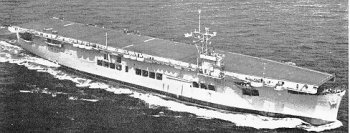
Escort carriers were developed by the British as a response to the deadly U-boat threat in the Atlantic. Their direct ancestor was the MAC, a cargo ship equipped with a catapult with which to launch a Hurricane fighter if the convoy containing the MAC was shadowed by German reconnaissance aircraft or attacked by long-range bombers. The concept was a desperate one: The fighter had no way to land once its mission was complete, so the pilot either had to be close to a land base, or he had to ditch in the water near his ship and hope for the best.
The next logical development was conversion of a
cargo ship to a small carrier
by the addition of a flight deck. As it became clear that air
cover was
an effective force multiplier
against
submarines, the idea of a
small,
cheap carrier that could provide such
air
cover became increasingly attractive. The British build
several
experimental escort carriers that demonstrated the soundness of
the
concept.
Roosevelt followed the British experiments with great interest and asked the U.S. Navy to explore the concept. Kimmel, commanding Pacific Fleet at Pearl Harbor, also requested in a 22 October 1941 report to Stark that a cargo ship be "converted to a carrier for training purposes at San Diego" (Prange 1981). The result was Long Island, which found itself assigned to the Pacific in an aircraft-ferrying role. This proved sufficiently valuable that the Navy began constructing entire classes of escort carriers. Sometimes called “jeep carriers” because they were small, mass-produced, and versatile, the escort carrier crewmen also grimly joked that the type designation (CVE) stood for “Combustible, Vulnerable, and Expendable.” They were cramped and uncomfortable, and flight operations were always hairy. Nevertheless, the ships were a success. During one six-month period, escort carrier aircraft sank 31 U-boats, over half of all U-boats destroyed by the U.S. Navy during that time period.
Because the Japanese
failed to
effectively deploy their submarines against Allied shipping lanes, the
escort
carriers assigned to the Pacific were able to branch out from the
antisubmarine
role. They accompanied
amphibious invasion
forces, flying ground support missions
while also providing
combat air and antisubmarine patrols. They provided replacement
aircraft to the fleet
carriers, allowing the latter to remain on station
longer, an idea that apparently originated with Nimitz. Those
converted for delivery of replacement aircraft
were unofficially designated CVET. The CVETs also returned a small
number of moderately damaged aircraft (about 212 by the end of the
war)
to the West Coast for salvage.
The Japanese badly needed escort carriers of their own, given the threat posed by American submarines to Japanese shipping. They had a number of small carriers that would have been ideal for this role, and built more, but it was not until much too late in the war that these carriers were actually employed in this fashion.
References
The Pacific War Online Encyclopedia © 2007-2009, 2011, 2014 by Kent G. Budge. Index