 The Pacific War Online Encyclopedia
|
| Previous: Kiland, Ignolf N. | Table of Contents | Next: Kimura Heitaro |
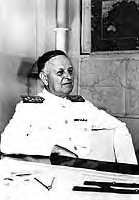
Naval Historical Institute #82800
Husband Kimmel ("Kim" to his friends) was born
at Henderson, Kentucky, and
graduated from the Naval Academy in 1904 after failing to get an
appointment to West Point. He served on several battleships, including Georgia during the world cruise of
the Great White Fleet. He was wounded
during the Vera Cruz expedition.
He served as an aide to Assistant Secretary of the Navy and future
President Franklin D.
Roosevelt
just prior to the First World War. During the war, Kimmel taught
gunnery and served as
squadron gunnery officer with the American
squadron assigned to
work with the British Grand
Fleet. Between the wars, he attended the Naval War College, commanded destroyer squadrons and
battleships, and was promoted to rank of rear admiral in November 1937.
He then commanded cruiser
formations until being selected over 46 more senior admirals to the
position of Commander in Chief, U.S.
Fleet (CINCUS).
Thus it was that Kimmel had the bad fortune to be in command of the fleet at Pearl Harbor on 7 December 1941. It was perhaps inevitable that he would be relieved shortly after the Pearl Harbor disaster and called to answer before numerous investigative committees. Historians still argue over whether he deserved to be relieved and retired or was simply a scapegoat for the pervasive lack of American preparedness.
Amid the controversy, a few facts seem fairly clear. Kimmel was a good naval officer, aggressive and capable. His behavior following the attack on Pearl Harbor was that of a leader who was not easily rattled and sought to take the fight to the enemy. Many of his contemporaries felt that what happened to Kimmel could have happened as easily to any of them. Nimitz, his successor, was particularly outspoken in his opinion that Kimmel did not deserve to be treated so ignominiously. Kimmel did not get full intelligence from Washington, and he lacked sufficient aircraft to adequately patrol the area around Hawaii.
However, it is also clear that Kimmel had a pronounced "can’t happen here" attitude that affected his defense preparations. He was sent a message shortly before the attack that began with "This dispatch is to be considered a war warning." Rather than alert the fleet to imminent hostilities, he focused on the list of potential Japanese targets in the message, which happened not to include Hawaii, and concluded that Pearl Harbor was a secure base. On the other hand, Kimmel also began planning for early raids against the Marshall Islands to relieve the expected pressure on the Philippines, which under other circumstances might have been a very reasonable course of action.
Kimmel’s relief was unnecessarily abrupt and damaged the early war effort. Kimmel was organizing an aggressive relief expedition to Wake Island when he was ordered to turn command over to Pye, his battleship commander, until Nimitz could get to Hawaii. This interim change of command was certainly unnecessary. Pye, who as interim commander seemed concerned mostly with avoiding any more disasters, called off the relief expedition. Some historians believe that if Kimmel had been allowed to retain command until Nimitz arrived, the relief expedition would likely have resulted in a badly-needed American victory in the first month of war.
On 26 January 1942 a Board of Inquiry concluded
that Kimmel was guilty of dereliction of duty. Further hearings
continued
through 1946, and while the findings against Kimmel were softened
slightly, he never escaped official blame for the debacle at Pearl
Harbor. Compelled to retire from the Navy, he put his considerable
energy and talent to work at Frederic R. Harris Company, a New York
shipbuilding firm, preparing floating
dry dock blueprints. Harris later claimed that Kimmel's knowledge
of battleships was of great value in designing the dry docks needed to
support the great Central Pacific offensive.
Kimmel was known for his emphasis on efficiency and routine, but he also gained a reputation for honesty, courtesy, and charm while dealing with Congress as Navy budget officer in the 1930s. He was highly knowledgeable on naval history, strategy, and tactics but not particularly creative. Though capable of laughing at a joke, he lacked any real sense of humor. However, he was no hidebound traditionalist: He broke longstanding Navy tradition by moving his headquarters ashore from flagship Pennsylvania, which greatly improved communications security. He also understood the diminished role of battleships, writing on 26 May 1941 (Prange 1988):
In the Pacific, our
potential enemy is far away and hard to get at ... and has a system of
defense ... that requires landing
operations, supported by sea forces, against organized land positions
supported by land-based air. This is the hardest kind of opposition to
overcome.... It also requires a preponderance of light force and carrier strength, in which
we are woefully deficient in the pacific. Our present strength is in
battleships — which come into play only after we have
reduced the
intervening organized positions....
Kimmel won the loyalty of his staff and
subordinates, whom he encouraged to speak freely and show initiative,
but preferred a good book in his cabin to wardroom socializing. He had
a temper, which when provoked led him to throw the nearest book at a
bulkhead or to stamp on his hat. Eventually a junior officer stood by
with a spare hat for him to stamp on on such occasions.
| 1882-5-14
|
Born in Henderson, Kentucky |
|
| 1904 |
Graduates from Naval Academy,
standing 13th in a class of 62 |
|
| 1926 |
Captain |
|
| 1933 |
Commander, BB New
York |
|
| 1934 |
Chief of staff, Battleships,
Battle Force |
|
| 1937-11 |
Rear
admiral |
|
| 1938-7 |
Commander, Cruiser Division 7 |
|
| 1939 |
Commander, Cruisers, Battle Force |
|
| 1941-2-1 |
Admiral |
Commander, Pacific Fleet |
| 1941-12-17 |
Rear
admiral |
Relieved |
| 1942-5-1 |
Retired |
|
| 1968-5-14 |
Dies at Groton, Connecticut |
References
Navy Historical Center (accessed 2007-11-20)
The Pacific War Online Encyclopedia © 2006, 2009 by Kent G. Budge. Index