 The Pacific War Online Encyclopedia
|
| Previous: King, Edward P., Jr. | Table of Contents | Next: King, W.L. Mackenzie |
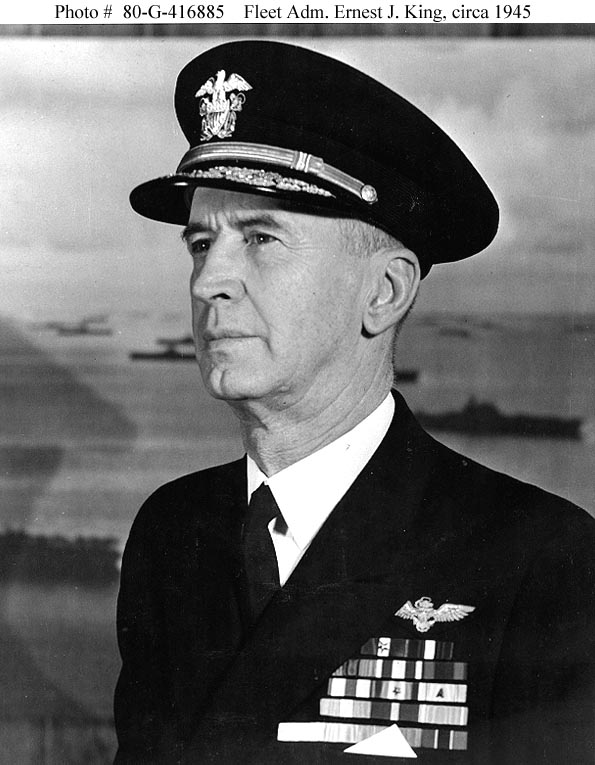
Naval Historical Center # 80-G-416885
Ernest J. King was born in Ohio, the son of a former seaman turned railroad shop foreman. He graduated fourth in his class from Annapolis in 1901, having seen service in the Spanish-American War as a midshipman. He was an observer with Japan during the Russo-Japanese War and commanded a destroyer in the occupation of Vera Cruz in 1914. He became a specialist in submarines after World War I, but in 1928 he became one of several senior officers to qualify as an aviator in order to be eligible for carrier command (Halsey was another). In particular, he was the only candidate for chief of the Bureau of Aviation in 1933 who was flight qualified, which got him an early promotion to rear admiral. He also graduated from the Navy War College in 1933. He was promoted to vice admiral in 1938 and command of Aircraft, Battle Force.
In 1939, Stark
was chosen over King as Chief of Naval Operations and King was
relegated to the Naval Board, the traditional final tour of
retiring admirals. However, King headed a study that revealed the
antiaircraft deficiencies
of the Fleet and their remedies. This so impressed Charles Edison,
the Secretary of the Navy, that he recommended King to Roosevelt as the
officer best suited to shake the Navy out of its peacetime
complacency. Roosevelt eventually promoted King to full admiral
and commander of the Atlantic Fleet, where King played a major
role in the undeclared war against the German U-boats.
Following the disaster at Pearl Harbor, Roosevelt shook up the top Navy command. King was chosen on 20 December 1941 to relieve Kimmel as commander in chief, U.S. Fleet. President Roosevelt then pushed through legislation to allow King to serve as Chief of Naval Operations as well, replacing Stark, in whom the President had lost confidence, on 26 March 1942. King served in both posts for the duration of the war.
King made himself commander of 10 Fleet, a paper
organization responsible for coordinating antisubmarine efforts in
the Atlantic, after taking sharp criticism for failing to
institute convoys. Like
many other officers on both sides of the Atlantic, King failed to
understand at first what advantage there could be to convoying in
the absence of adequate escort, in spite of British experience
showing that even unescorted convoys were better than no convoys
at all.
Most historians have assumed that King’s real interest
lay in the Pacific, the focus of the Navy’s planning for two
decades. However, Larrabee (1987) argues that King was an incisive
global strategist who fully
understood and supported the "Germany
First" policy. But King also understood that there is no such
thing as a defensive war at sea, and he pushed for the allocation
of resources to the Pacific sufficient to support an aggressive
strategy of spoiling
attacks and limited offensives. These would keep the
Japanese off-balance until the Navy was strong enough for a
full-blooded counteroffensive. King also believed, as apparently
did Lord Beaverbrook as early as ARCADIA,
that there would be enough munitions for offensive action in both
the Pacific and Europe once American industry was brought up to
full war production.
Although the new Pacific Fleet commander, Chester Nimitz, was one of the finest admirals the United States Navy ever produced, King kept him on a somewhat short leash. It was King who dictated the early Pacific strategy of carrier raids against the Japanese perimeter: King had shrewdly evaluated early Japanese operations, concluding that they were carefully planned but rigidly executed and susceptible to being unhinged by the unexpected. This strategy bore scant fruit at first, for the perverse reason that Japanese planning was so rigid that the Japanese were almost incapable of reacting to diversionary attacks. However, the Doolittle Raid ultimately vindicated King's strategic vision, by removing the remaining opposition in Japan to the ill-considered and ultimately disastrous Midway operation. King then found the wisdom and forbearance to let Nimitz fight the Midway battle his own way. It was King who instigated the decisive Guadalcanal campaign and who saw to it that the rapidly expanding fleet began to put Plan Orange into effect in late 1943. However, King lost the political struggle with MacArthur over whether Luzon or Formosa should be the objective of the converging Pacific offensives.
King had a reputation as a sundowner, Navy slang for a
brutal disciplinarian. "Once Ernie King got down on someone,
he never changed his mind. Only first impressions counted"
(Lundstrom 2006). One manifestation of this was his pledge that no
officer who lost his ship
would ever be given another ship to command, regardless of
circumstances — a promise he came very close to keeping.
King's ruthlessness reached a climax in in July 1944, when he
toured Hawaii and Saipan and thoroughly shook up
the leadership of Pacific Fleet. Although King was unwilling to go
as far as John Towers,
who loudly argued that all top commands should go to aviators
(which, not incidentally, would have Towers relieving Nimitz as
commander of Pacific Fleet), King did decree that all commanders
who were not aviators should have chiefs of staff who were, and vice versa.
King was also vulgar, arrogant, and a heavy drinker,
with a terrible reputation for chasing skirts (he is alleged to have
made a pass at the wife of a subordinate during a formal
dinner.) However, after the sinking of Reuben James, he
pledged to abstain from alcohol
for the duration, and it is thought that he fell off the wagon
only two or three times during the war. He was also, in
common with many other brilliant men, a poor delegator. In spite
of his faults, he was an exceedingly capable organizer and
administrator and made a great contribution towards winning the
war. He had a knack for technology, a remarkable memory, and the
versatility to qualify in both submarines, destroyers, and
aircraft. Larrabee (1987) concluded that "The strongest mind
within the American Joint Chiefs of Staff was the mind of Ernest
J. King."
In many respects King was the polar opposite to Yamamoto, who did not
drink but was a fatalist who loved gambling. By contrast, King was
a "calculating unsentimental opponent ... once described by an
admirer as the 'perfect human machine'" (Marston 2005) who left
nothing to chance or to fate.
King opposed the planned
invasion of Japan but also disliked the development of nuclear bombs: "...
didn't like the atomic bomb or any part of it" (Larrabee 1987). An
admirer of Stilwell,
he lost much of his enthusiasm for a landing on the China coast in support of the
blockade of Japan after Stilwell was recalled. He also came around
to the view that Russian
intervention against Japan was no longer desirable. He was among
the first to recognize the leadership qualities of Truman when he succeeded
to the presidency on the death of Roosevelt.
Promoted to fleet admiral on 17 December 1944, King
retired in December 1945 to serve in important advisory capacities
and write his memoirs.
| 1878-11-23
|
Born at Lorain, Ohio |
|
| 1901-6-7 |
Midshipman |
Graduates from Naval Academy,
standing 4th in a class of 67 |
| 1903-6-7 |
Ensign |
|
| 1906-6-7 |
Lieutenant
|
Instructor, Naval Academy |
| 1909 |
Staff, Battleship Division 2 |
|
| 1910 |
BB New Hampshire |
|
| 1911 |
Staff, Atlantic Fleet |
|
| 1912 |
Commander, Engineering
Experimental Station, Annapolis |
|
| 1913-7-1 |
Lieutenant
commander |
|
| 1914-4-30 |
Commander, DD Terry |
|
| 1914-7-18 |
Commander, DD Cassin |
|
| 1916 |
Staff, Atlantic Fleet |
|
| 1917-7-1 |
Commander |
|
| 1918-9-21 |
Captain |
|
| 1919-5-1
|
Superintendent, Naval
Postgraduate School |
|
| 1921-7-7 |
Commander, Bridge |
|
| 1922 |
Qualifies as submariner |
|
| 1922-11-20
|
Commander, Submarine Division
11 |
|
| 1923-9-4 |
Commander, New London
Submarine Base |
|
| 1926-7-28 |
Commander, Wright |
|
| 1927-1 |
Flight training, Pensacola,
Florida |
|
| 1927-5-26 |
Completes flight training |
|
| 1927 |
Commander, Wright | |
| 1928-8 |
Assistant chief, Bureau of
Aeronautics |
|
| 1929-5-24 |
Commander, Hampton Roads
Naval Air Station |
|
| 1930-6-20 |
Commander, Lexington |
|
| 1932 |
Naval War College |
|
| 1933-4-26 |
Rear admiral |
Chief, Burea of Aeronautics |
| 1936-6-15 |
Commander, Aircraft, Base
Force |
|
| 1937-10-1 |
Commander, Aircraft, Scouting Force |
|
| 1938-1-29 |
Vice admiral |
Commander, Aircraft, Battle
Force |
| 1939-7-1 |
General Board |
|
| 1941-12-17 |
Commander, Patrol Force, U.S.
Fleet |
|
| 1941-2-1 |
Admiral |
Commander, Atlantic Fleet |
| 1941-12-30
|
Commander, U.S.
Fleet |
|
| 1942-3-26 |
Chief
of
Naval Operations / Commander, U.S. Fleet |
|
| 1944-12-17
|
Fleet Admiral |
|
| 1945-12-17 |
Retires |
|
| 1956-6-26 |
Dies at Portsmouth Naval
Hospital, New Hampshire |
References
Naval
Historical Center (accessed 2008-1-11)
The Pacific War Online Encyclopedia © 2007-2008, 2010, 2018 by Kent G. Budge. Index