 The Pacific War Online Encyclopedia
|
| Previous: Wolfe, Kenneth B. | Table of Contents | Next: Wonsan |
National Archives. Via ibiblio.org
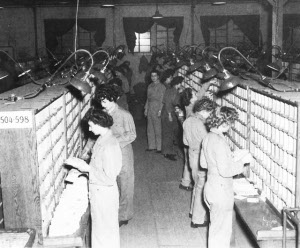
Women have historically been victims of warfare rather than participants. This mostly remained true during the Second World War. Women as combatants were limited to some Russian units in Europe and to last-ditch militia units in Japan that never saw combat. However, the major Western powers, the United States and Britain, employed significant numbers of women in noncombat military roles, and both these powers and Japan employed large numbers of women as part of the wartime labor force.
The Nurse Corps had been
part of the Army long before the Pacific
War, but in early 1941 Congresswoman Edith Nourse Rogers of
Massachusetts introduced a bill to establish a Women's Auxiliary
Army
Corps. This did not receive serious attention until after the
attack on
Pearl Harbor. After a
long and
bitter debate, the WAAC Bill was passed on 14 May 1942 and signed
into
law the next day. The WAAC was distinct from the Army and had its
own
rank structure. Women officers were not authorized to command men and
pay was significantly less for women than for men of equivalent
rank.
Authorized enrollment was 150,000.
WAACs performed duties ranging from air warning observer to file clerk to aircraft ferry pilot. As the war progressed and manpower became scarcer, the Army found more and more positions where exposure to enemy action was not anticipated and which did not require strength, endurance, or skills beyond a woman's ability. Every such position filled by a woman freed up a male soldier for more hazardous duty. The program was generally regarded as a success, and on 3 July 1943 a law was passed converting the WAAC to the Women's Army Corps, a part of the regular Army with pay, privileges, and theoretical legal protection if taken prisoner equal to that of the rest of the Army.
On 30 July 1942 a law was passed that created the WAVES, or Women
Accepted for Volunteer Emergency Service, the Navy counterpart to
the
WAC. These women were part of the Navy Reserve from the start, and
performed functions similar to those of the WACs.
Britain had similar programs, including the Women's Royal Naval Service known unofficially as the "Wrens". However, the Wrens did not become part of the regular Navy until 1993. The Auxiliary Territorial Service and Air Transport Auxiliary corresponded roughly to the ground and air branches of the WAC.
Women were heavily recruited into the labor forces of all the major powers in the Pacific. The U.S. labor force already included 13 million women in 1940 and had reached 18 million by 1944. "Rosie the Riveter" became a symbol of total national effort, though women constituted only about 10% of war workers. Britain also heavily recruited women into its labor force. Japan was reluctant to take women out of their traditional roles, but as the war situation worsened, women began to be drafted into the work force, sometimes in roles as strenuous as coal mining. Entire classes of Japanese teenage girls were taken to factories by their teachers to perform lighter work.
Ironically, the increased use of welding in place of riveting favored the employment of women in the U.S. shipbuilding industry, since welding plates on the ground or in jigs required less stamina than riveting plates within a partially complete ship's hull. Women made up 10 to 20 percent of the work force in most Maritime Commission shipyards. Women were actually found superior to men at installing electrical systems, for which fine finger work was required. However, while many women became leadermen, only one woman ever became a foreman. The general belief was that men would resent working under a woman.
Industries employing increased numbers of women struggled to
adjust. Work clothes were a problem; many women resisted wearing
slacks, and specialized clothing such as leather pants (for
welders), work gloves, and work boots were unavailable in women's
sizes. Catholic women
sometimes resisted removing their wedding rings, until priests
assured them that their sanctity would not be impaired. Hair was a
particular problem, as caps were too hot and hairnets were
inadequate to prevent long hair from being drawn into machinery.
The British made the discovery that their 1939 ban on cosmetics
reduced productivity significantly, and provisions were made for
cosmetics in both British and American manufacturing plants.
Factories that made accommodations for menstruation were able to
cut in half the time lost to menstrual difficulties. Pregnancy was
usually grounds for discharge, and abortion rings sprung up around
major factories employing women in the United States.
Outside of agriculture, participation by women in the work force seems to have been seen as a temporary emergency measure rather than as a permanent social shift. As the war began to wind down and production contracts were canceled, Congressional investigators found that fully 30% of women from closed munitions plants made no effort to seek employment elsewhere. Between January and May 1944, the number of women employed in manufacturing dropped by 134,000. Not until the 1960s would a majority of women of working age be part of the work force.
The Kuomintang found that rural women were not supportive of the war: "Women are conservative, and their outlooks are rooted in clan and countryside. They don't know the meaning of the War of Resistance" (quoted by Mitter 2013). The author of this report recommended that women be mobilized with propaganda about Japanese atrocities against women and children and put to work as nurses or in light industry.
Although both chaplains and medical officers attempted to discourage sexual promiscuity, rates of venereal disease among British soldiers rose to 49.4 per thousand troops in India by 1943. Venereal disease was also a source of casualties in the Philippines and, to a lesser extent, in Australia. One American division in Australia is reported to have set up a brothel with the connivance of its commander and medical officers, the latter regularly inspecting the women for infection.
A number of Japanese medical officers encouraged other solutions to the sexual frustrations of the soldiers. Whereas homosexual liaisons were criminal in the Western armed forces, they were not an offense under the Japanese military code and were actually encouraged by some Japanese medical officers. One prisoner of war captured on Attu estimated that 20% of the Japanese troops on the island engaged in homosexual relations. The practice apparently had some roots in the samurai tradition (Allen 1984).
Women and Sexual Assault. Rape has always been one of the most brutal aspects of warfare. The Western powers tried to eliminate this by making rape a capital offense, but enforcement was spotty in combat areas. Some Japanese nationalists have claimed that up to 10,000 rapes took place in Okinawa after its capture in early 1945, a figure deserving some skepticism. Even this figure pales in comparison to the estimated 200,000 "comfort women" forcibly or deceptively recruited by the Japanese Army, which also actively encouraged rape in places like Hong Kong immediately following its capture.
There is evidence that Russian troops engaged in widespread rape during and after their offensive in Manchuria in August 1945.
References
Bureau of Labor Statistics (accessed 2008-11-8)
Naval Historical Center (accessed 2008-11-8)
U.S. Army Center of Military History (accessed 2008-11-8)
The Pacific War Online Encyclopedia © 2008, 2011, 2014-2016 by Kent G. Budge. Index