The Pacific War Online Encyclopedia
|
| Previous: Adroit Class, U.S. Fleet Minesweepers | Table of Contents | Next: Agano Class, Japanese Light Cruisers |
Racism played a major role in the Second World War. The
ideology of Nazi Germany was
built on the belief that the Germanic peoples of northern Europe
were inherently superior to other races, and that the Eastern
European peoples in general and the Jews in particular were untermenschen (subhuman).
Likewise, Japanese nationalists
claimed that the Japanese were a divine race; that the Emperor was a direct
descendant of the Sun God, Amaterasu; and that it was Japan's
destiny to bring the eight corners of the world under one roof (hakko ichiu). Japanese
contempt for their Asian neighbors and their own burakumin became
increasingly manifest as the war in China
raged on and as Japan expanded its empire
across Southeast Asia.
The German and Japanese attitudes were the most extreme and murderous expressions of a general human disposition towards racism. Seen against this background, the widespread discrimination in the United States against Americans of African descent seems mild. This observation is not meant to condone racism, but to put the American racism of the 1940s in its proper historical context. Black Americans theoretically enjoyed the right to vote, to serve on juries, to hold public office, and to enjoy the equal protection of the law. In practice, these rights were regularly abridged in many areas of the country, particularly in the South, where racist attitudes were perpetuated by extralegal organizations such as the Ku Klux Klan. The legal doctrine of "separate but equal" public accommodations provided justification for widespread segregation of blacks and whites, and in practice the facilities for blacks were usually far from equivalent to those offered white Americans.
Underlying this widespread racism were real problems within the black community. The black slaves of the 19th century were denied any form of education, and their postbellum descendants continued to suffer from low levels of education up to the time of the Pacific War and beyond. Widespread poverty among Southern blacks also took its toll. Again, this observation is not meant to condone racism. The problems within the black community of the 1940s were not of their making. It is doubtful that persons of any ethnic extraction could have done better given the same history.
Eleanor Roosevelt, the President's wife, was outspoken against racism, and African-Americans, who were historically supporters of the Republican Party, were enthusiastic about the promises of the New Deal and switched to the Democratic Party in large numbers. In spite of this, the Roosevelt administration had a mixed record on promoting civil rights. Roosevelt did sign an executive order forbidding discrimination by race in defense industries, but he did not take positive action to end segregation in the military (believing it would erode on its own under the realities of manpower allocation) and he did not push anti-lynching legislation. It is likely Roosevelt felt he could not afford to alienate southern white Democrats, who were among his strongest supporters in Congress.
However, the sweeping social changes that came out of the war would not leave the black community untouched. For example, the practice of tenant farming (sharecropping) in the deep South, already in decline during the Depression, would be all but done away in the wave of agricultural modernization during the war, leading to a mass migration of poor Southern blacks to the cities of the North.
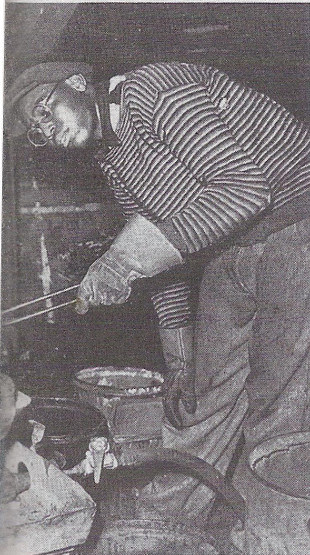
The war created new pressures to make use of blacks in industry. The responses to this pressure revealed a willingness to consider change but also showed how great the remaining barriers were.
In September 1941, about half of all job openings (51%) were
barred to black Americans. This varied somewhat by industry; the
chemical industry barred 69% of positions to blacks, while at the
other extreme, the shipbuilding industry barred 28% of positions
to blacks. Discrimination also varied by region, but not the way
one might expect: In Texas, 52% of defense industry jobs were
closed to blacks versus 82% in Michigan, 94% in Indiana, and 84%
in Ohio. Northern opposition seems to have centered around
powerful unions. The CIO was hindered from fostering equal
treatment of blacks by the opposition of its southern affiliates,
while the AFL did not even pretend to foster equal treatment.
Andrew Higgins, who operated Maritime Commission shipyards in the New Orleans area, was willing to make extensive use of black labor, but not to lower segregation barriers still common in the South. He proposed to operate two white assembly lines and two black assembly lines, separated by the fabrication shops, and with separate training schools for white and black workers. The labor unions, many of which had barred blacks from membership before the war, agreed to this plan so long as all foremen and supervisors were white. Higgins claimed that his plan would "... result in a competitive spirit between each of the lines, white to white on adjoining lines and black to black on adjoining lines, and a healthy and patriotic competition will be insured between the two production lines separated by the fabricating shops." The reluctance to put blacks in supervisory roles and to put blacks in direct competition with whites were not at all unusual for the time.
Racial tensions were evident in some of the Gulf Coast shipyards, The Mobile, Alabama, shipyard had a workforce that was just under one-third black, and blacks were increasingly moved into skilled positions and even as foremen. This created resentment among white workers, and the assignment of black welders to a ship construction way that had previously been all-white led to a riot in which several blacks were badly injured. Thereafter black ship workers were confined to four of the twelve ways. Lane (1952) concluded that the leadership necessary to change deeply-rooted cultural patterns simply did not exist in that area at the time.
Notwithstanding his segregated production lines, Higgins' use of
black labor put him on the progressive side of black employment.
Other companies that were relatively open to employing blacks
included Lockheed,
Wright, and
Western Electric. The Western Electric plant at Kearny, New
Jersey, did not segregate work assignments, cafeterias, or
restrooms, and reported no significant workplace conflict or
decline in work quality. The percentage of blacks employed in
industry had jumped from 4.2% in 1940 to 8.6% at war's end.
The massive war production centered in Detroit, Michigan, attracted some half million new workers to the area between 1940 and 1943. These included about 60,000 African-Americans. Housing was critically short, and the U.S. Housing Authority constructed two hundred houses for black families near Hamtramck, a Polish-American suburb. The existing residents did not want the new housing there, claiming that Communists were selecting the tenants. When twenty black families tried to move in in February 1942, they were blocked by a mob, and it was not until April that they were able to move in. Even then the move required the backing of a regiment of the Michigan National Guard.
On 20 June 1943 a fight broke out between white and black at
Belle Isle, a popular weekend picnic park. The riot spread into
Paradise Valley, and by the time it had been put down by 6000
federal troops, it had taken the lives of 26 blacks and 9 whites
and left another 700 injured. The Detroit riot sparked off similar
riots in Beaumont, Texas, and Harlem, New York City. The Beaumont
riot was brought to a halt by the local sheriff, Bill Richardson,
who met a lynch mob with a Tommy
gun and told them bluntly to get back to building ships to defeat the
Axis. By then one
black and one white were dead and another 50 injured. The Harlem
riot was brought under control by mayor Fiorello La Guardia, who
urged his police to exercise restraint and deputized 1500
African-American leaders to help restore order. Six blacks were
killed and another 300 hospitalized.
The U.S. Army was largely segregated throughout the Pacific War. Although African-Americans had volunteered for the Army at greater rates than white Americans, many American officers believed that blacks were unfit to be good soldiers, and even those who did not hold such racist views felt that racial tensions would reduce the cohesiveness and fighting power of integrated combat units. Secretary of War Henry Stimson reflected the common belief of the Army leadership when he declared that "Leadership is not embedded in the Negro race yet" (Fleming 2001). As a result, almost all blacks serving in the Army were assigned to "colored" units led mostly by white officers. Many of the officers involved considered their assignment degrading, and morale suffered accordingly. However, Congressman Hamilton Fish III of New York, who had commanded black troops in the First World War, was a champion of black servicemen (quoted in McRae 2010):
Fourteen millions of loyal Americans have the right to expect that in a war for the advancement of the 'Four Freedoms' their sons be given the same right as any other American to train, to serve, and to fight in combat units in defense of the United States in this greatest war in its history.
Many "colored" units fought with distinction in Africa and Europe, including a tank destroyer battalion and the famed Tuskegee Airmen. A company of African-American paratroopers was activated in December 1943 but its parent battalion, 555 Parachute Infantry Battalion, did not complete training before the war ended.
MacArthur was one
of the few theater commanders who welcomed black troops into his
command, ignoring pressure from the Australian government (with
its "White Australia" policy) to refuse to accept black troops.
However, "colored" units in the Pacific were almost never employed
in a combat role. One exception was 93 Division.
Notwithstanding the skepticism of many senior commanders, the division had performed
satisfactorily in training
and in the Texas-Louisiana maneuvers of 1943. 93 Division was
ordered to Hawaii in December
1943 over the objections of the Western
Defense Command commander, Delos Emmons, in order
to free a white division for combat. However, its orders were
changed almost at once to send the division to New Georgia, where Harmon had reluctantly
accepted its services.
From Munda a single battalion from the division, 1/24 Regiment, was deployed to the Bougainville perimeter in January 1944, and elements of the battalion reached the front line in March. For the most part, the battalion performed well in combat, but on 6 April a single inexperienced company from the battalion panicked when it came under fire during a routine patrol. Discipline broke down, troops from one platoon mistakenly fired on another platoon, and the company returned to the perimeter in considerable disorder. Such conduct was hardly unknown among inexperienced soldiers of any race, but the mistakes and confusion among the black troops was widely reported in the media, and rumor inflated the failure of a single company into an impression of poor performance by the entire division. 93 Division saw very little combat thereafter.
Most black troops in the Pacific were employed as service troops. These were certainly needed and made an invaluable contribution to ultimate victory. About a third of the troops working on the Alaska-Canada Highway and the Burma Road were black. Other blacks served in amphibious tractor battalions that played an important role in amphibious assaults.
In 1942, there was a mutiny at Townsville by African-American troops of 96 Engineer Battalion, who responded to abuse by two white officers by machine gunning the officers' tents. At least one officer was killed and several others wounded, and Australian troops had to be called in to put down the riot. Future president Lyndon B. Johnson visited the base for three days, apparently to defuse the situation. The mutiny was subsequently covered up and did not come to light for seventy years.
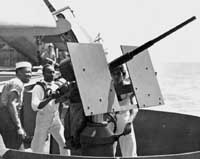
The Navy had been largely integrated, at least among its enlisted men and petty officers, until the First World War. The Wilson administration adopted policies that all but excluded blacks from the Navy, even replacing black mess stewards with Filipinos. It was not until the 1930s that blacks began to be quietly recruited into the Navy again. Though most served as mess specialists or in other stereotypical roles (such as in a jazz band at the Ulithi recreation center), there are no noncombatants on a warship, and segregation is difficult to enforce. Black sailors eventually won grudging respect from their white crew mates, opening the door a little wider to eventual desegregation of the armed forces.
The Marines were very reluctant to accept black recruits. However, once the necessity was forced on them, they quickly adapted. A black Marine was still a Marine. Although attempts were made to restrict black Marines to defense battalions and support services, black ammunition carriers served with distinction under fire at Saipan and began appearing in the front lines at Peleliu (Sloan 2005):
As the men of the supply unit picked up their weapons and fell into line behind their sergeant, Mulford tried to discourage them. "Nothing you people have seen this beach is gonna prepare you for the hell you're gonna face if you go with us," he said. "So don't say I didn't warn you."
"We can take it," the black sergeant assured him.
For the rest of the day, the African-American Marines made dozens of trips between the front lines and rear areas. They carried dead and wounded in one direction and hauled back ammo, food, and other supplies on their return trips. That night, they moved into vacant foxholes along the line and helped fight off a Japanese counterattack. The next morning, in several hours of bloody fighting, they charged and took an enemy-held hill shoulder to shoulder with what was left of I Company.
Andruski marveled at their courage, strength, and endurance....
A formation of black Marines, 8 Field Depot, helped turn back the final Japanese counterattack on Iwo Jima on 4 April 1945. Regrettably, the Marines would revert to a heavily discriminatory racial policy after the war.
Segregation sometimes went to such extremes as refusing to make good use of African-American physicians except in segregated hospitals and refusing to give "Negro" blood to white casualties. Many black servicemen took fierce pride in their service, but this was often mingled with bitterness over continuing racism. Black Americans knew they were fighting against enemies whose racism greatly exceeded that of their own countrymen, but such comparisons did not eliminate the sting of discriminatory treatment. Most blacks seemed to believe that their service in the war would entitle them to better treatment at home, a belief that came to be shared by enough white Americans that the armed forces would be desegregated within a decade and all other forms of legal discrimination repealed within a quarter century of the end of the war.
References
Bavas (2012; accessed 2012-2-12)
McRae
(20108-27; accessed 2013-9-8)
The Right to Fight: African-American Marines in World War II (accessed 2007-12-26)
The Pacific War Online Encyclopedia © 2007-2013, 2016 by Kent G. Budge. Index