The Pacific War Online Encyclopedia
|
| Previous: E14Y "Glen", Japanese Reconnaissance Floatplane | Table of Contents | Next: East China Sea |
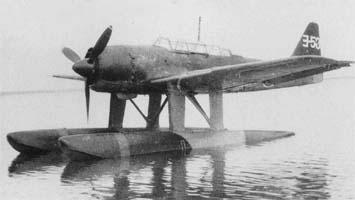
Aichi E16A1 Zuiun ("Auspicious Cloud") "Paul"
| Crew | Two in tandem cockpit |
| Dimensions | 42'0" by 35'7" by 15'9" 12.81m by 10.83m by 4.79m |
| Wing area | 301 square feet 28 square meters |
| Weight | 6,493-10,038 lbs 2945-4553 kg |
| Speed | 273 mph at 18,045 feet 439 km/h at 5500 meters |
| Cruising speed | 207 mph at 16,405 feet 333 km/h at 5000 meters |
| Climb rate | 35 feet per second 10.7 meters per second |
| Ceiling | 32,810 feet 10,000 meters |
| Power plant | One 1300 hp (970 kW) Mitsubishi MK8A Kinsei 51 14-cylinder air-cooled radial engine driving a three-blade constant-speed metal propeller. |
| Armament | Two wing-mounted 7.7mm Type 97 machine
guns One flexible 13mm Type 2 machine gun in the rear cockpit |
| External stores | 2 250 kg (551 lb) bombs |
| Range | Normal 731 miles (1180 km) Maximum 1,504 miles (2420 km) |
| Production | A total of 256 E16As
were
built.
Aichi Kokuki K.K., Eitoku: 59 E16A1 production aircraft (1944-8 to 1945-8) |
| Variants |
Late production aircraft were
powered by the 1300 hp (970 kW) MK8D Kinsei 54. This engine differed
little from the Kinsei 51 in performance. |
"Paul" was the replacement for the E13A "Jake"
but did not come into service before the
Japanese had lost control of the air. Requirements were first drafted
in 1939, before "Jake" had even come into full production, but
disagreements over the requirements prevented serious design work until
October 1940, when a team lead by Matsuo Kishiro and Ozawa Yasushiro
began drafting the new design. The prototype was completed in May 1942
and was of all-metal construction except for wingtips, tailplane and
some control surfaces. The wings could be folded for storage. The type
went into production in August 1943.
"Paul" suffered heavy losses in the Philippines, and most of the survivors were expended as kamikazes in the Okinawa campaign. Oddly enough, it was designed to be capable of dive bombing, being equipped with dive brakes on the forward float struts.
References
The Pacific War Online Encyclopedia © 2007-2009 by Kent G. Budge. Index