 The Pacific War Online Encyclopedia
|
| Previous: Pennsylvania Class, U.S. Battleships | Table of Contents | Next: Pensihu |
|
|
 ONI 222 |
| Tonnage | 9100 tons standard displacement |
| Dimensions | 585'6" by 65'3" by 18'4" 178.46m by 19.89m by 5.59 |
| Maximum speed | 32.7 knots |
| Complement | 631 |
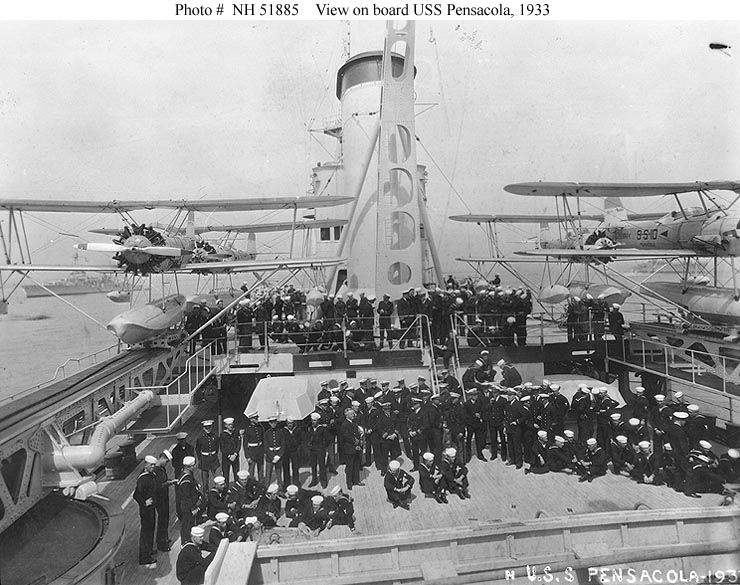
| Aircraft | 2
catapults 4 seaplanes |
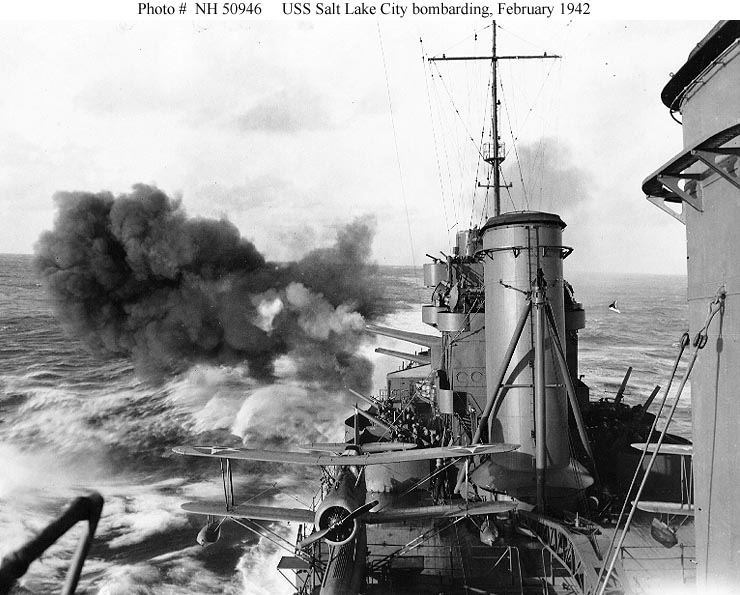
| Armament | 2x3, 2x2 8"/55
guns 8x1 5"/25 AA guns 2x4 1.1" AA guns 8 machine guns |
| Protection | 1090 tons: 3" machinery belt 3.5" aft magazine side 4" forward magazine belt 2.5" bulkheads 1.5" deck over machinery 1.75" deck over magazines 2.5"/1.5"/0.75"/0.75" turret front/roof/side/rear 0.75" barbettes 1.25" conning tower |
| Machinery |
4-shaft Parsons geared
turbines
(107,000 shp) 8 White-Forster boilers |
| Bunkerage | 2116 tons fuel oil |
| Range | 10,000 nautical miles (19,000 km) at 15 knots |
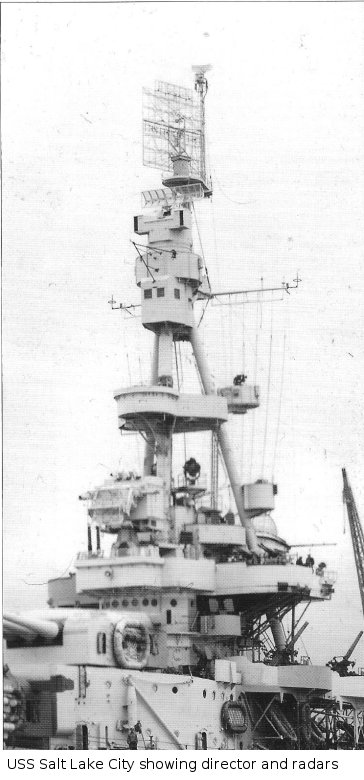
| Sensors | CXAM1 air
search
radar (Pensacola) |
| Modifications |
Radar was regularly
upgraded.
1942: Light antiaircraft upgraded to 4x2 1.1" guns and 8x1 20mm Oerlikon AA guns. 1943: 1.1"guns replaced with 4x4 40mm Bofors AA guns. 1944: Light antiaircraft upgraded to 6x4 40mm, 20 20mm guns and aircraft reduced to two seaplanes and a single catapult. |
Following the end of the First World War, the U.S. Navy saw a need
for
a new class of cruisers that
could outfight the British
Hawkins
class and had the radius of action needed for a Pacific conflict.
Although design studies began as early as 1919, the mood of the
country
was opposed to new armaments and no design was accepted before the
naval
disarmament treaties created the new category of heavy
cruisers,
which were limited to 10,000 tons displacement and 8" (203mm)
guns. The
Navy eventually looked at no less than seven designs ranging in
displacement from 5000 to 10,000 tons and armed with 5" (127mm) to
8"
(203mm) guns. A design began to emerge in November 1923 and was
finalized in March 1925 that would become the Pensacola class.
Like most American
cruisers built between the wars, the Pensacolas were built
with the utmost
economy
(costing $11 million apiece), were rather lightly armored, and were
somewhat
unstable. Their armament was fairly substantial, but the
barrels
were so close
together that the muzzle blast from adjacent barrels perturbed the
shells and
resulted in a rather high dispersion pattern. The guns were
mounted on a
single sleeve, so that they had to be elevated together. The ships
had the distinctive feature of triple turrets superfiring over
twin turrets, to better allow the lower turrets to fit within a
very slim hull. Fire control for the main battery was provided by
a Mark 18 director atop the main mast.
These ships used
mostly welded construction rather than riveting, a departure from
previous
practice. Machinery dispersal was good.
Extensive weight-saving measures brought the displacement well
below the 10,000 tons permitted by treaty, and some of the weight
allowance was
reincorporated in the form of increased protection.
The Pensacolas were
completed in 1929-1930. Although Pensacola was laid down
first, Salt Lake City was launched and completed first,
and so some authors describe the class as the Salt Lake City
class. Like most American cruisers, the Pensacolas landed
their
original torpedo
armament prior to the
outbreak of war in the Pacific.
Both ships survived the war.
|
Pensacola Convoy, near Phoenix Islands en route Philippines |
|
|
Task Force 8 (Halsey, Enterprise) returning from Wake |
 |
 |
 |
 |
 |
 |
References
Gogin
(2014; accessed 2014-3-19)
The Pacific War Online Encyclopedia © 2007, 2009, 2012-2014, 2016 by Kent G. Budge. Index
