 The Pacific War Online Encyclopedia
|
| Previous: Izumi | Table of Contents | Next: J1 Class, Japanese Submarines |
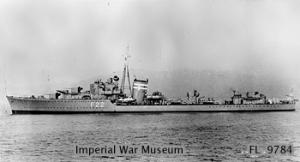
Imperial War Museum. Via Wikipedia Commons
| Tonnage | 1690 tons standard displacement 2330 tons fully loaded |
| Dimensions | 348' by 35' by 9' 108.6m by 10.8m by 2.7m |
| Maximum speed | 36 knots |
| Complement | 220 |
| Armament | 3x2 4.7"/45
guns (250 rounds per gun) 1 4"/45 DP gun 1x5 21" torpedo tubes 4x1 40mm/40 AA guns 4x1 20mm Oerlikon AA guns 1 depth charge track (20 depth charges) 2 depth charge throwers |
| Machinery |
2-shaft Parsons geared turbine
(40,000 shp) 2 Admiralty 3-drum boilers |
| Bunkerage | 484 tons fuel oil |
| Sensors |
Type 285 radar Type 286P radar |
| Range | 5500 nautical miles (10,200km) at 15 knots |
| Modifications |
1942: Type 291 radar
Numerous and variable modifications as the war progressed, including restoring a second bank that had been removed in 1941 and adding a few more 20mm guns, updated radars, and HF/DF. |
The "J" class or Javelins were
completed in 1939-1941. The
design was developed partially in response to criticisms of the
previous "Tribal" class,
which was
thought to be too large and too gun-oriented. The new design was
smaller and more balanced, though the desire to use a dual-purpose main
armament was thwarted by the lack of a really suitable weapon.
The ships were somewhat wet but otherwise had good seakeeping. Machinery
dispersal was somewhat inadequate, due to the decision to go to two
boilers with a single funnel, but the use of
longitudinal framing imparted great
hull
strength.
Their balanced design ended further discussion of constructing separate classes of attackers (emphasizing torpedoes) and counter-attackers (emphasizing gunnery), and their basic hull form would be adopted for the mass production destroyers of the war years.
| Jupiter |
Changi | Mined 1942-2-28 off Java |
References
Gogin (2010; accessed 2012-12-25)
The Pacific War Online Encyclopedia © 2007-2009, 2012-2013 by Kent G. Budge. Index
