 The Pacific War Online Encyclopedia
|
| Previous: P Class, British Destroyers | Table of Contents | Next: P-26 Peashooter, U.S. Fighter |
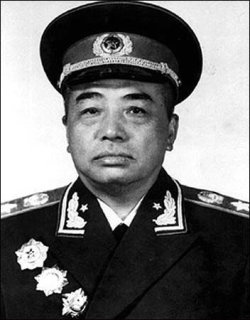
P'eng Te-huai (Peng Dehuai) was born in Hunan province under
circumstances of significant personal hardship. However, sources
disagree on the particulars of his early life, including even the year
of his birth. P'eng's own autobiography gives his date of birth as 10
September 1898, but on the old lunar calendar, which corresponds to 24
October 1898 in the Western calendar. He came from a peasant
background, but Communist propaganda reported different levels of
prosperity as P'eng himself fell in and out of favor: poor peasants
when he was in favor, rich peasants when he was not. According to a
careful Western biography (Domes 1985) the truth likely lay somewhere
in the middle, with his father owning about an acre and a half of land
and a bean curd shop in the local village.
P'eng's mother died when he was young, probably in 1905. His education was limited to three years
in a private primary school, which would have emphasized Confucian
literature, followed by a year in a modern hsien (county) school. These were
undoubtedly years of considerable poverty for his family, with his
mother dead and his father ill and with the 1905 and 1906 harvests
being very poor. His youngest brother, who was six months old, starved
and his father was forced to sell most of the family land. His
great-uncle was a Taiping rebel and helped shape P'eng's social
and political philosophy. After his great-uncle's death in 1911,
P'eng left his native village to work as a common laborer in a coal mine. A year later the mine went
bankrupt and P'eng returned to his village, surviving on odd jobs, and
participated in a grain riot that led to a warrant being issued for his
arrest. He fled to north Hunan and found another job as a laborer on a
dam, returning home after two years when the authorities had lost
interest in him.
In March 1916 P'eng joined the local warlord army, which was
contesting control of Hunan with a Kuomintang
army under T'ang Hsiang-ming. His platoon leader was a follower of Sun
Yat-sen, and Kuomintang influence was evident throughout the younger
officer corps. In 1917 the division mutinied and went over to the
Kuomintang side. P'eng was given instructions both in military tactics
and in classical written Chinese. Thereafter he rose rapidly through
the ranks,
becoming an officer in 1921. In
November 1921 he summarily executed a local landlord for mistreating
peasants, for which he was reprimanded but not dismissed or demoted. An
attempt to join the central Kuomintang army at Guerr in February 1922
was unsuccessful, but in August 1922 he passed the entrance exam and
was admitted to the Hunan Military Academy. He graduated nine months
later and became a captain in his old unit. Although 2 Division was
again fighting the Kuomintang, P'eng continued to sympathize with
the Kuomintang cause. 2 Division again mutinied in March 1926 and went
over to the Kuomintang for good, joining Chiang's Northern Expedition
as 1 Division, 8 Corps.
P'eng's division initially sided with the Communists in the split of October 1927, but defected to Chiang in February 1928. When P'eng's unit was assigned to anti-Communist operations near Changsha, P'eng kept his unit passive; he had already secretly joined the Chinese Communist Part by this time. No political ideologue, P'eng was simply "a rebel with a populist desire for the improvement of the living conditions of the rural masses" (Domes 1985). His unit defected to the Communists on 22 July 1928, marking the occasion by summarily executing the local magistrate and about 100 other local landlords and militia leaders. His force was driven out of Hunan, suffering heavy casualties, and he joined Mao Tse-tung in the Kiangsi Soviet along with a few hundred of his men. P'eng became deputy commander (under Chu Teh) of 4 Corps, with Mao as political commissar.
P'eng rescued Mao from likely capture and execution when Mao's unit was cut off, and later commanded the rearguard (5 Corps) when the Kiangsi Soviet moved to Juichin. Thirty-eight years later, this would be condemned by the Red Guard as P'eng's "first crime" (Domes 1985). Later P'eng joined Chu in arguing for strict military discipline and organized warfare rather than guerrilla tactics; Mao accepted a compromise strategy of professional military leadership combined with political indoctrination. On 25 July 1930 P'eng's force participated in a general offensive ordered by the Central Committee in Shanghai, broke through the Kuomintang lines, and captured Changsha. However, Mao was to distant to effectively support P'eng, and he was driven out of Changsha on 5 August by a Kuomintang counteroffensive that cost him 7500 of his men.
Between December 1930 and April 1933, Chiang attempted four times
to wipe out the Kiangsi Soviet, failing each time with heavy losses.
This emboldened the Communists and their Russian advisers, who launched a conventional military offensive against
Kanchow by 5, 7, and 8 Corps under P'eng in February 1932. The city was
defended by well-trained
Kuomintang troops under Ch'en Ch'eng
who crushed the Communist offensive. Chiang now launched a fifth
campaign against the Communists, personally leading 800,000
Kuomintang troops against 150,000 Communist defenders. Ch'en defeated
P'eng a second time near Kwangchang, inflicting 30% casualties on
P'eng's force. The Communists were forced to break out to Hunan and
begin what became known as the Long March to distant northern Shensi.
P'eng commanded 3 Army
during the Long March. Of the 18,000 men under his command who began
the March, only 3000 made it to northern Shensi. P'eng was then made
the deputy commander of 8 Route Army
under Chu.
However, Mao did not trust
Chu, and P'eng
had long held the real authority over the army. In 1937 P'eng
wrote a
pamphlet arguing for a full-scale military effort against the Japanese,
but by 1939 his writings fully supported Mao's strategy of guerrilla
warfare and expansion of base areas.
P'eng led the
Hundred Regiments Offensive
in 1940, which greatly irritated the Japanese
but was costly to
the Communists. Although the Hundred Regiments Offensive could
reasonably be regarded as a limited success, it was denounced as
P'eng's "second crime" (Domes 1985) when he fell into disfavor decades
later. Following the Hundred Regiments Offensive, the Japanese launched
a counteroffensive against P'eng's headquarters in the Taihang
Mountains which compelled P'eng to withdraw rather than suffer
unacceptable attrition. Thereafter he restricted himself to inserting
Communist forces into
areas swept clear of the Kuomintang
by the Japanese advance.
During this time P'eng grew increasingly close to Mao, and he played
a major role in the cheng-feng
or "rectification" movement of 1943. He became a Politburo member
sometime in 1945.
Following the Japanese surrender,
P'eng commanded Northwest Field Army in the unsuccessful defense of
Yenan in March 1947 against the well-trained Kuomintang troops of the
capable Hu Tsung-nan.
However, he finally halted Hu's offensive in August 1947 at
Shachiatien, a battle often considered the turning point of the Chinese
Civil War. P'eng
recaptured the Yenan area in April 1948 and embarked on the conquest of
northwest China. Following the Communist victory in the civil war,
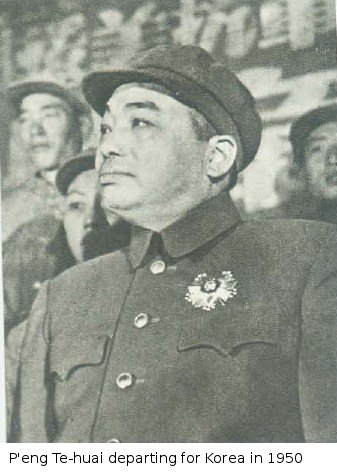
P'eng commanded the Chinese forces in Korea
from the spring of 1950 and
became minister of defense in 1954, becoming one of the ten marshals of
the People's Liberation Army.
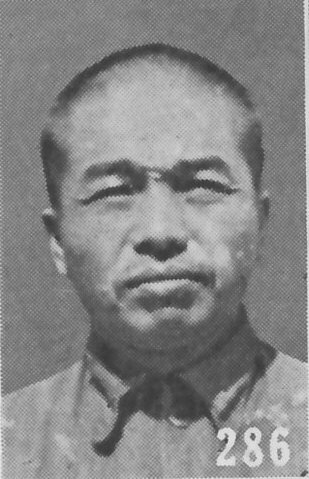
P'eng was forced into retirement after
criticizing the economic disruption of the Great Leap Forward in
1958-1959, was imprisoned in 1966, and was subject to severe torture by
the Red Guards in July 1967. He was transferred to a military hospital
after becoming seriously ill in 1974, but was discharged and, on Mao's
orders, denied further medical
care. "He died alone, lying in a pool of his own blood, on November 29,
1974" (Domes 1985). He was posthumously rehabilitated on 22 December
1978 as a "great revolutionary fighter and loyal member of the Party."
P'eng was a capable and dedicated soldier, blunt, honest, and mindful of his subordinates. He was one of the few Chinese Communists leaders whom P.P. Vladimirov, a Russian adviser to the Chinese Communists between 1942 and 1945, spoke well of (Domes 1985):
P'eng Te-huai is well-versed in military affairs, and is popular in the army. He dresses simply, even in Yenan terms. The most significant trait of this character is modesty. He has a deep, coarse voice, his movements are slow. This man has a rare sense of personal dignity. He holds Mao Tse-tung in respect as the leader of the CCP.
It was likely P'eng's air of modesty that allowed him to survive for as long as he did. However, his willingness to speak the truth even to Mao eventually cost him his life.
| 1898-10-24
|
Born in Hunan province |
|
| 1916-3 |
Private second
class |
Joins 2 Division, Hunan Army
(warlord army of T'an Yen-k'ai) |
| 1919-4 |
Master sergeant |
|
| 1921-8 |
Second lieutenant |
|
| 1922-8 |
Enters Hunan Military Academy |
|
| 1923-8 |
Captain |
Commander, 1 Company, 1
Battalion, 6 Regiment, 3 Brigade, 2 Division, Hunan Army |
| 1926-6 |
Major |
Commander, 1 Battalion, 1
Regiment, 1 Division, 8 Corps, National Republican Army |
| 1927-10 |
Lieutenant colonel |
Commander, 1 Regiment, 1
Division, 35 Corps |
| 1928-2 |
Colonel |
Commander, 1 Regiment, 5
Division, National Republican Army |
| 1928-7-23 |
Commander, 5 Corps |
|
| 1928 |
Lieutenant
general |
Commander, 3 Army, Long March |
| 1937-5 |
General | Deputy commander, 8 Route Army |
| 1945-5 |
Politburo |
|
| 1946-3 |
Commander, Northwest Field Army |
|
| 1950-10-5 |
Commander, People's Volunteers
Army, Korea |
|
| 1954-9-28 |
Minister of Defense |
|
| 1955 |
Marshal | |
| 1959-9-17 |
Forced into retirement |
|
| 1965 |
Secretary, Control Commission,
Southwest China Bureau |
|
| 1966-12-25 |
Arrested |
|
| 1974-11-29
|
Dies |
 |  |
 |
References
Chang
and Halliday (2005)
Tong (1947)
The Pacific War Online Encyclopedia © 2007-2010, 2013 by Kent G. Budge. Index


