 The Pacific War Online Encyclopedia
|
| Previous: B6N "Jill", Japanese Torpedo Bomber | Table of Contents | Next: Baba Masao |
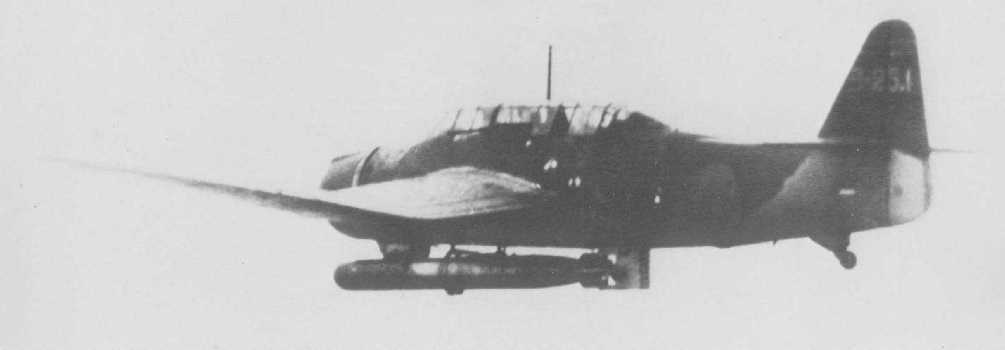
Aichi B7A2 Ryusei ("Shooting Star") "Grace"
| Crew | 2 in tandem cockpit |
| Dimensions | 47'3" by 37'9" by 13'5" 14.4m by 11.49m by 4.08m |
| Wing area | 381
square feet 35.4 square meters |
| Weight | 8,400-14,330 lbs 3810-6500 kg |
| Maximum speed | 352 mph at
21,490 feet 566 km/h at 6550 m |
| Climb rate | 32 feet per second 9.8 meters per second |
| Ceiling | 36,910 feet 11,250 meters |
| Power plant | One 1825 hp (1361 kW) Nakajima NK9C Homare 12 eighteen-cylinder air-cooled radial engine, driving a constant-speed four-blade metal propeller |
| Armament | Two wing-mounted 20mm Type 99/2 cannon One flexible rear-firing 13mm Type 2 machine gun |
| Bomb load |
1 1760-lb (800 kg) torpedo or up to 1760 lbs (800 kg) of bombs |
| Range | Normal 1150 miles (1850 km) Maximum 1890 miles (3040 km) |
| Production | Aichi Kokuki K.K. at Funakata: 9 B7A1 prototypes (May 1942-Feb 1944) 80 B7A2 production aircraft (May 1944-July 1945) Dai-Nijuichi Kaigun Kokusho at Omara (Sasebo): |
"Grace" combined the carrying
capacity of the "Kate"
with the performance of the Zero.
It might have been troublesome had it gone into production before the
Allies
gained control of the air and destroyed the Japanese
carrier fleet. Like the U.S.
TBF Avenger,
it
was capable of dive bombing
as well as torpedo bombing.
Design began under Ozaki Norio in 1941 in response to a Navy call for an aircraft of outstanding performance and maneuverability, capable of replacing both the B6N "Jill" and the D4Y "Judy". The aircraft was required to be able to carry two 551 lb (250 kg) or six 132 lb (60 kg) bombs in an internal bomb bay or a single 1760 lb (800 kg) torpedo externally. The aircraft was to fly from a new class of carrier with larger elevators, and so the specification permitted a larger airframe than any previous carrier aircraft. This in turn meant the the aircraft could be powered by the massive Homare engine. To allow sufficient clearance for both the bomb bay and the propeller, the wings were given an inverted gull configuration. The ailerons could function as flaps, thereby lowering the landing speed to an acceptable figure, and the aircraft was equipped with dive brakes. The first prototype flew in May 1942 but suffered from the unreliability of the new Homare 11 engine. The problem was solved in April 1944 with the Homare 12, and the aircraft finally went into production.
Few were produced and fewer saw combat. Production was interrupted by Allied strategic bombing and by an earthquake in May 1945 that destroyed the Funakata factory.
 |
References
The Pacific War Online Encyclopedia © 2007-2009, 2015 by Kent G. Budge. Index


