 The Pacific War Online Encyclopedia
|
| Previous: Chengtu | Table of Contents | Next: Chiai |
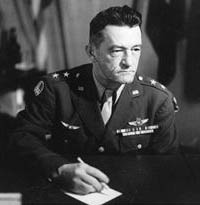
Chennault was born in Texas and worked his way through college prior to graduating from Officers' Training Camp during the First World War. Denied a posting overseas, he took aviation training and accepted a Regular Army commission in 1920. A strong advocate of fighter aircraft, he was one of the few regular Air Corps officers to challenge the “bomber cult” during the 1930’s. He was retired from the Air Corps in 1937, at age 44, ostensibly for deafness. He subsequently became the principal air adviser to the Chinese Republican Air Force, and organized an effective air warning system based on observers using telephones. Under his leadership, the Chinese inflicted heavy losses on Japanese bombers, until the introduction of the Zero fighter tipped the balance decisively in favor of the Japanese. Chennault carefully studied the Japanese fighter, filing a report with Marshall in December 1940, and lecturing a spellbound audience of Army pilots at Oahu for three hours in July 1941 on the flight characteristics of the Zero.
In 1940 Chennault returned to the United States and, with the covert support of the Roosevelt administration, organized the American Volunteer Group, later known to the public as the Flying Tigers. The group was still training in Burma when war broke out. Moved to China, it became 14 Air Force on 20 March 1943, and Chennault was promoted to brigadier general.
Chennault’s flyers were remarkably successful against the Japanese Army pilots in China, inflicting heavy casualties at modest cost. Their greatest accomplishment was probably forcing the Japanese to scale back their aerial bombardment of Chungking. Chennault’s fighter tactics were carefully studied by U.S. Navy officers such as Jimmy Thatch, who improved on them and used them with success against the Japanese Navy in the Pacific. Nonetheless, 3 Air Division proved a tough and wily opponent, repeatedly driving 14 Air Force out of its forward bases whenever replenishment of supplies over "The Hump" fell behind demand.
But Chennault was not without his
blind spots. He got
along very poorly with his superiors, particularly “Vinegar
Joe” Stilwell. Stilwell was a
crusty old infantry officer who despised Chiang
Kai-shek, while Chennault was one of the few foreigners that
Chiang
trusted. This was in part because Chennault had allied himself with
Madame Chiang, who was made honorary commander of the Flying Tigers.
Stilwell rejected Chennault’s claim that
air power alone could
defeat the Japanese in China, arguing that the Chinese Army must first
be
brought up to acceptable standards of training and equipment. But
Chennault had
Chiang’s ear, and succeeded in getting priority assigned to
supplies for 14
Air Force. Chennault even went so far as to send Roosevelt a letter on 8
October 1942 asking for "full authority as the American military
commander in China", in effect demanding Stilwell's job (Romanus and
Sunderland 1953).
The Japanese Ichi-go
offensive of 1944 largely
vindicated Stilwell’s position. The Japanese
Army was easily able to
overrun Chennault’s airfields
against feeble ground
resistance in spite of the
air support provided by Chennault’s airmen.
Chennault also got along poorly with Clayton Bissel, Stilwell’s air chief, who commanded the rival 10 Air Force in India. Chennault’s flyers went so far as to train a Chinese coolie (who had no understanding of English) to stand at the end of the runway and shout “Piss on you Bissell!” every time a 10 Air Force plane landed.
Chennault was assisted by Joseph Alsop, a well-connected journalist who was a first cousin of Eleanor Roosevelt and was cultivated by the President. Alsop proved skilled at propagandizing for Chennault, though he earned the scorn of Stilwell, who referred to him in his diaries as "Alslop." Alsop eventually received a commission in the Army, over the objections of George C. Marshall, but continued to undercut Stilwell, who as his superior officer could technically have charged him with insubordination.
Chennault made fantastic claims for the potential of air power, as when he told President Roosevelt that with twelve heavy and thirty medium bombers he could bring Japan to her knees. His pilots’ claims were also extravagant, including a claim that they had sunk 49,600 tons of Japanese shipping in 1942 (the actual figure was about 7000 tons), but there is no doubt that their own combat losses were relatively modest and that they hurt the Japanese. Given that the Japanese pilots in China were Army pilots rather than the superbly trained Navy pilots encountered in the Pacific, and that they were flying inferior aircraft such as the Nate rather than the Zero, it was unsurprising that Japanese losses were relatively heavy. But when the Japanese broke off their pursuit of the Chinese Army into Yunnan from Burma, Chennault drew unwarranted conclusions about the effectiveness of air interdiction, believing it was his pilots who had knocked out the Salween bridges who stopped the Japanese. In fact, the Japanese broke off the pursuit simply because they had no orders to invade Yunnan.
Chennault was so good at making enemies that by 1945 Madame Chiang was about the only supporter he had left. “Hap” Arnold forced Chennault to retire in August 1945, just as the war was ending, whereupon Chennault helped organize an airline in China that became a front for CIA efforts to intervene in the Chinese civil war.
| 1890-9-6
|
Born in Commerce, Texas |
|
| 1917-11 |
Second
lieutenant |
Commissioned through OTC |
| 1919 |
Completes flight training |
|
| 1920-4-9 |
Commissioned into Army Air Corps |
|
| 1937 |
Major |
Retired for deafness |
| 1942-4 |
Brigadier general |
Recalled to active duty |
| 1943-3-14
|
Major general |
Commander, 14 Air Force |
| 1945-8-10 |
Retires |
|
| 1958-7 |
Lieutenant general (retired
list) |
Dies in New Orleans |
References
The Pacific War Online Encyclopedia © 2007-2008, 2012 by Kent G. Budge. Index
