 The Pacific War Online Encyclopedia
|
| Previous: American Fork | Table of Contents | Next: Amoy |
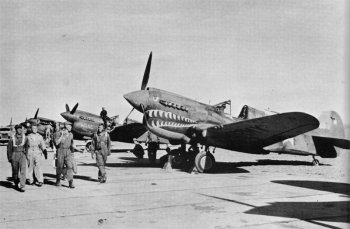
U.S. Air Force. Via ibiblio.org
By the summer of 1941, Japan and China had been at war for over ten years. The cream of the Chinese Air Force had been destroyed by superbly trained Japanese pilots flying superior aircraft, and China turned to foreign mercenaries to continue the battle in the air. The bulk of these were Russian “volunteers” sent in accordance with Stalin’s policy of supporting the Kuomintang in order to keep Japan bogged down in China.
By November 1940 the Chinese had begun exploring the possibility of military assistance from the United States.
a military mission under Major General Mao Pang-tzo arrived at
Washington with a request for 500 combat aircraft and crews, 150
trainers, ten transports, a year's supply of ammunition, and supplies
to build fourteen airfields and 122 landing strips.
With American already supplying Britain while trying to equip its
expanding military forces, no such forces were available, but the British agreed to transfer 100 Lend-Lease P-40Bs to China in return for priority claim on 100 later model fighters.
The supply of Russian pilots dried up abruptly with the German invasion of Russia in the spring of 1941. American sentiments were increasingly turned against the Japanese, but the American public was still strongly isolationist. President Roosevelt therefore agreed to the suggestion of Chiang Kai-shek’s American air adviser, Claire Chennault, to secretly send American pilots to help the Chinese. Chennault was authorized to recruit Army and Navy fliers, who resigned their commissions (with a secret understanding that they would be restored to former rank if the U.S. joined the war) to fly under Chinese colors on one-year contracts. Chennault was given the unmilitary title of "supervisor" and and he recruited some 101 pilots, 63 from the Navy or Marines and 38 from the Army. The pilots and aircraft sailed for Burma in June 1941 and were escorted by American warships through the Japanese Mandates in violation of neutrality laws. This was the origin of the American Volunteer Group.
As might have been anticipated, many air commanders used this as an opportunity to rid themselves of troublemakers. As a result, the AVG suffered from serious discipline problems, which was spun into a legend of hard-drinking, straight-shooting, fighting airmen. Chennault largely ignored what a man did on the ground so long as he was ready when it came time to take to the air. (It was later claimed that one of Chennault’s most famous pilots, “Pappy” Boyington, flew better drunk than sober.) The Chinese were not ready to base the AVG on its arrival in Burma, and Chennault began rigorous training of his pilots, some 100 strong, at the British airbase at Toungoo in central Burma.
Before Chennault was able to commit the AVG to combat in China, the Japanese attacked Pearl Harbor and the U.S. was in the war. The AVG pilots were promptly committed to combat in Burma, which was invaded by the Japanese in early 1942. They scored well against the Japanese Army pilots, who were flying inferior Nates and were not as superbly trained as their Navy counterparts in the Pacific. In April 1942, one of their best months, they claimed 33 Japanese aircraft destroyed and 10 probable for the loss of 1 AVG aircraft destroyed and 9 damaged by strafing. But the AVG was unable to stem the tide until the Chinese armies retreated across the Salween River. AVG pilots put the bridge across the Salween out of action and the Japanese broke off the pursuit.
Some 49 ground crew for a second American Volunteer
Group were on the way to Burma when war broke out, and they ended up
stranded in Australia. Plans for further volunteer groups were subsequently canceled.
The strain on the AVG reached the breaking point in late April 1942, when some of the pilots assigned to a mission to escort British Blenheim bombers refused to go. Subsequently some 24 pilots tendered their resignations. Chennault responded by telling the pilots they would be treated as deserters, and most took back their resignations. The Army Air Forces redesignated the AVG as 23 Fighter Group on 6 July 1942, restoring the military standing and ranks of the former Air Force pilots and promoting Chennault to brigadier general. Not all the pilots were happy about being back in the Air Forces. In addition, many AVG pilots had come from the Navy or Marines and found themselves in limbo. Discipline problems persisted, and Romanus and Sunderland (1953) report rumors that the Flying Tigers organized a lucrative smuggling ring. There was a fair amount of reshuffling, and when the dust cleared the original AVG was no more. 23 Fighter Group continued to have important successes under Chennault, but it was now a conventional Army Air Force organization, albeit with an unusually colorful history and body of tradition.
References
The Pacific War Online Encyclopedia © 2006-2008, 2011-2012, 2014 by Kent G. Budge. Index