 The Pacific War Online Encyclopedia
|
| Previous: Indian Ocean | Table of Contents | Next: Indio |
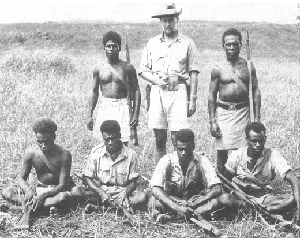
U.S. Marine Corps. Via Zimmerman (1949)
Much of the fighting of the Pacific War took place in areas that had
very limited contact with the modern world. Though technically
nationals of the various colonial powers, the indigenous population
lived much the same way as it had for thousands of years, apart from a
veneer of Christianity acquired from European missionaries, some
limited trade with outsiders, and occasional bartering of labor (such
as on copra plantations) for goods
like cloth or tobacco. Most of these areas had inhospitable climates and terrain or lacked natural resources
that might have attracted greater European interest.
American attitudes of the
day towards "natives" are reflected in
descriptions by contemporary historians, such as that by Samuel
Eliot Morison of the occupation of Majuro
atoll:
Captain V.F. Grant, the atoll commander, took a great interest in the natives, whose ranks had been thinned by the enemy's removal of the young and able-bodied of both sexes to Jaluit. His war diary has a Stevensonian touch: "29 February 1944. King Langlan, Queen and Royal Party were entertained at lunch by Captain Grant." He established a trading post where the Majurians could obtain gaily printed cotton (for their lava-lavas) and black twist tobacco, in return for pandanus-leaf baskets, mats, model canoes and other products of their skill. Thus the souvenir racket which develops wherever American bluejackets set foot was somewhat regulated. The King and Queen even rated a royal salute from Captain Grant's "Majuro Navy", consisting of four LCIs, ten LSTs, a small minesweeper and tug Arapaho.
Modern readers may find Morison's attitude condescending, but it was
quite typical of American attitudes of the day, which combined a sense
of cultural superiority with a distaste for colonialism -- much as was
the case in the Philippines
and in China. The American attitude
was certainly more benign than the Japanese
treatment of indigenous peoples, as hinted at in the previous excerpt.
With few exceptions, the Allies
could count on the support of the indigenous population in most areas
of the Pacific.
Melanesia. The first Allied
offensives of the Pacific War took place in the Solomons and New Guinea, which form the heart
of Melanesia. The indigenous Melanesians are tall and dark-skinned with
distinctive curly or woolly hair, and they speak a bewildering variety
of languages, estimated at over 200 on New Guinea alone. However, these
languages share common features, and most anthropologists believe the
Melanesians share a common descent from inhabitants of Papua (eastern
New Guinea) who settled the area at least 40,000 years ago. Many of the
indigenous peoples of the Solomons had been converted to Christianity
and gave significant assistance to Allied coast watchers and downed airmen. Future president John
F. Kennedy was rescued by Melanesians following the sinking of PT-109.
Solomon Islanders served as guides for tank/infantry
teams on New Georgia.
The New Guinea tribes were less reliably pro-Allied. While
friendly Melanesians provided portage during the Buna campaign, and were particularly
helpful in evacuating the wounded,
the Orokaiva tribe of the Buna area were very hostile to Europeans and
initially sided with the Japanese, providing them with laborers and scouts. This later changed due to Japanese
mistreatment, particularly of women, and the Orokaiva proved unreliable as carriers on the Kokoda trail.
Micronesia. The Gilbert, Marshall, and Caroline Islands constitute the heart of Micronesia. The Micronesians are less dark-skinned than the Melanesians and show more Oriental characteristics, reflecting their likely descent from ancient Formosans who migrated to the Philippines and on to what is now Micronesia. Genetic studies reveal surprisingly little intermarriage with the Melanesians, and the languages of Micronesia belong to the Austronesian family rather than the Papuan family. The Micronesians of the Gilberts and Marshalls were treated harshly by the Japanese and seemed not unhappy at the arrival of the Allies, although they cannot be said to have given much active assistance. The Micronesians of the Carolines had had their standard of living sufficiently raised under the Japanese mandate that they were reasonably loyal subjects of the Emperor, though, again, they cannot be said to have actively opposed the Allies in those few areas (Palau and Ulithi) that were occupied by the Allies during the war.
The Americans brought an immense influx of material riches to the
islands of the Pacific, including an abundance of food that was freely
shared with the indigenous peoples. In Micronesian culture, the sharing
of food is of immense social significance, and the American generosity
was misread in ways that caused some signficant postwar social and
political difficulties.
Polynesia. The Japanese
offensive never reached Polynesia, which is located roughly in the
triangle formed by New Zealand,
Hawaii, and Easter Island. However,
significant number of Polynesians fought as regular soldiers in the
armed forces of New Zealand and the United States. The Polynesians are
thought to have descended from the same Formosan sailors as the
Micronesians, though there are important distinctions in language and
culture.
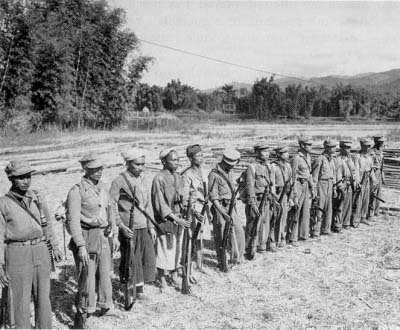
U.S. Army Center of Military History
Burma. There were numerous indigenous tribes in Burma when it was overrun by the Japanese. The Shan tribes of eastern Burma, who had strong ethnic and cultural ties to Thailand, were strongly pro-Japanese. By contrast, the Kachin and Naga tribes of northern Burma sided with the Allies, largely as the result of Japanese atrocities. The success of the OSS in working with the Kachins was one of their few real triumphs in the war against Japan.
The Naga were a warlike group of tribes, living in villages in the mountainous region of northern Burma and northeast India.
They were one of the few indigenous peoples of whom there were still
credible reports of headhunting in the 1940s. When journalist Eric
Sevareid was forced to bail from a crippled transport aircraft
on 2 August 1943, he and his fellow passengers parachuted into Naga
territory. The local British district supervisor later told Sevareid
that the Nagas from one of the villages in the area had taken 106 skulls from neighboring villages in 1942.
The British Force 136
worked more closely with the Karen people, who were an ethnic minority
living mostly in southern Burma or along the border with Thailand. Many
of the Karens had converted to Christianity, and they were more
pro-European than most ethnic Burmese. The Japanese distrusted them from the start, and the Burma Independence Army tried to disarm
them. Two Karen villages, Kanazogon and Tayagon, were razed to the
ground and their inhabitants massacred, creating lasting postwar enmity
between the the ethic Burmese and the Karen.
Marianas. The Chamorros of the southern Marianas form a distinct group, distantly related to the Micronesians and Polynesians. Though the island of Guam had been U.S. territory since 1898, the American population remained small, consisting mostly of Navy administrators and their families, and there was little economic development apart from the fueling station. Efforts were made to improve health care and education for the Chamorros, but they were otherwise left largely undisturbed, a policy sometimes described as "salutary neglect" (Morison 1953). The Chamorros in return developed considerable loyalty to the United States, which led to their mistreatment by the Japanese following their occupation of the island. Many were confined to concentration camps, and Leckie (1962) describes the Marines discovering such a camp at Yona:
There were 2,000 of them, cheering, weeping, laughing, singing. They had been living in lean-tos and thatched huts built in the mud to either side of a sluggish stream. They had had little food, no medical care. They were clothed in rags. They were weak, racked by continual coughing fits— victims of malnutrition, malaria and tuberculosis. Their bodies were sticks of bones and their olive skin was drawn drum-tight. But this thirty-first of July was the day they had awaited for nearly three years. When they saw the American soldiers coming through the trees, they hobbled to their feet with glad cries.
They sang "The Marines' Hymn" — for they remembered the Marines — but the soldiers of the 3rd Battalion, 307th Infantry, didn't mind that at all....
One of the Chamorro refugees was the elderly Gaily R. Kamminga, a former member of the Guam Congress, who had taken considerable personal risks to preserve the American flag that had been flying over Piti Navy Yard on the day of the Japanese invasion.
Philippines. The Philippines
were the home of a number of tribal peoples, including
the Negritos, a dark-skinned race of very short stature and uncertain
ancestry (though genetic studies suggest descent from the first humans
to enter Asia from Africa.) TheIgorot ("mountain people") were a warlike
Austronesian group who, according to Alexander (2009), killed Japanese
soldiers and took their jawbones as trophies. The Igorotes worked well
with the Alamo Scouts, but Alexander (2009) also alleges that the Igorotes killed two American escapees from Bataan when one of the men began a sexual relationship with a married Igorote woman.
References
Alexander (2009)
Leckie (1962)
Morison (1951, 1953)
The Pacific War Online Encyclopedia © 2009-2012, 2014 by Kent G. Budge. Index