 The Pacific War Online Encyclopedia
|
| Previous: Yamashita Tomoyuki | Table of Contents | Next: Yamauchi Masafumi |
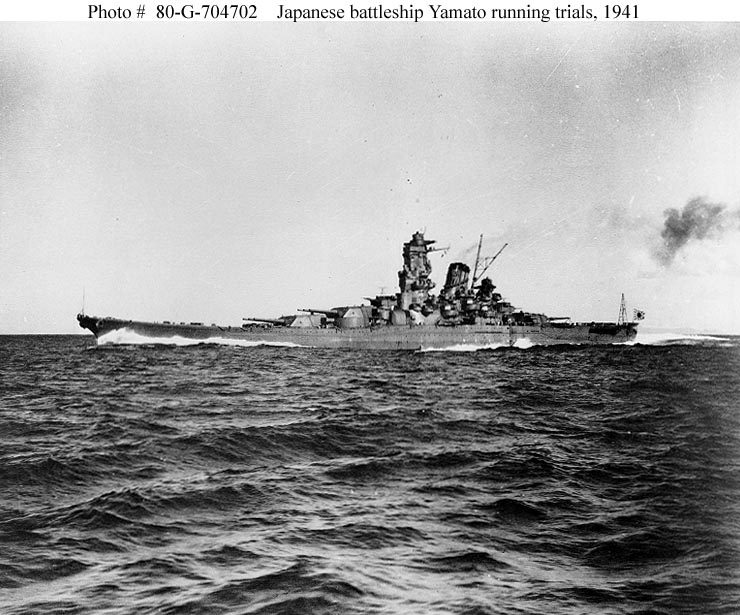
National
Archives
#80-G-704702
| Tonnage | 62,315 tons standard displacement |
| Dimensions | 862'10" by 121'1" by 34'2" 262.99m by 36.91m by 10.41m |
| Maximum speed | 27 knots |
| Complement | 2500 |
| Aircraft | 2 seaplane
catapults 7 seaplanes |
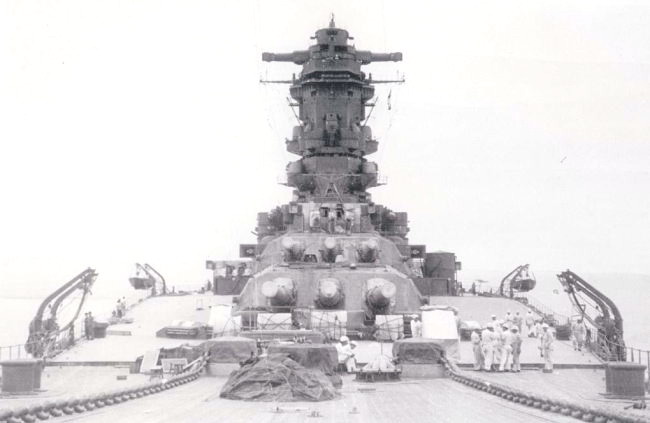
| Armament | 3x3 18.1"/45
guns 4x3 6.1"/60 guns 6x2 5"/40 dual-purpose guns 8x3 25mm/60 AA guns 2x4 13mm/76 machine guns |
| Protection | 16.1" (410mm) VH belt inclined 20 degrees 10.6" to 3" (270 to 75 mm) lower VH magazine belt inclined 14 degrees 7.9" to 3" (200 to 75 mm) lower VH machinery belt inclined14 degrees 13.4" (340mm) VH bulkheads inclined 20 degrees 0.4" (10mm) Ducol splinter deck 7.87" to 9.1" (200mm to 230mm) MNC third deck, sloped 7 degrees from horizontal at its edges. 0.39" to 0.98" (10mm to 25mm) CNC second deck 1"+0.3" (25mm+9mm) Ducol hull between third deck and second deck 0.47" to 0.79+0.71" (12mm to 20+18mm) CNC weather deck 1"+0.7" (25mm+18mm) Ducol hull between second deck and weather deck 3.6" (140mm) MNC uptakes 25.6"/9.8"/10.6"/7.5" (650mm/250mm/270mm/190mm) VH main turrets 22" (560mm) VH barbette 1" (25mm) CNC secondary turrets 19.7"/7.9" (500mm/200mm) VH conning tower 13.8" (350mm) VH steering room sides 2" (51mm) machinery floors 3" (75mm) machinery and steering room floors 4-bulkhead void-void-void-liquid torpedo protection (0.35", 0.63", lower armor belt, 0.4", 0.6" or 9mm, 16mm, lower armor belt, 11mm, 15mm bulkheads from inboard to outboard) effective against 880 lbs TNT. |
| Machinery |
4-shaft geared turbines
(150,000 shp) 12 Kampon boilers |
| Bunkerage | 6300 tons fuel oil |
| Range | 7200 nautical miles (13,300 km) at 16 knots |
| Modification | In late 1943, both ships unshipped the beam triple
6.1"/60 turrets to make room to bring the total 25mm count
to 36. Yamato: Musashi
underwent similar upgrades until her loss. |
Design work began with the withdrawal of Japan from the naval disarmament treaties in 1934. The United States was already seen as the most likely future naval opponent, and the Japanese sought to achieve a qualitative advantage to offset American numerical superiority. The Japanese had made some rather shrewd guesses at what the United States was then designing, based largely on the assumption that any U.S. battleship would be designed to fit through the Panama Canal. Japanese intelligence estimated that future U.S. battleships would displace 35,000 tons, would have a speed of 33 knots and a main battery of nine 16" (406mm) guns, and would have a length of 880 feet (268 meters). In fact, the Iowas displaced 45,000 tons, had a speed of 33 knots and main battery of nine 16"/50 guns, and had a waterline length of 860 feet (262 meters). It is fair to say that the Yamatos were designed specifically to outclass the Iowas. It is not clear that the Japanese were successful at this, though since the Yamatos never met the Iowas in combat, we will never know.
The hull form was carefully designed to be as
efficient as possible while permitting a large enough beam to
allow the machinery to be tightly concentrated in a heavily
armored citadel. The Japanese were remarkably successful at this,
and the unusual hull form, most notable for a narrow prow ending
in a large bulbous bow, achieved a remarkable 58.7% propulsive
efficiency at 18 knots. The large beam allowed the main belt to be
kept to just 53.3% of the waterline length of the ship. On the
other hand, the short citadel had the effect of crowding the
secondary armament amidships. The machinery was highly
compartmentalized, with separate fire rooms for each of the twelve
boilers, and the unarmored bow and stern were also highly
compartmentalized, yielding a total of 1147 separate watertight
compartments in the hull. The designers claimed the ship had a
full 57,450 tons of reserve buoyancy, but this was optimistic. The
ships had the controversial longitudinal bulkheads that
characterized Japanese cruiser
design between the wars, which may have actually increased the
risk of capsizing due to flooding on one side of the ship.
Consideration was given early in the design process
to giving the Yamatos a dual diesel/turbine drive that
would give a greater cruising range, but this was abandoned due to
a lack of confidence in Japanese diesel technology and the
difficulty of making any major engine alterations once the heavy
deck armor was in place.
The turning ability of the ships was better than any
battleship in the world in 1941, with a heeling angle of just 9°
for a rudder angle of 35° at 26 knots. The ships were unusually
habitable and were the first Japanese warships equipped with air
conditioning. Navy men accustomed to more Spartan accommodations
referred to Yamato derisively as "The Yamato Hotel."
The armor on the Yamatos was slightly inferior in quality to American armor, due to the deficiencies of Japanese metallurgy, which made their main belts nominally just 20% more resistant to penetration than the thinner belts of the Iowas. The arrangement was faulty, being particularly weak where the upper belt joined the lower belt. Underwater protection was poor, in part due to an overemphasis on protection against underwater shell hits, reflected in the very deep lower belts. When Yamato was hit by a single torpedo from a U.S. submarine, she lost nine knots of speed and could never really be properly repaired. On balance, the Iowas probably got nearly as much protection from their well-arranged belt of high-quality Class “A” armor. The 18" guns had a very low rate of fire and unremarkable ballistic performance, and fire control was not up to American standards. The Iowas probably got similar performance out of their smaller but superbly designed 16” guns and shells, and they were five knots faster. An encounter between the two Yamatos and two of the Iowas could have gone either way. In a daylight encounter in good weather, the Yamatos probably would have had the edge; at night or in foul weather, the advantage probably would have been with the Iowas.
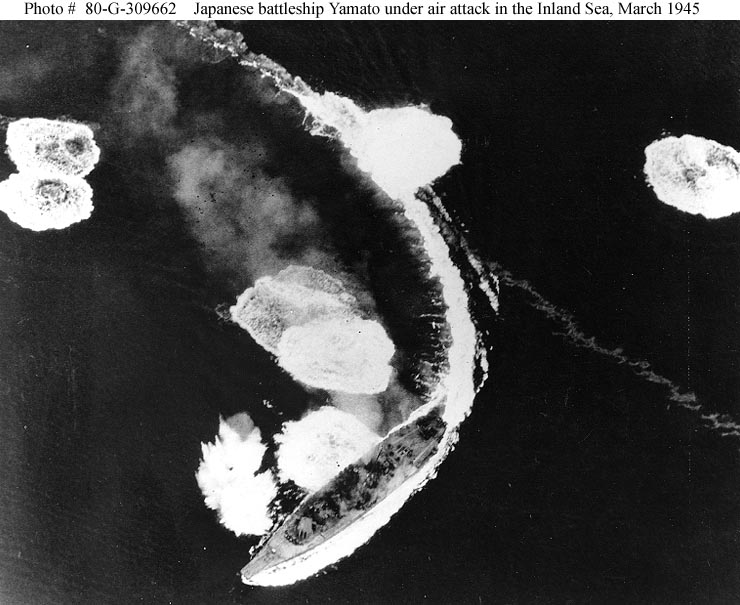
But the greatest fault of the Yamatos was that they were
designed for a kind of war that was never fought. Both units were
lost to air attack (though it took the attention of 300 aircraft to do
each of them in) and they never met another capital ship in
battle. Half of their secondary battery was useless against
aircraft, and, while their light antiaircraft armament was
substantial, it was based on the mediocre 25mm antiaircraft
gun and was never really adequate. The Japanese would have
been far better off to have built three or four more carriers, with their
air groups, than to have built these monsters. But this was not
obvious at the time of their construction, except to a few
farsighted officers like Yamamoto
Isoroku:
Military people always carry history around with them in the shape of old campaigns. They carry obsolete weapons like swords and it is a long time before they realize they have become purely ornamental. These battleships will be as useful to Japan in modern warfare as a samurai sword.
(Garzke and Dullin 1985). Of course, the Iowas were also designed for
a kind of war that was never fought, but the U.S. Navy put them to
effective use as escorts for carrier task groups, where their
powerful antiaircraft batteries provided substantial protection
for the carriers. This was possible because the Iowas were just fast enough
to keep up with the carriers.
The Yamatos were so large that the Japanese were compelled to construct extensive new facilities to support them. Huge new dry docks were constructed at Yokosuka and Sasebo and existing slipways at Kure and Nagasaki were deepened and strengthened. The Nagasaki yard had its floor capacity increased to 2,600,000 square feet (240,000 square meters), and floating cranes were built with lifts of 350 and 150 tons. Two new Navy yards capable of servicing these behemoths were planned, but construction was abandoned in 1943.
Construction of the ships took place in great secrecy, and the Japanese deliberately released false clues that the ships were armed with 16" rather than 18" guns. The Allies did not get any idea of their real capability until two captured Japanese sailors revealed their characteristics under interrogation, and they were still listed as having 16" guns in Allied intelligence publications as late as December 1944. Spurr (1981) has suggested that the great secrecy in which the ships were designed prevented wider review that might have detected design flaws.
The Japanese destroyed virtually all their records
of the Yamatos at the time of the capitulation. As a result,
few images of the ship survived, and design details are uncertain.
Most of what is known about the ships comes from Allied interviews
with former Japanese naval officers whose memories were inexact
and who may not have been candid in their recollections.
| Yamato | Completed 1941-12-16 (Kure)
|
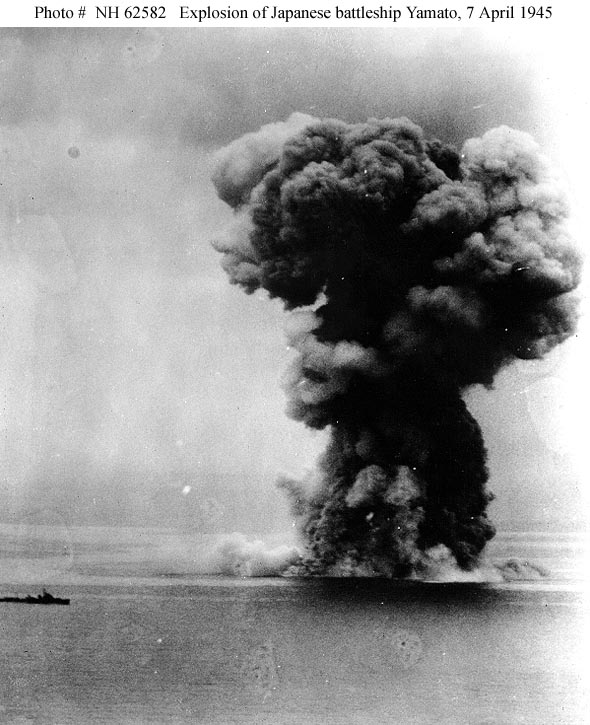
Sunk by aircraft 1945-4-7 |
| Musashi | Completed 1942-8-5 (Mitsubishi-Nagasaki)
|
Sunk by aircraft 1944-10-24 |
 |
 |
 |
 |
 |
 |
 |
References
CombinedFleet.com (accessed 2007-12-5)
Friedman
(1978)
Garzke and
Dullin (1985)
Gogin
(2010; accessed 2013-1-28)
Jentschura, Jung, and Mickel (1977)
ORD-ONI-9 (December 1944; accessed 2012-6-12)
world-war.co.uk
(accessed 2012-11-15)
The Pacific War Online Encyclopedia © 2007, 2010, 2012-2015 by Kent G. Budge. Index


