 The Pacific War Online Encyclopedia
|
| Previous: F3F, U.S. Fighter | Table of Contents | Next: F4U Corsair, U.S. Fighter |
Grumman F4F-3 Wildcat
|
Crew |
1 | |||||||||||||||
|
Dimensions |
37’8” by
27’8” by
11’8” 11.48m by 8.43m by 3.56m |
|||||||||||||||
|
Wing area |
260 square feet 24 square meters |
|||||||||||||||
|
Weight |
4425-5876 lb 2007-2665 kg |
|||||||||||||||
|
Maximum speed |
331 mph (533 km/h) at
21,300
feet (6490 meters) 281 mph (452 km/h) at sea level |
|||||||||||||||
|
Diving speed |
480 mph 772 km/h |
|||||||||||||||
|
Landing speed |
76 mph 122 km/h |
|||||||||||||||
|
Rate of climb |
41 feet per second 12.5 meters per second |
|||||||||||||||
|
Ceiling |
37,000 feet 11,300 meters |
|||||||||||||||
| 1 1200 hp (895 kW) Pratt & Whitney R-1830-76 Twin
Wasp 14-cylinder two-row radial engine driving a three bladed metal
propeller. |
||||||||||||||||
|
Range |
860 miles (1380km) at 161
mph (259 km/h) Maximum range 1690 miles (2720km) with drop tanks |
|||||||||||||||
|
Armament |
4 Browning M2 0.50 machine guns in
outer
wings (400 rounds per gun) |
|||||||||||||||
|
External Stores |
2 100 lb (45kg) bombs or one 87-gallon (329 liter) drop tank. | |||||||||||||||
|
Fuel |
144 gallons (545 liters) 231 gallons (874 liters) with drop tanks |
|||||||||||||||
|
Cost |
~$30,000 | |||||||||||||||
| Production |
|
|||||||||||||||
|
Variants |
The F4F-3P was a photoreconnaissance
version. The F4F-4 and FM-1 had R-1830-86 engines. The F4F-4 also introduced manually
folded wings, two
more wing guns, and standard wing racks for two 250lb (113 kg) bombs,
although
the –3
was sometimes field modified to take two 100 lb bombs, as at Wake
Island. Ammunition loadout was 240 rounds per gun. The F4F-7 Wildcat Scout was an unarmed reconnaissance version with a whopping 685 gallon (2593 l) fuel capacity and a range of 3700 miles at 130 miles per hour. The FM-1 went back to four guns but with
430 rounds per gun. The FM-2 used a 1350 hp (1007 kW) R-1820-56 engine. |
|||||||||||||||
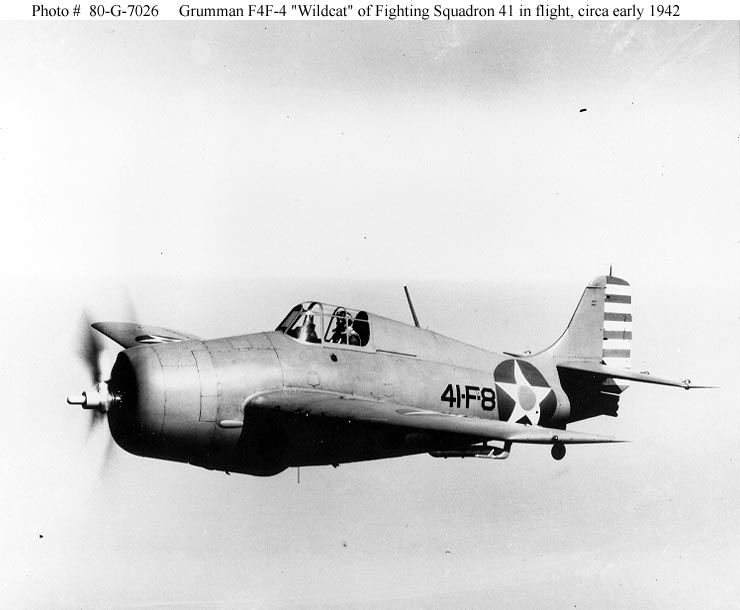
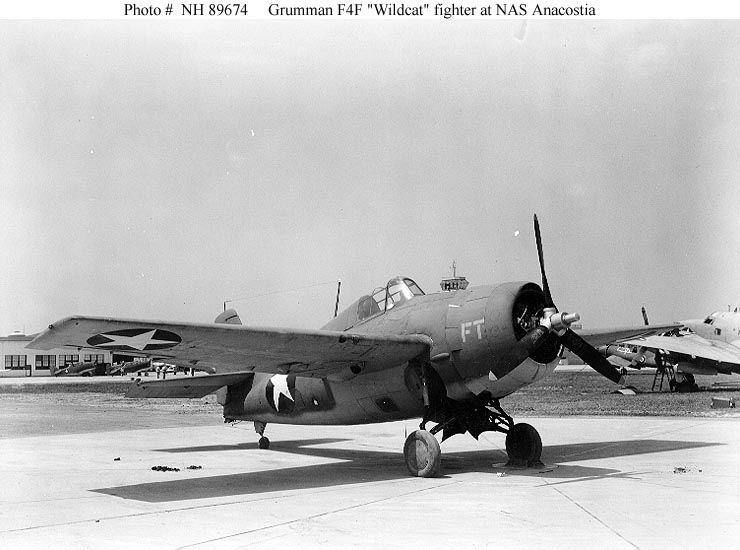
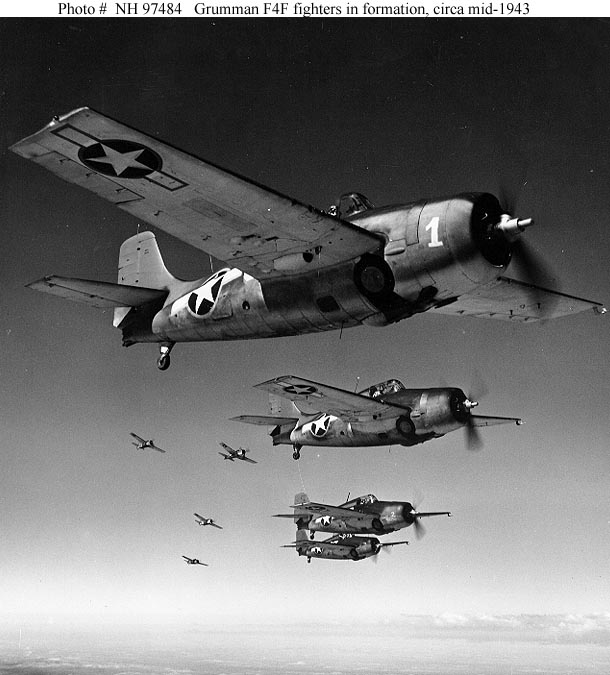
The Grumman Wildcat was the principal American carrier fighter from the
time war broke out until it was replaced with the Hellcat in mid-1943. The design was a
monoplane development of
Grumman's long line of successful Navy biplane fighters and the
prototype first flew on 2 September 1937. However, the Navy chose to
purchase the F2A Buffalo instead,
which was likely a superior aircraft at the time. Grumman responded
with a major redesign using a more powerful supercharged engine,
completing the new XF4F-3 prototype in February 1939. Production
aircraft began to roll out of the factory in February 1940.
The Wildcat was a better match for the Japanese Zero than was appreciated in early 1942. Though the Zero had superior low-speed maneuverability, was slightly faster, and had a better climb rate and range, the Wildcat was much more rugged, could dive faster, and carried a more effective armament, which allowed it to make effective use of hit-and-run tactics. It was also equipped with reliable radios, which allowed its pilots to use cooperative tactics that the Zeros, which often did not carry radios, could not. It had good visibility from the cockpit, including a pair of windows in the lower fuselage giving downwards vision. The early successes of the Zero against the Wildcat owe as much to the superior training and experience of the Japanese Navy pilots as to the qualities of the Zero itself.
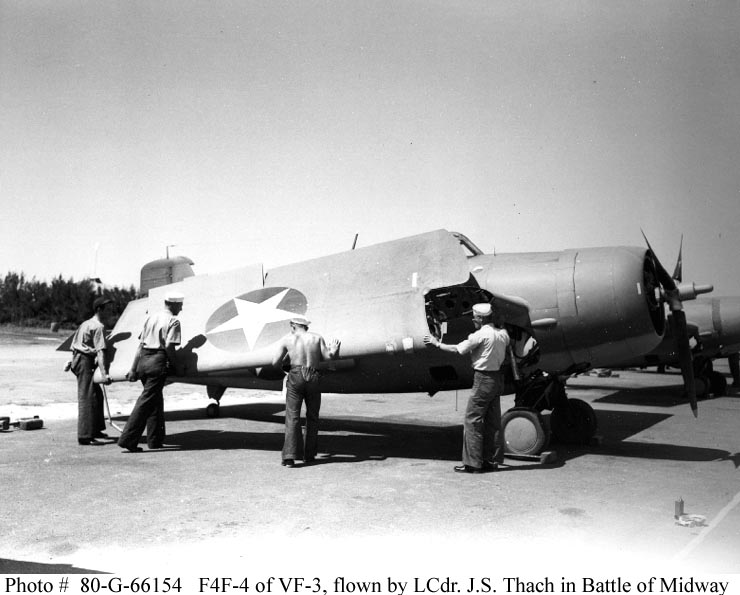
Wildcat pilots quickly learned that attempting to dogfight a Zero was tantamount to suicide, and that Zeros with an altitude advantage had almost complete control over the battle. This produced a crisis of morale among Wildcat pilots severe enough to lead Nimitz to recommend that Marine squadrons be equipped with the Army's P-40F Warhawk and that the Warhawk be evaluated for carrier suitability. However, by the the time of the Battle of Midway, Navy pilots such as Jimmy Thatch were already developing tactics, such as the Thatch Weave, that worked with the Wildcat's strengths against the Zero's weakness. Wildcat pilots at Guadalcanal learned that they had to gain the altitude advantage and use diving attacks to defeat the Zero, which allowed them to make full use of the Wildcat's good roll rate at high speeds. Allied radar proved crucial to giving defending Wildcats enough warning to climb to altitude.
The U.S. Navy was almost alone in requiring extensive
training of its pilots in deflection shooting. The Wildcat supported
this emphasis by placing the pilot high in his cockpit, where he could
see up to eight degrees downwards, which helped him keep the target in
view during high deflection attacks.
The Japanese sometimes had more respect for the Wildcat than its own pilots. Saburo Sakai was impressed with its ruggedness and believed it was only slightly inferior to the Zero in performance. Harada Kaname recalled that (Werneth 2008):
The only American fighter that I fought against was the Grumman F4F Wildcat, and the performance was probably the same as the Zero fighter. Nevertheless, I was impress with the American pilots' attacking spirit and skills.
The F4F-3 introduced pilot armor and self-sealing fuel tanks. Early model fuel tanks proved unreliable: Gasoline sometimes penetrated the rubber layer, allowing particles of rubber to flake off and produce clogs in the fuel system. This resulted in the loss of a few aircraft when their engines failed, and improved tanks were rushed to the carrier fleet just in time for the Coral Sea battle.
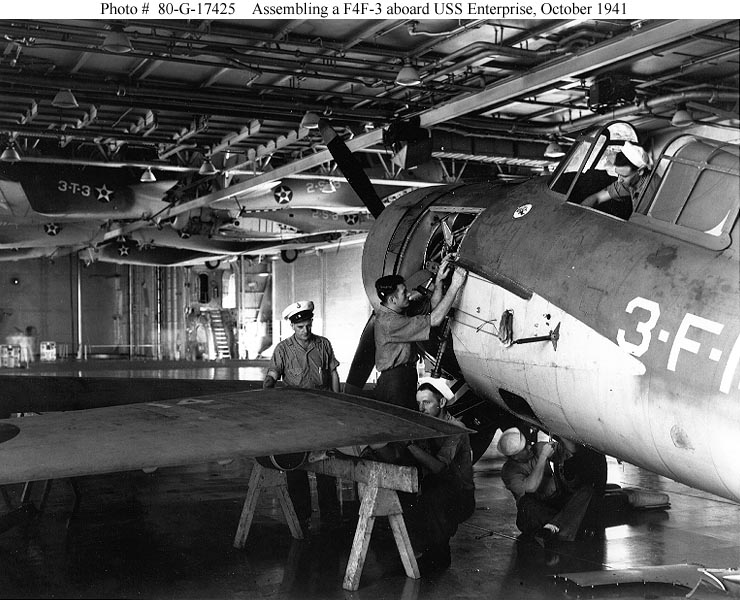
The aircraft also introduced folding wings, which allowed
many more aircraft to be packed on a carrier. Leroy Grumman modeled the
Sto-Wing, as he called it, on the way that a bird twists its wings
nearly ninety degrees to fold them against its body. Grumman
demonstrated the concept with a drafting eraser with two bent paper
clips pushed into it to represent the wings. Grumman boasted that five
Wildcats with wings folded could fit into the same deck area as two
Grummans with wings locked into flight position.
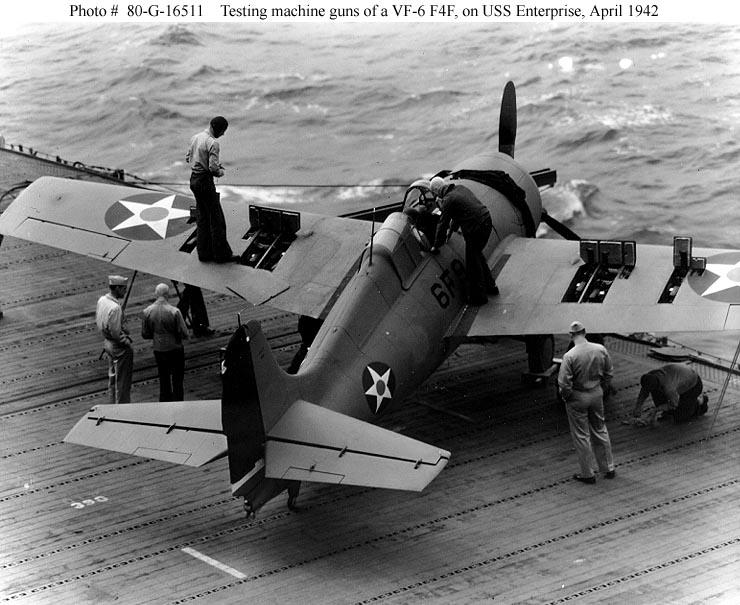
The F4F-3 was armed with four machine guns, while
the F4F-4 increased the armament to six machine guns. This required a
reduction in the number of rounds per gun, which reduced firing time
significantly and was unpopular with the pilots. Some pilots used the
gun selection switch to fire only four guns, saving the remaining two
guns and their ammunition as a kind of reserve. Following the battle of
Midway, Fletcher pointed
out that the folding wings on the F4F-4 were
an improvement only if they permitted more fighters to be added to the
carrier air group, and Nimitz recommended that the F4F-4 be modified to
carry much more ammunition even if this meant reverting to four machine
guns. Both Fletcher and Halsey
called for the F4F-4s to be equipped with drop tanks. The armament was
left unchanged, but the other recommendations were acted on.
The F4F-7 was a long-range unarmed reconnaissance
aircraft which was to be deployed one to a carrier. It had an enormous
fuel tank that could be rapidly dumped if necessary. A large camera was
fitted behind the pilot's seat, and the aircraft was equipped with a
Sperry autopilot to assist the pilot with extremely long flights. Frank
(1990) claims that Enterprise
and Saratoga had their F4F-7s at
the Battle of the Eastern
Solomons, but the F4F-7 was not a success, and most of the few
produced operated from shore facilities.
Production of the Wildcat continued throughout the
war. Although by mid-1944 it had been replaced on American fleet and light carriers by the Hellcat, it continued to serve on escort carriers, whose flight
decks were inadequate for the higher takeoff speed of the newer model
fighter. Production was shifted from Grumman to General Motors' Eastern
Aircraft Division, whose FM models were armed with four guns with a
larger ammunition loadout.
The Wildcat was known as the Martlet by the British Fleet Air Arm, which
received 1082 of the aircraft as Lend-Lease.
 |
 |
 |  |  |
 |
References
The Pacific War Online Encyclopedia © 2007-2010, 2012-2013 by Kent G. Budge. Index
