 The Pacific War Online Encyclopedia
|
| Previous: Chinchow | Table of Contents | Next: Chindwin River |
Imperial War
Museum. Via Wikipedia
Commons
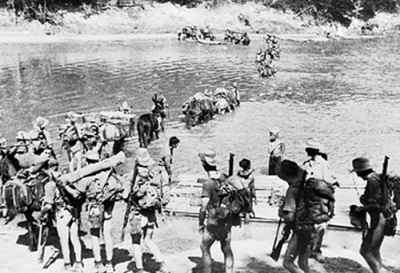
The Chindits were unconventional warfare forces organized by Orde Wingate under British command for operations in Burma. They specialized in deep penetration of Japanese lines, with resupply provided from the air. Wavell, general officer commanding India in the early part of the war, had been sufficiently impressed by Wingate's activities during the campaign in Italian Somaliland that he authorized Wingate to raise a deep penetration force for the Far East. Wingate took charge of the Bush Warfare School, which had been forced to retreat to India with the rest of Burma Corps in early 1942.
Training at the school followed the typical special forces model, with emphasis on unarmed combat, jungle craft, physical training, ambush, and demolition. However, the Chindits differed from most special forces in that the men were not handpicked volunteers. Much of the original manpower came from 13 King's Liverpool Battalion and were older men who had previously served in garrison duty. Most of the rest were Gurkhas, who were normally excellent soldiers, but 3/2 Gurkha Rifles lacked experienced officers fluent in Gurkhalese. This may have been a deliberate choice by Wingate, who wished to show that ordinary soldiers could carry out deep penetration missions. One of Wingate's brigadiers, Michael "Mad Mike" Calvert, later said (Roberts 2011):
Most Europeans do not know what their bodies can stand; it is the mind and willpower which so often give way first. Most soldiers never realized that they could do the things they did ... One advantage of exceptionally heavy training is that it proves to a man what he can do and suffer. If you have marched thirty miles in a day, you can take twenty-five miles in your stride.
Nor was the training without its reflections of the pecularities of Wingate. Troops were marched constantly because of Wingate's belief that marching stopped malaria, the men were forbidden to waste time shaving, and the menu included raw onion, which Wingate was convinced was a panacea. Medical training was particularly brutal (quoted in Webster 2003):
You have to diagnose your own complaints and then cure yourselves...We shall not stop for you, for our very lives may be jeopardized by waiting for stragglers. if you are sick, you are of no use to us — you are an unwanted liability. We shall leave you to effect your own salvation.
The men were trained to handle mules, which would serve both as pack animals and as
emergency provisions.
The first Chindit unit, 77
Indian
Brigade, was committed to battle on 8 February 1943 from its
base in Imphal. The
timing was unfortunate, as the only offensive action being taken
by regular forces against the Japanese in Burma at the time was a
poorly planned and anemic advance into the Arakan region. A Chinese offensive had been
planned at the same time as the Chindit operation, but had been
called off. Nevertheless, the operation went forward, even though
the Japanese could now easily protect their communications while
pursuing the Chindits. Wingate apparently was eager to test his
theories and to use his men at their psychological peak, and he
argued that the operation might have value as a spoiling attack to throw off
Japanese offensive plans in north Burma. Wavell seems to have
had wholly unrealistic expectations of the expedition, believing
it might so demoralize the
Japanese (whom he consistently underestimated) that they might
pull out of Burma entirely.
Notwithstanding the poor timing, the Chindits might have been able to operate effectively if they had stayed in the jungle; but Wingate pursued a grandiose scheme that took his columns across the Irrawady, where they would risk being caught in the open during the dry season. The expedition accordingly crossed the Chindwin on the night of 13 February 1943 in seven columns. The Northern Group, composed of Columns 3, 4, 5, 7, and 8 would cross at Tonhe (94.683E 24.550N) and strike out for the rail line between Mandalay and Myitkyina. Meanwhile a Southern Group composed of Columns 1 and 2 would cross at Auktange (94.600E 24.067N) further south, draw Japanese attention in that direction, then strike out for the Irrawady at Tagaung (96.012E 23.496N). After cutting the railway west of the Irrawady, the entire force would cross the river and join up to cut the railway from Mandalay to Lashio.
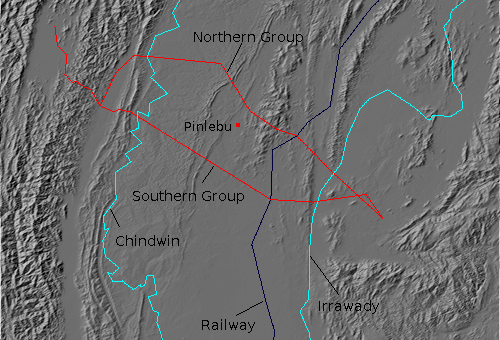
The route lay across the 4000' (1200m) Zibyu Range, the wide valley beyond, and the Mangin Range before reaching the Meza River valley that led to the Irrawady. The chief Japanese garrison between these ranges was at Pinlebu (95.368E 24.075N), and Wingate ordered 7 and 8 Columns to make a diversionary attack on the town. He then learned that the trail through the Mangin Range northeast of Pinlebu was unguarded, and 4 Column was sent to link up with 7 and 8 Columns and use the trail to head straight for the railway. However, 4 Column ran into a strong Japanese force and lost its communication equipment in the subsequent fire fight. Finding himself isolated with no way to contact Wingate, Major Emmit, the column commander, ordered his column to disperse and return to the Chindwin. Meanwhile 2 Column had been caught in the open while approaching the railway at Kyaikthin (95.667E 23.533N). Heavy mortar fire prompted its commander to order a retreat to a prearranged rendezvous, but communications broke down and this column, too, was dispersed.
The fighting at Pinlebu provided enough of a distraction to allow 3 and 5 Columns to slip through to the railway at Nankan (95.870E 24.001N). A bomber raid on 5 March 1943 on nearby garrisons ensured minimal interference with the two columns the next day as they demolished three railway bridges and destroyed the track at numerous other locations. However, a chance encounter with a Japanese patrol left two men dead and six wounded, and the wounded had to be left behind. Only one survived the wrath of the Japanese and local Burmese. The two columns then moved on to cross the Irrawady, but 5 Column was fired on by the Japanese while crossing the river at Tigyaing (96.147E 23.755N). 6 Column was also caught as they crossed, but the rearguard held off the Japanese until the crossing was complete. Their wounded were also left behind, with a note reminding the Japanese of the traditional Bushido ethic of humanity, and these wounded were properly cared for.
The Japanese responded vigorously to the penetration. 55
Regiment (18
Division) west of the Zibyu Range and 215
Regiment (33
Division) to the south had each made contact with
Chindit columns, and both began pursuing the Chindits towards the
Irrawady. It was a battalion
of 55 Regiment that caught 6 Column at Tigyaing. The
Japanese soon realized that the Chindits were operating without
conventional lines of supply, decided they were a significant
threat, and committed both 18
and 33
Divisions to destroying Wingate's force. After it
became clear the Chindits were continuing east beyond the
Irrawady, 56
Division was brought in as well. Wingate's brigade now had the undivided
attention of three Japanese divisions
in open country during the dry season with two major rivers between his force and his
base.
The outcome was that Wingate was forced by 25 March 1943 to order his columns to split up and make their way back to India as best they could. Plans to blow up the viaduct at Gokteik (96.916E 22.351N) were abandoned, but not before Calvert ambushed a large Japanese patrol outside Myitson (96.565E 23.272N), killing 100 Japanese for the loss of a single man. A proposal to move north into country with a friendlier population was rejected because it would take the Chindits out of air supply range. An attempt to resupply by air near Baw (96.669E 22.264N) failed when surprise was given away and a pitched battle ensued. The officer responsible for giving away surprise was cashiered and finished the expedition as a private. The dispersed Chindits had to make their way home through three enemy picket lines, along the Irrawady, the Chindwin, and the Mu Valley between them. Seriously wounded men were sometimes given a lethal dose of morphine rather than leave them to the Japanese (Hastings 2011):
I had a wounded Gurkha, shot to bits in great pain, and dying. After agonizing for a bit, I gave him a lethal dose of morphia ... The Gurkhas were amazing, they just accepted it ... To my horror I found another very seriously wounded Gurkha. I said, "I've just had to do it." George looked at me as if to say "You do it again." I protested, "There's no way I'm going to do it twice." He gave the chap a lethal dose.
By the end of May the bulk of the surviving Chindits were back at
Imphal, while a few stragglers escaped through Fort Hertz to the north or even
into China.
The first Chindit expedition merely inconvenienced the Japanese while suffering heavy casualties. Of the 3000 men who crossed the Chindwin in February, 2182 made it back to India by June. Only six hundred of these were fit for further military service. Some 450 had been killed in action, 430 were taken prisoner by the Japanese, and 120 men of the Burma Rifles were allowed to disband and return to their homes. Even one of Wingate's best column commanders, Major Bernard Fergusson (5 Column), admitted that the operation had achieved (Roberts 2011):
... not much that was tangible. What there was became distorted in the glare of publicity soon after our return. We blew up bits of railway, which did not take long to repair; we gathered some useful Intelligence; we distracted the Japanese from some minor operations and possibly from some bigger ones; we killed a few hundreds of an enemy which numbers eighty millions; we proved that it was feasible to maintain a force by supply dropping alone.
This was optimistic. Actual Japanese casualties were around 205
killed.
But Wingate was a sufficiently charismatic visionary that the raid was seen as some kind of great military accomplishment. Even Slim, who was privately highly critical of the whole concept, claimed that the Chindits had been very good for morale in the Indian Army, stating that "for this reason alone, Wingate's raid was worth all the hardship and sacrifice his men endured" (Lewin 1976). Churchill himself fell under the charm, and considerable additional manpower, including the whole of 70 Division (Symes), was committed to new Chindit formations. Eventually five additional Chindit brigades were raised: 3 West African, 14, 16, and 23 British, and 111 Indian Brigades. Each was composed of four battalions, and the entire Special Force was designated 3 Indian Division as cover. Inspired by the British example, the Americans raised their own irregular force, 5307 Composite Unit, who rejected their official designation ("disgustingly like a street address in Los Angeles") in favor of "Merrill's Marauders." There is reason to suspect that the British viewed the Chindit operations as a way to satisfy American demands for action in Burma without committing large formations to a theater in which they had little interest.
After Wingate won over "Hap"
Arnold at the Quebec
conference, the Chindits were given their own air component,
1
Air Commando Group, consisting of 13 C-47 Dakotas, 12 C-46 Commandos, 12 B-25 Mitchells, 30 P-51 Mustangs, 100 L-5 Sentinels, and six R-4 Hoverfly helicopters.
The light aircraft and helicopters were of particular significance
to both command and control and morale,
since they provided a way to move commanders around quickly and to
evacuate the wounded, who had to be left behind during LOINCLOTH.
Wingate's original concept of deep penetration raids became more
grandiose with time. He began to see the Chindits, not as
auxiliary forces devoted to cutting enemy communications while
avoiding pitched battles, but as the main offensive force to which
the regular divisions of 14 Army would
themselves be little more than auxiliaries. Wingate eventually
developed a "stronghold" doctrine (Royle 2002):
The stronghold is a muccan (ph) overlooking a kid tied up to entice the Japanese tiger. The stronghold is an asylum for long range penetration for wounded. The stronghold is a magazine of stores. The stronghold is a defended airstrip. The stronghold is an administration centre for loyal inhabitants. The stronghold is an orbit around which columns of the Brigade circulate. It is suitably placed with reference to the main objective of the Brigade. The stronghold is a base for light planes operating with columns on the main objective.
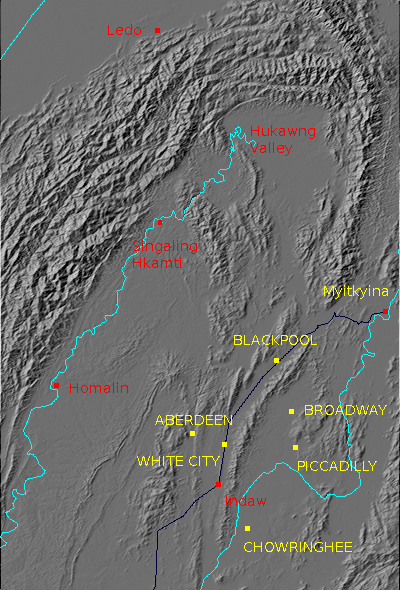
A second series of Chindit expeditions began with the departure
on 5 February 1944 of 16
Long Range Penetration Brigade (LRP) from Ledo marching south towards
"Aberdeen", a site selected for its suitability for construction
of a small airstrip for resupply. Stilwell was leading
a force of three American-trained Chinese divisions from Ledo
across the Pangsau Pass into the inhospitable Hukawng Valley. From
there he planned to advance to the railroad east of Myitkyina, building a road
behind him as he advanced, with the objective of joining hands
with a second Chinese force from Yunnan
and restoring land communications with China. Wingate's men were
to support Stilwell by severing the lines of communication of the
defending 18 and 56
Divisions.
16 LRP took almost a month to cross the rugged mountains between Ledo and the Chindwin, which they crossed at Singaling Hkamti (95.700E 26.002N) on 3 March. Two days later, 77 Indian Brigade began its air landings at "Broadway". Plans for a third stronghold, "Picadilly", were dropped when the planned site for the air landings was found to be covered with log obstacles. Wingate worried that the Japanese had somehow gotten wind of their plans, and he had to be persuaded by Slim to continue the Broadway air landings. As it turned out, the obstacles were felled trees left by civilian foresters and had nothing to do with the Japanese.
The first gliders into
"Broadway" discovered that there were two trees on the main runway
and a number of ditches, and of the 61 gliders that took off that
night, only 35 made it to the strip. Seventeen came down in Assam
and six landed in Japanese-controlled areas of Burma. However, two
bulldozers had made it in, these cleared the strip, and by the
next evening the first of 63 Dakotas began to fly in, led
personally by Old. On 6
March 111 Brigade began flying in to "Chowringhee". Eventually
some 600 sorties brought a total of 9000 troops with 1400 pack animals and artillery.
On 8 March the Japanese began their long-planned U-Go offensive with the objective of
seizing Imphal, Kohima, and Dimapur, isolating the Allied forces in
northeast Assam and opening the
road to India. The British had
hoped that the Chindit activity would interfere with the Japanese
offensive, but the Japanese were relying on capturing British
dumps to resupply and Mutaguchi
did not initially consider the Chindits a serious threat. The
senior Japanese air commander in Burma, Tazoe Noboru, had
anticipated a Chindit airborne operation based on the airstrips
the British had constructed during LOINCLOTH and on intelligence
that the British were construction large numbers of gliders at Calcutta. However, he could
not persuade Mutaguchi to deploy more than a small force to
contain the Chindits, whom Mutaguchi regarded as "a mouse in a
bag" (Allen 1984).
"Chowringhee" was raided by 20 fighters and two light bombers on 10 March 1944 and "Broadway" was raided by 55 fighters and three light bombers on 13 March. The Japanese also brought in some 11 battalions under 24 Independent Mixed Brigade (Hayashi) to counter the twenty battalions of Chindits.
Attack on Indaw. Mutaguchi soon deduced that the main Chindit target was the massive supply dump at Indaw (96.142E 24.222N), and this was reinforced on 10 March with two infantry companies and on 15 March with a full battalion from 51 Regiment. The two companies attacked Calvert's railroad block at "White City" on 17 March and were cut to ribbons in a desperate night attack. On 21 March a battalion from 114 Regiment was repulsed at "Broadway" with heavy casualties. By this time the Japanese had revised their initial estimate of 1000 Chindits to a much more accurate figure of 10,000.
The Chindit attack on Indaw was a failure. The main attack force, 16 Brigade, was supposed to be in position by 15 March, but the march from Ledo proved too difficult, and it was not until 20 March that 16 Brigade reached its planned stronghold location at "Aberdeen". Here Wingate met the brigade commander, Fergusson, and ordered him to proceed at once to attack Indaw and seize the airfield there. Wingate's intentions were never clarified before his death, but Fergusson had the impression that Wingate meant to expand THURSDAY by flying in a division of regular Indian troops (26 Indian Division). Fergusson also thought 14 Brigade would be supporting his attack, but Wingate had already ordered 14 Brigade to move southwest and cut the supply lines from Indaw to Homalin (94.920E 24.887N).
Because Wingate had stressed the importance of reaching Indaw
before the Japanese could reinforce, Fergusson stepped off to
attack the town almost immediately, without taking time to rest
his exhausted columns. It was the peak of the dry season and there
was no water between Aberdeen and Lake Indaw. 45 Column was
ordered to take Thetkegyin on the north shore of the lake but
found the village stoutly defended by the Japanese. 17 Column was
almost at the airfield before making contact with the Japanese,
and took position in a stream bed that provided a water supply,
but after repelling counterattacks
for three days Fergusson was compelled to withdraw his force back
to "Aberdeen." The attempt to take Indaw was not entirely
fruitless: The Chindits discovered the massive Japanese supply
dumps in the area and called in a bombing raid that destroyed most
of the supplies earmarked for 18 Division.
Death of Wingate. On 24 March Wingate was killed in an air crash. Command of the Chindits was taken over by the senior brigade commander, Lentaigne, and came under the overall control of Stilwell. Both were controversial decisions. Of all Wingate's brigadiers, Lentaigne was the most skeptical of the entire concept of deep penetration, and Stilwell was skeptical he could exert any real command authority over the Chindits. Lentaigne immediately made a number of decisions that badly hurt the Chindit operations.
Slim wished the Chindits to concentrate around Kalewa (94.301E
23.201N) to cut the supply lines to 15 Army. However,
two
of the Chindit brigades were already in battle and could not
easily break contact with the Japanese; abandoning "White City"
would reopen the railroad to north Burma and 18 Division;
and the approach to Kalewa invited a Japanese ambush. A compromise
in which the two as-yet unengaged Chindit brigades would move
towards the Chindwin was approved by Lentaigne but then
countermanded by Slim, who recommended the Chindits shift to
Stilwell's control.
77 Indian Brigade at "White City" had thrown back a second Japanese assault on 6-11 April that cost the Japanese an estimated 3000 casualties. With roughly seven battalions against Hayashi's eight, the brigade commander, Calvert, had every confidence he could hold the position indefinitely. However, on 8 May, Lentaigne ordered Calvert to abandon the block at "White City" and reestablish a blocking position at "Blackpool", closer to the front line. Lentaigne wanted to concentrate his forces to ensure the rail corridor could be held through the monsoon, but was unwise to abandon so strong a position.
"Blackpool" was to be held by 111 Indian Brigade while 14 and 77 Indian Brigade acted as a floating column operating in the direction of Mogaung (96.940E 25.303N). The exhausted 16 Brigade had already been evacuated and 23 Brigade had been redeployed behind the Chindwin to cut 15 Army's supply lines to Kohima. The Chindits were promised that when Mogaung fell to the Chinese, the campaign would be over and the Chindits would be evacuated back to India. Meanwhile the Japanese had responded to the attack by created a new headquarters, 33 Army (Honda), to deal with Stilwell and the Chindits.
The Chinese had paused again after reached the Mogaung Valley on 19 March 1944, buy on 19 May they began advancing again. Sun's 112 Regiment outflanked 18 Division and took Kamaing (96.711E 25.522N), cutting off 18 Division. The Japanese threw 53 Division (Takeda) into the effort to break the block, but the Chinese could not be dislodged and 18 Division was forced to withdraw, with just half its original strength escaping the Chinese grip.
Meanwhile "Blackpool" had come under heavy attack. Lentaigne had
placed the new base too close to the Japanese front lines, and it
came under heavy artillery fire almost as soon as it was
established.A week later 128
Regiment joined the attack, 14 Brigade never arrived
to reinforce 111 Indian Brigade, and by 25 May the stronghold had
to be abandoned. Stilwell then earned the everlasting hatred of
most of the Chindits by ordering the survivors of 77 and 111
Indian Brigades to take Mogaung. The Chindits were outnumbered two
to one by the garrison, and although they took the town on 27
June, their casualties were so heavy (about 50%) that they were
finished as a fighting force. By 27 August 1944 the last of the
Chindits had been evacuated back to India.
Outcome. The Japanese later admitted that, in addition to
pinpointing the dumps at Indaw for destruction by air strike, the
Chindits interfered so seriously with the Japanese lines of
communication that neither 15 nor 33 Divisions
facing Imphal received any supplies to supplement their original
25-day allocation. Having failed to capture the British supplies
on which they had planned to sustain their offensive, the Japanese
were forced back and the route to Imphal from Dimapur reopened.
Chindit units also interfered with the lines of communication of 18 Division as it attempting
to hold Myitkyina against Stilwell's Chinese forces, and hindered
the reinforcement of northeast Burma by 49 Division.
Of the 11 battalions the Japanese brought in against the Chindits, only one was drawn from 15 Army, the rest being drawn from garrisons around Burma. This suggests that the Chindit foray diverted more Allied than Japanese troops from the main effort before Imphal. On the other hand, Mutaguchi later stated that "The Chindit invasions did not stop our plans to attack, but they did have a decisive effect on these operations and they drew off the whole of 53 Division and parts of 15 Division, one regiment of which would have turned the tables at Kohima" (Roberts 2011).
WIth the opening of the Ledo Road and the collapse of U-Go, the British finally felt in a position to mount a conventional counteroffensive into Burma. This largely eliminated the need for special forces supplied by air, particularly since the air transport was now needed to support the regular forces. As a result, the Chindits were disbanded.
Wingate's "stronghold" doctrine was heavily criticized after the
war. However, something like it was tried again by the French in Indochina in 1954 at
Dien Bien Phu. The result was a crushing defeat for the French. On
the other hand, the Americans at the battle of Khe Sanh in Vietnam
in 1968 used similar tactics but were more successful, though
victory was achieved only through massive use of superior
firepower in the form of air and artillery support. The terrain at Khe Sanh was also
more favorable for the American defenders.
References
Chindits.info
(accessed 2011-10-8)
Royle (2002; accessed 2010-12-21)
The Pacific War Online Encyclopedia © 2007, 2010-2011, 2014 by Kent G. Budge. Index
